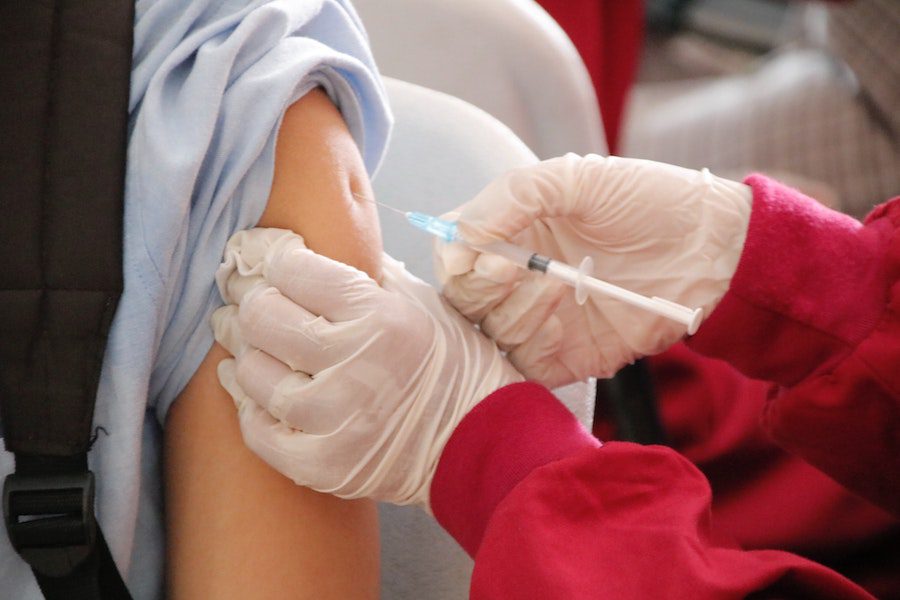
As Monaco prepares to provide a hundred doses of paediatric strength Covid vaccine to fragile children aged five to 11, France has approved distribution for all kids in this age group.
Monaco’s Minister of State Pierre Dartout made the announcement during a press conference on Monday, revealing that the Monegasque National Vaccination Committee has been given the green light to inoculate the Principality’s vulnerable children aged five to 11 against Covid.
Authorities have already received a hundred doses of the Pfizer-BioNTech jab, specially formulated for children, and will be offering appointments at the Princess Grace Hospital as opposed to the national vaccination centre in the Rainier III Auditorium.
France, meanwhile, has gone one step further, announcing on Monday that all children in this age group are now eligible for the paediatric strength vaccine.
Last week, France started vaccinating five to 11-year-olds with medical conditions that require special protection and ramped up logistics to roll out vaccination of all children in this age group once the country’s health regulator, Haute Autorite de Sante (HAS), approved the move.
Monaco’s Director of Health Action, Dr. Alexandre Bordero, told reporters on Monday that the Principality is still considering this option.
“Before making a final decision for the other children, it will be necessary to consult the vaccination committee again. The committee is likely to meet in early January. The question will then be asked whether or not it is appropriate to vaccinate all children aged five to 11 years and under what modalities. For the moment, it is not yet fixed.”
The last legislative session of 2021 was opened with the amendment to the Financial Activities Act of 2007, with a heavy focus on crypto currencies and for the Financial Activities Control Commission to gain membership to the International Organisation of Securities Commissions.
Crypto currencies are the wave of the future according to many and Monaco is certainly open to riding that wave, but with provisions to ensure legality in all arenas.
This is what came from the National Council’s last meeting of the year where amendments to the financial activities law was top on the agenda.
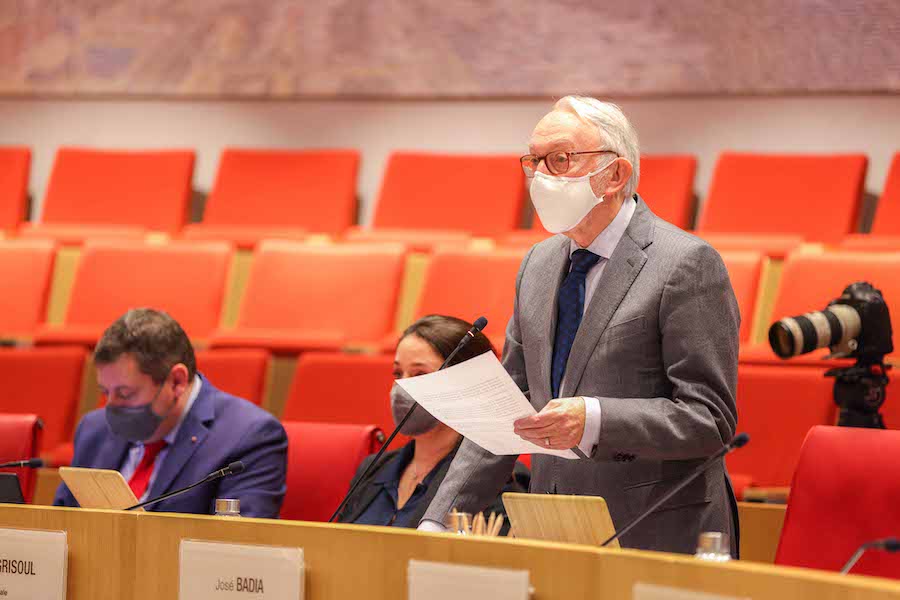
The proposed law aims to modernise certain provisions of the law but, above all, that it “meets the criteria and objectives required for the membership of the Financial Activities Control Commission (CCAF) to become an ordinary member of the IOSCO, the International Organization of Securities Commissions”, said Councilman José Badia, which brings together the regulators of financial organisations and the main stock exchanges in the world.
The CCAF has been an associate member since January 2018 and allows for it to make bilateral agreements, as a tool to help Monaco secure its place as an international financial hub.
According to Badi, the text is organised along two axes. The first is the expansion of the CCAF’s missions in terms of controls and investigations, and the other is the creation of certain criminal sanctions and the insertion of a section devoted to insider trading and market manipulation.
Several elected officials would have liked to take advantage of this bill. This would be advantageous “to complete the Monegasque legislative framework in terms of digital assets and crypto-assets,” said Franck Julien, Chairman of the Digital Development Commission.
The government took this into consideration but decided to make it a stand-alone bill. Julien, nonetheless, made a detailed presentation on the subject by describing what is going on internationally, explaining the proportion taken up by crypto coins in the wallets of the wealthy as well as the variety of cryptocurrencies on the market.
While stressing that Monaco clearly must take a stand against money laundering and conceded the risks of people using crypto-currencies for money laundering, he still believed that, “Monaco must position itself in the promising world of crypto-money. Bill 1035 could have been more attractive by demonstrating the Principality’s desire to join the concert of nations fighting against money laundering through the fraudulent use of crypto-currencies.” He therefore announced that he would not vote for Bill 1035.
With 89 approved establishments and €129 billion in deposits and securities, Minister of Finance and the Economy Jean Castellini wanted to make clear the importance of the proposed bill and asked for “the tabling in the first quarter of next year of a bill establishing service providers on digital assets and establishing a system of specific authorisation.”
In the end, the law was passed with 17 votes out of 21 in the affirmative.
Photo of José Badia by National Council of Monaco
“No curfew or confinement” as incidence rate hits 814
Monaco is reluctant to tighten restrictions during Christmas, despite the circulation of Covid-19 reaching a staggering new high. Testing has also doubled in the lead-up to Christmas as health authorities reveal Delta still remains the dominant variant in the Principality.
The government’s weekly figures released on Monday show that from 13th to 19th December, 9,046 PCR and antigen tests were performed on residents and non-residents in the Principality. The average throughout the year has been around 4,000.
Of the most recent tests, 5.17% came back positive – the highest figure yet for Monaco. Meanwhile, the incidence rate reached 813.56, up from 544.98 the previous week, and just shy of the Alpes-Maritimes which has an incidence rate of 920. France, overall, has an incidence rate of 536.
The Princess Grace Hospital Centre is currently treating 14 people with Covid, four of whom are residents, while five others are in ICU, including two residents.
A year ago, these figures would have sent Monaco into lockdown. But now, with 25,667 members of the population double vaccinated, or around 66%, the government is reluctant to reintroduce such strict measures.
In an interview with Monaco Matin, Minister of State Pierre Dartout said that Prince Albert “wants the holidays to go as well as possible, without curfews or confinement. Also, there will be no change from the measures already in force and which must be respected. Restaurants will remain open, people will be able to shop normally in stores. Simply, we must continue to be, or be even more, attentive to the respect of barrier gestures, and make sure that as many people as possible get vaccinated. It will also be the heart of a communication campaign that will be implemented in January.”
The minister said that the government also has no intention of closing Monaco’s border to residents of France and Italy.
Currently, around a third of the eligible population in Monaco – 10,598 people – have received their third booster shot.
Just under 35% of the eligable population remains unvaccinated.
With regards to the presence of the Omicron variant in Monaco, health authorities say they have their suspicions that it is here.
“At the Monaco Scientific Centre, all positive samples are screened to identify the strains of the virus – Wuhan, Alpha, Delta,” says the Health Department’s Director of Health Action, Dr. Alexandre Bordero. “But, for the moment, we have not been able to identify for certainty the Omicron variant. When the variant detected does not correspond to any of these strains, we assume that it is the Omicron variant. But the ratio is very low, we are still currently seeing the Delta variant in 99% of cases.”
Dr. Bordero says it will take several weeks to determine if samples sent to a specialist centre in Marseille confirm the presence of Omicron in Monaco.
Photo by Monaco Life
YCM renews Malizia partnership at annual awards ceremony
It’s been a busy year for the Yacht Club of Monaco, which they have rounded out with a cocktail party, awards ceremony, and highlights of future plans.
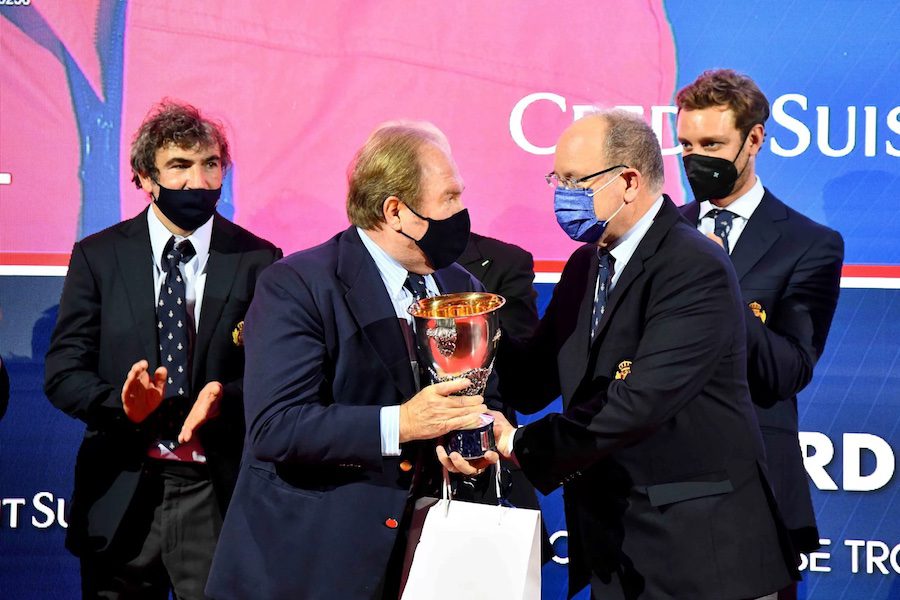
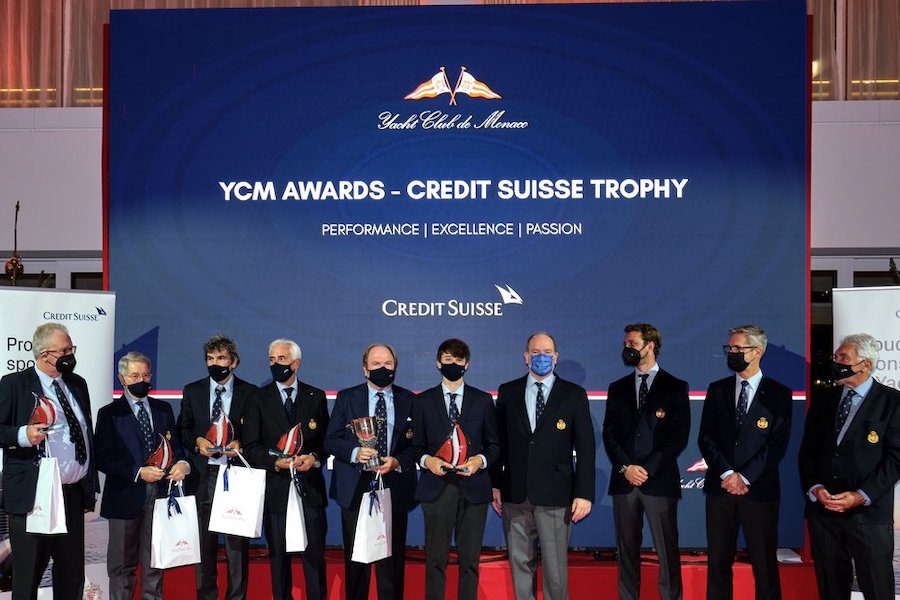
The Yacht Club of Monaco’s (YCM) annual winter cocktail event has traditionally been the time to also welcome new members as well as to recognise the best sailors from the year with the YCM Awards-Trophée Credit Suisse.
This year was no different, with the announcement of the YCM Sailor of the Year 2021 Trophée Credit Suisse. Among the nominees were top helmsmen and YCM members Nico Poons, RC44 World Vice Champion, Valter Pizzoli, winner of the Régates Royales de Cannes and Les Voiles de Saint-Tropez, Dmitry Rybolovlev, winner in real time of the Rolex Fastnet Race, and Oren Nataf, real time winner of the RORC Transatlantic and 2nd in the Rolex Fastnet in the MOCRA category, and Guido Miani for his victories in the 2021 Rolex Giraglia and Palermo-Montecarlo.
In the end, the prize went to Giangiacomo Serena du Lapigio, a nominee in 2015, 2016, 2017 and 2018 who this year showed remarkable consistency in J/70 and Swan 36, a class he embarked on just a year ago.
Winner of the Swan One Design Worlds and of the 37th Primo Cup-Trophée Credit Suisse in the J/70, then in the Swan Sardinia Challenge, Giangiacomo Serena di Lapigio gave a short but sweet speech, saying, “I’m delighted to receive this award. It’s fantastic. I love to sail and win with my team and we’re preparing for next season and in particular for the J/70 World Championship which will be held in Monaco next year.”
Additionally, a special prize was awarded to Tomaso Polli, winner in pole position and 2nd overall at the XCAT World Championship in Dubai on motorised catamarans.
The evening was also a chance to congratulate the many YCM members who compete year-round and excelled in some of the most prestigious events in the world. First in the spotlight were the youngest sailors nominated for the YCM Youth Awards 2021, the big winner being Mathis Duplomb for his progress in ILCA 4 (formerly Laser 4.7). As well as several podium finishes in league regattas, he did very well in France’s internationals to finish 2nd overall.
The ceremony continued with the YCM Awards-Trophée Credit Suisse for adults in the One Design category going to young Francesco Vauban for his impressive Smeralda 888 season, a five-event championship he won for the first time this year.
The awards weren’t the only exciting moments in the evening, as YCM President Prince Albert II welcomed new members and spoke about the upcoming 10th anniversary of the Monaco: Capital of Yachting initiative. After a decade of progress, the Prince has plans to do more.
“I want us to redouble efforts to protect the oceans which are our playground,” he declared. “A sustainable superyacht still sounds like an oxymoron today, even though owners are much more environmentally aware.”
He also took the opportunity to recognise work achieved to date by YCM and Credit Suisse on the SEA Index (Superyacht Eco Association), a benchmark for assessing CO2 emissions of yachts over 40 metres, with the aim of positioning Monaco as a centre of excellence and innovation in the luxury yacht sector.
The Monaco Energy Boat Challenge was also mentioned. The dates for 2022 are 4th to 9th July and is an event in line with the philosophy of the Principality.
“Wishing to look to the future of yachting, our club has naturally positioned itself as a pioneer of innovation; a player at the service of transforming our sector to meet sustainable development goals set by the United Nations,” said the President of the YCM.
Prince Albert II went on to say, “Anchored in our values, daring in action and driven by an eco-conscience, my wish is that through the Yacht Club de Monaco, an established platform for exchanges, we can go even further to reinvent ourselves. We are arriving at a major turning point in history. Our decisions today will determine our lives tomorrow. It is not just one facet of yachting that needs to be improved, the whole ecosystem needs to be revamped.”
Alongside Malizia 3’s Captain Boris Herrmann, who notably placed 5th in last summer’s Vendée Globe around the world solo race, the Prince formally announced another five-year campaign with the team. Club Vice-President Pierre Casiraghi presented the programme’s highlights which include the Route du Rhum in 2022, the team Ocean Race in 2023 and the Vendée Globe in 2024/2025.
“Malizia 3 is still under construction and the process should be completed during the summer of 2022,” said Casiraghi. “We have opted for a few new features, particularly on the hull. The IMOCA is designed to better manage the swell. We have also worked on the cockpit which has been redesigned, and looked into a new type of battery, photovoltaic panels and hydrogen.”
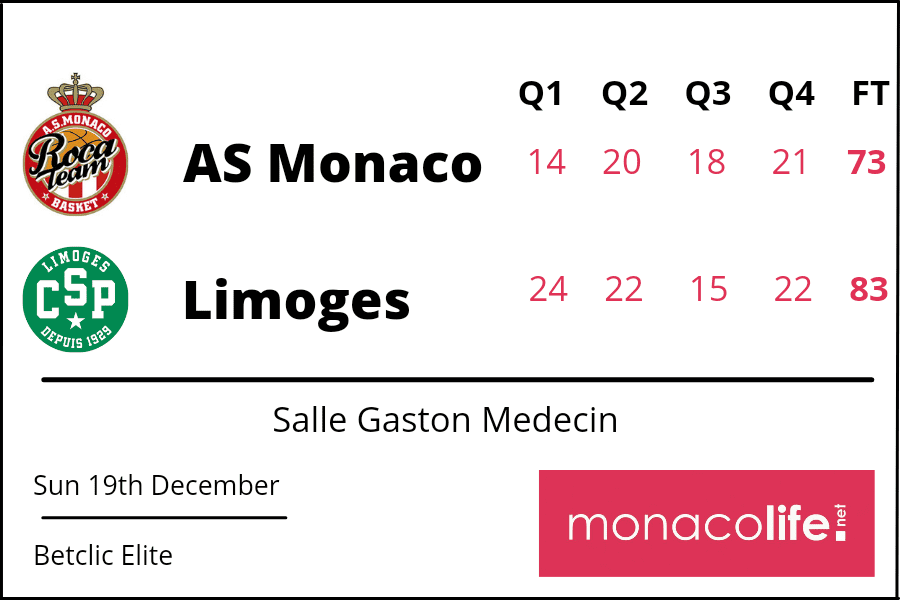
Another poor first-quarter from Sasa Obradovic’s men left AS Monaco Basketball with an insurmountable mountain to climb as Limoges condemned the side to a second defeat in 48 hours on Sunday.
Despite ultimately losing to a quality Zenit side on Friday, Monaco did mount a spirited comeback, at one point taking the lead, but this wasn’t to be replicated at the Salle Gaston Médecin. Limoges, having hit the front early, consolidated the game with some excellent game management, only narrowly losing one quarter.
Monaco started strongly under their new manager, but their recent dip in form has arrested any momentum that the new appointment gave them. What has been witnessed under Obradovic’s reign thus far is a continuation of the levels of inconsistency that ultimately saw Zvezdan Mitrovic and Monaco part ways.
Obradovic, however, has the excuse of a lack of preparation, a source of great bemusement to the new coach, who expressed his frustration after Friday’s match against Zenit. “It isn’t easy without practice to prepare for the game. The guys fight, which is important, but you have to fight with a plan,” said the Serbian.
Coming into the game with little to no preparation, Monaco couldn’t match Limoges’ intensity. The away side’s aggression in defence deprived Monaco of chances whilst also preventing ample opportunity to counter. By the end of the first-quarter, the away side had built a comfortable 10-point advantage.
Prince Albert II watched on from the stands as Limoges continued to eke out their lead in the second-quarter. The Roca team had Danilo Andjusic to thank for not being completely out of sight at half-time, his 27 point-haul on the night a season best for the Serbian player.
Andjusic was once again instrumental in the third-quarter as Monaco set about reducing the deficit. As the scorer of over a third of Monaco’s points on the night however, the Serbs’s efforts weren’t backed up by his teammates, and were therefore ultimately in vain. The Principality side slumping to a 73-83 loss.
Point guard was the first to admit this in a starkly honest post-match tweet: “I’m awful right now, but I’m also going to get better.”
Obradovic was equally as frank in his post-match assessments, but once again saw the lack of preparation time and his depleted roster as a key factor. “With all the players that we are missing, and the frequency of the Euroleague matches, I think there was a bit of fatigue in my team. But despite all of that, we can’t complain. We should have done better, a lot better.”
Obradovic will have the opportunity to get the Roca team’s season back on track as his side travel to face ALBA Berlin on Wednesday.
Photo source: AS Monaco Basketball
All the headlines and highlights from Monaco, direct to you every morning