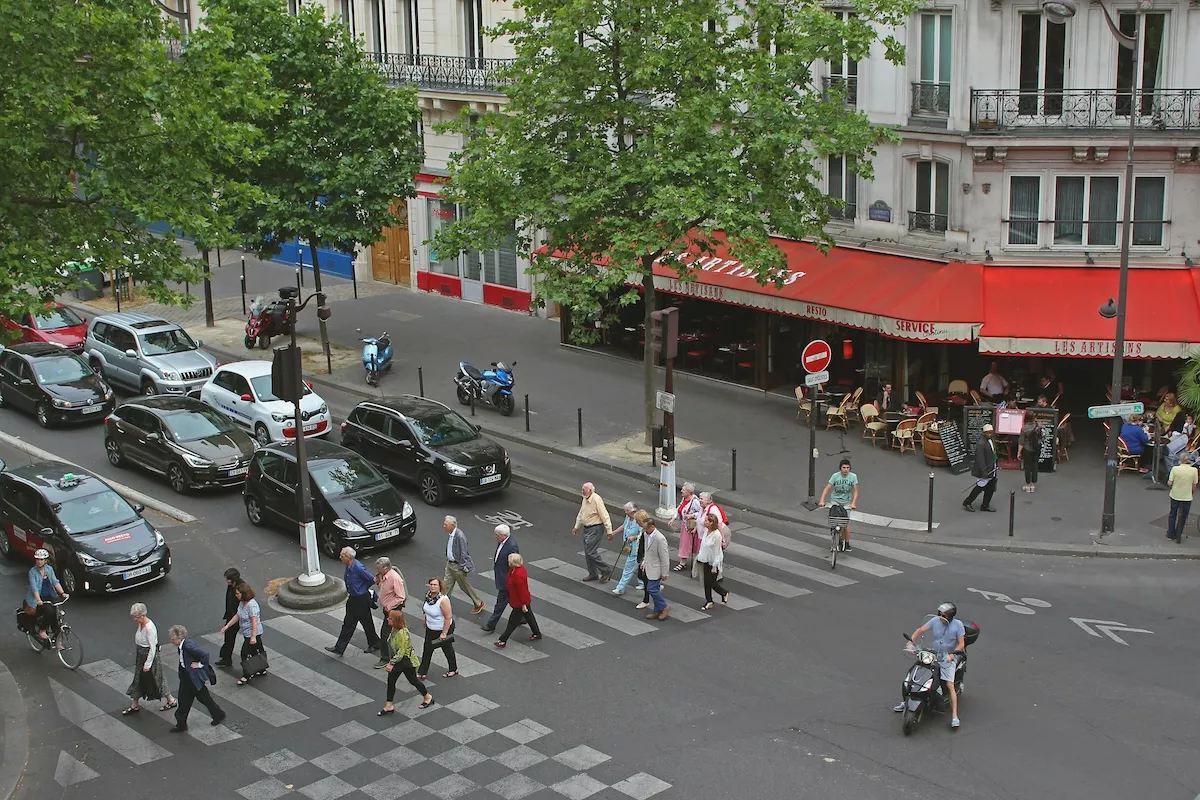

Louis Sarkozy proposes removing road signs to improve driver safety

Louis Sarkozy has called for removing traffic lights, road markings and signage to make drivers more responsible, citing European examples where accident rates dropped after signalisation was simplified or eliminated.

Speaking on RMC on 3rd December, the son of former French president Nicolas Sarkozy responded to a new VINCI Autoroutes study showing widespread rule-breaking by European road users. The fifth edition of the study, surveying 12,000 Europeans including 2,400 French respondents, found that 58 percent of French drivers fail to use indicators, 40 percent of cyclists admit running red lights, and 70 percent of pedestrians cross against signals.

“The solution here, as elsewhere, is more freedom, not less. What kills motorists is dependency,” Sarkozy said from his Menton home studio, where he regularly broadcasts commentary.

Naked roads concept

Sarkozy advocates for what he termed “an immense simplification of our roads: remove traffic lights, white lines, signage panels. In short: make citizens responsible for their own driving, instead of delegating it entirely to the highway code.”

The concept draws on “naked roads” pioneered by Dutch engineer Hans Monderman, which relies on fear of other road users to heighten attention and caution. According to Le Figaro, Sarkozy argues that without signalisation, drivers slow down, observe more carefully and anticipate better.

“Look at the survey: 95 percent of road users fear the behaviour of others. Naked roads use precisely this fear,” he said. “When there are no pavements, no traffic lights, no white lines, everyone pays more attention, citizens take responsibility, and what researchers call ‘implicit negotiation between users’ emerges. They become two to three times more cautious.”

International examples

Sarkozy cited Drachten in the Netherlands, where removing signalisation reportedly reduced accidents by 40 percent. He also claimed that London’s Kensington High Street saw a 44 percent accident reduction over three years after simplifying signalisation.

The philosophy contrasts sharply with French metropolitan traffic management. “When you make people responsible, they naturally become slower, more attentive and more generous with each other,” Sarkozy said. “It’s exactly the opposite of Parisian bureaucratic authoritarianism: you increase freedom and observe improved behaviour.”

He acknowledged one limitation: “It seems the only real problem with these ‘naked roads’ is that they work less well for elderly people and the visually impaired, but that’s about it.”

Road safety context

The VINCI Autoroutes study highlighted that nearly one in two road deaths in Europe involves vulnerable users such as pedestrians, cyclists or motorcyclists. The foundation’s research reveals a significant gap between traffic regulations and actual behaviour, with substantial percentages of all road user categories admitting to rule violations.

Sarkozy’s proposal represents a radical departure from current French road safety policy, which has increasingly relied on automated enforcement, reduced speed limits and expanded signalisation. The naked roads concept has been implemented in limited areas internationally, primarily in residential zones and town centres rather than main roads or motorways.

The approach remains controversial among traffic safety experts, with proponents citing reduced accident rates in trial zones whilst critics question applicability to high-traffic areas and express concerns about vulnerable road users including the elderly, visually impaired and children.

Stay updated with Monaco Life: sign up for our free newsletter, catch our podcast on Spotify, and follow us across Facebook,  InstagramLinkedIn, and Tik Tok.

Photo credit: J Shim, Unsplash


International school expansion drives private education boom as Monaco public enrolment drops

Monaco’s private school sector has grown 20% over the past decade, driven largely by the expansion of international schools catering to the Principality’s cosmopolitan population, whilst public school enrolment has declined to its lowest level in ten years.

The 2025-26 academic year saw 6,566 students enrolled across 16 schools, with private institutions now educating 2,427 students compared to 4,139 in public schools, according to statistics released by IMSEE in December. The private sector added 89 students this year whilst public schools lost 88 students, continuing a trend that has reshaped Monaco’s educational landscape.

International schools reshape the sector

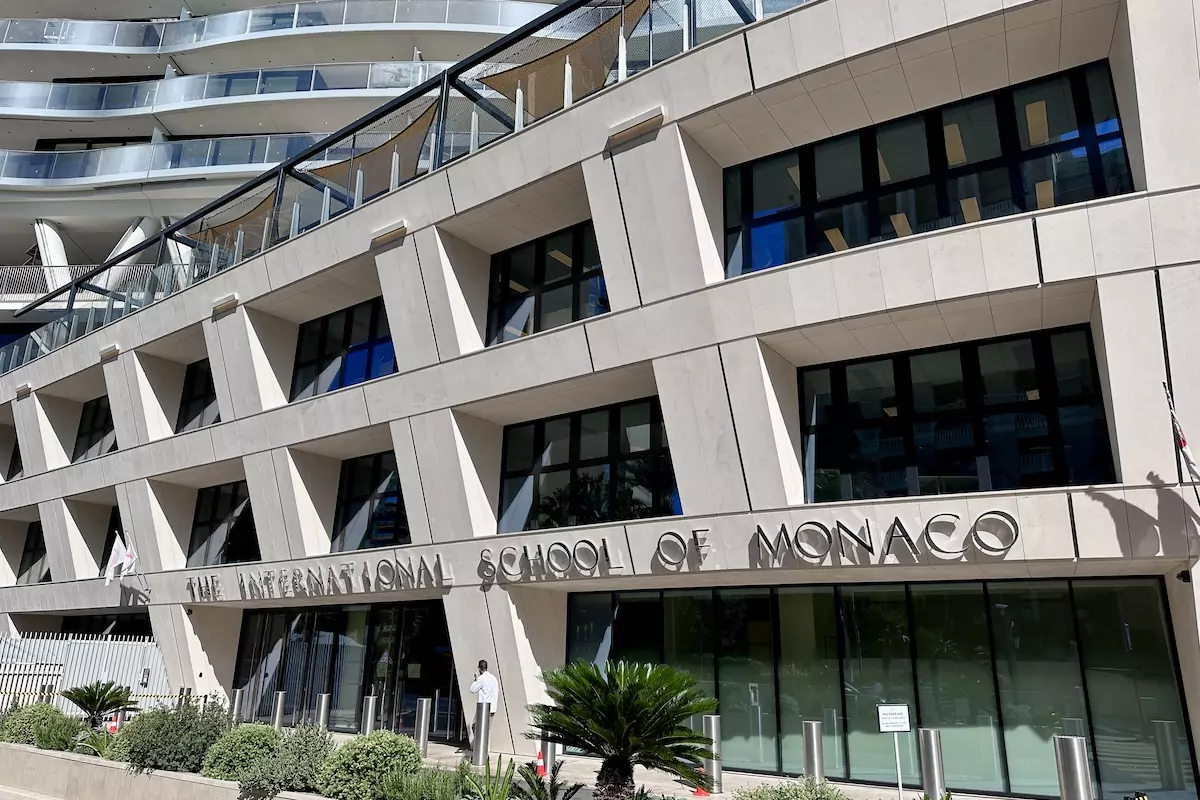
The opening of the British School of Monaco and the expansion of the International School of Monaco into larger premises explains much of the recent growth. Between 2022-23 and 2023-24, these two schools alone accounted for 102 of the 113 additional students registered across Monaco’s entire education system.

The International School of Monaco now serves 848 students, making it the third-largest school in the Principality after the Institution François d’Assise – Nicolas Barré (1,182 students) and École Saint-Charles III (1,125 students). The British School has grown to accommodate 399 students.

This expansion responds to Monaco’s increasingly international character. The student body represents 92 nationalities, with French students comprising 38 percent, Monegasques 20 percent, Italians 12.7 percent, British 5.9 percent and Russians 2.4 percent.

Nationality patterns reveal distinct educational preferences. British students show the strongest preference for private education, with three-quarters attending private institutions. In contrast, Monegasque, French and Italian students remain predominantly in public schools, though private schools are gradually gaining ground even among these traditionally public-leaning groups.

Public education contracts

Whilst private schools flourish, public education faces sustained contraction. Public school enrolment has dropped from around 4,350-4,400 students in 2019-20 to 4,139 students in 2025-26, the lowest level of the decade. The decline accelerated from 2020-21, with the steepest drops coinciding with the pandemic period and subsequent expansion of private alternatives.

The public sector still educates 63% of Monaco’s students and includes the Principality’s largest schools. However, the trend suggests public institutions are losing market share to private alternatives offering international curricula, English-language instruction and globally recognised qualifications.

Monaco residents favour private schools

Students living in Monaco show stronger preference for private education than those commuting from neighbouring communes. Among Monaco residents, 74.6% of those in private schools live in the Principality, compared to 65.7% in public schools.

For the 23.6% of students commuting from Beausoleil, Cap-d’Ail, La Turbie and Roquebrune-Cap-Martin, the pattern reverses: they represent 26.6% of public school students but only 18.4% of private school enrolment.

Nearly 70% of all students live in Monaco, reflecting the Principality’s appeal to international families seeking quality education in a compact, multilingual environment.

Diverse educational offerings

Monaco’s 16 schools accommodate varied educational needs. Elementary education serves 2,071 students (31.5%), whilst secondary education accounts for 3,511 students (53.5%). Secondary students are split between collège with 1,848 students, academic and technological tracks with 1,336 students, and vocational programmes with 282 students.

Additionally, 63 students benefit from adapted education through specialised programmes, representing 1% of enrolled students.

The system maintains gender balance with 50.7% boys and 49.3% girls across all schools.

See also: 

Inside the new state-of-the-art International School of Monaco campus

Sixty people woke up on Christmas morning in Monaco hotel rooms rather than their own homes, after a retaining wall monitoring crisis escalated dramatically on Christmas Eve.

Authorities ordered immediate evacuation of buildings in Monaco and neighbouring Beausoleil at 2:15pm on 24th December, giving residents barely three hours to pack before spending the festive period in emergency accommodation. By 6pm, all had been installed in a Monaco hotel offering Christmas Eve dinner and Christmas Day lunch, according to a Monaco government press release.

The dramatic intervention came after monitoring equipment detected what Minister of Equipment and Urban Development Céline Caron-Dagioni described as a “critical alert threshold” in the hours before evacuation.

“We wanted to allow families to spend Christmas in complete safety rather than with their eyes fixed on an indicator,” Caron-Dagioni told journalists at a 3pm press conference, as firefighters and police were knocking on doors in the evacuation zone.

A WEEK OF MOUNTING TENSION

The Christmas Eve evacuation capped a tense week that began quietly enough. On Saturday 20th December, the government announced that 840 high school students would start January term remotely due to concerns about the retaining wall above their temporary campus at the former Collège Charles III.

By that afternoon, workers were installing active ties on the failing wall to control pressure from the embankment above. The Annonciade car park closed on Monday.

But the real alarm came Tuesday afternoon. At 5pm, the government warned residents in the “geotechnical influence zone” that evacuation might be necessary. An hour later, according to Monaco Matin, residents of the Virginia Palace and Point du Jour buildings in Monaco began receiving letters from police.

“Prepare a bag containing clothing changes for four to five days,” the letters advised, along with toiletries, essential documents and necessary medications. Across the border in Beausoleil, municipal police delivered similar warnings to residents at 24 and 26 Boulevard Guynemer.

Less than 24 hours later, the evacuation began.

On Wednesday morning, Minister of State Christophe Mirmand convened a crisis meeting. Monaco Matin reporters in the Annonciade neighbourhood spotted the first signs of mobilisation at 2pm: firefighters, police and Prince’s Carabiniers converging on the former college. At 3pm, the government summoned journalists to the Ministry of State for the press conference.

SIMULTANEOUS CROSS-BORDER OPERATION

Sixteen minutes later, the operation began on both sides of the border. Monaco evacuated Virginia Palace and Point du Jour, according to a government press release. Beausoleil evacuated 24 and 26 Boulevard Guynemer after activating its Municipal Safeguard Plan in coordination with Monaco and French state authorities, a Beausoleil municipal statement confirmed. Monaco Matin reported that 31 Rue des Orchidées residents in Beausoleil were also evacuated.

Colonel Tony Varo, Superior Commander of the Public Force, detailed the choreography: “Avenue de l’Annonciade has been neutralised and will be closed to traffic and pedestrians for obvious safety reasons. The area was secured, then firefighters and police presented themselves to residents who had been identified beforehand.”

Prince’s Carabiniers ferried residents to the hotel in two specially chartered minibuses, Monaco Matin reported.

The minister explained what monitoring equipment had detected: “The pressure observed in recent days on the wall has been stabilised, but at a level that remains too high in terms of prevention.” She confirmed the nearby Tour Odéon tower, structurally independent, remained outside the safety perimeter.

Minister of Social Affairs and Health Christophe Robino told the press conference that multiple government departments had mobilised to support evacuees throughout the process, with teams ready to redirect anyone who hadn’t been contacted and might arrive seeking help.

DECADES OF SURVEILLANCE

The wall has been monitored since the 1970s and equipped with sensors since the 2000s. Reinforcement work began in July 2025, with surveys during October half-term. But recent monitoring revealed accelerated deformation requiring urgent intervention.

Authorities are finalising studies to identify an alternative site for the 840 Albert I High School students, whose remote learning “will be temporary”, the government stated. Details will be announced early this week.

The government is expected to provide another update on Monday before confirming where students will continue their education.

Stay updated with Monaco Life: sign up for our free newsletter, catch our podcast on Spotify, and follow us across Facebook,  InstagramLinkedIn, and Tik Tok.

Photo of the International School of Monaco by Cassandra Tanti