
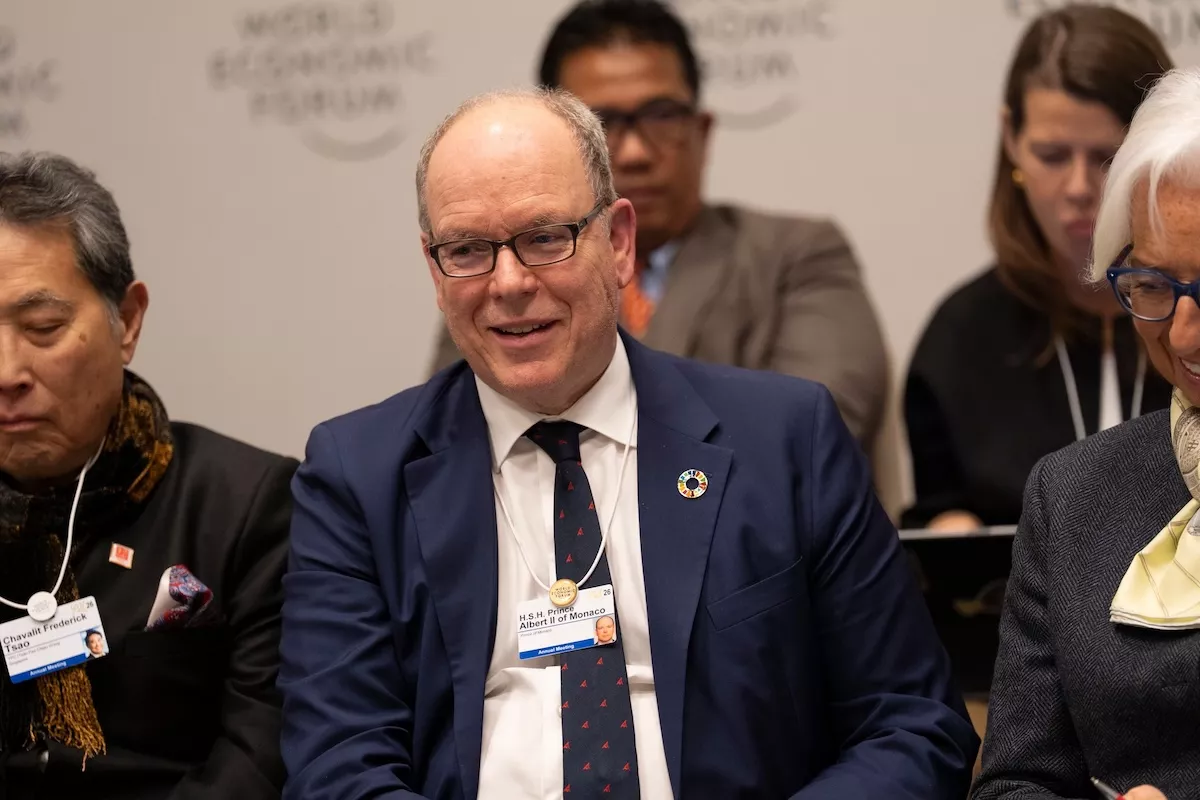
Prince Albert II delivered a forceful call to action on ocean finance at the World Economic Forum in Davos on Thursday, arguing that the question facing world leaders is no longer whether to act for the ocean, but how to act at the scale that the moment demands.
The Prince participated in a roundtable titled ‘Scaling Blue Finance for the Ocean Economy’ alongside Christine Lagarde, Ray Dalio, and other leaders from finance, policy, and industry. The session focused on mobilising capital for marine conservation and building ocean economies that are resilient, nature-positive, and inclusive.
€8.7 billion in commitments from June forum
Opening the session, Prince Albert II pointed to last June’s Blue Economy and Finance Forum in Monaco as proof that large-scale ocean finance is achievable. The event brought together over 1,800 participants from nearly 100 countries and generated €8.7 billion in concrete financial commitments, with a pipeline of over €25 billion in investable ocean projects identified.
“We organised it not as another conference. Not as another list of pledges,” the Prince said. “But as a platform to test our capacity to accelerate and scale existing solutions for the blue economy.”
Building on this success, Monaco will host the 2026 Blue Economy and Finance Forum on 28th and 29th May, welcoming 300 decision-makers in a business-to-business format.
“What we often lack is alignment”
Drawing on more than 20 years of work through his Foundation, Prince Albert II identified a critical gap in ocean conservation efforts. “We do not lack intelligence. We do not lack capital,” he said. “What we often lack is alignment. And alignment begins with science.”
He emphasised that scientific truth must be carried into markets, policies, and boardrooms. “Protecting the Ocean is not charity. It is a strategy for our common future,” he continued, noting that the sustainable blue economy is projected to exceed $3 trillion in value by 2030.
The Prince highlighted Foundation initiatives including the Global Fund for Coral Reefs and the ReOcean Fund, which has raised over €80 million to deploy capital into companies transforming maritime industries.
Environmental protection is not zero-sum
In one of the speech’s most striking passages, Prince Albert II challenged the notion that ocean protection requires economic sacrifice. “Environmental protection is not a zero-sum game,” he stated. “When one actor succeeds, we all gain. When one ecosystem recovers, markets stabilise. When one innovation scales, risk declines for everyone.”
He concluded by connecting ocean finance to broader questions of international cooperation. “At a time when multilateralism feels fragile, when power politics dominate the headlines, let us remember something essential,” he said. “Trade and finance have always been engines of peace and progress. Now, they must also become engines of planetary stewardship.”
His final words were direct: “History will not ask whether we were aware. It will ask whether we acted.”
Stay updated with Monaco Life: sign up for our free newsletter, catch our podcast on Spotify, and follow us across Facebook, Instagram, LinkedIn, and Tik Tok.
Photo credit: WEF-PBlitz