
Football: Tense draw seals Monaco’s Champions League qualification

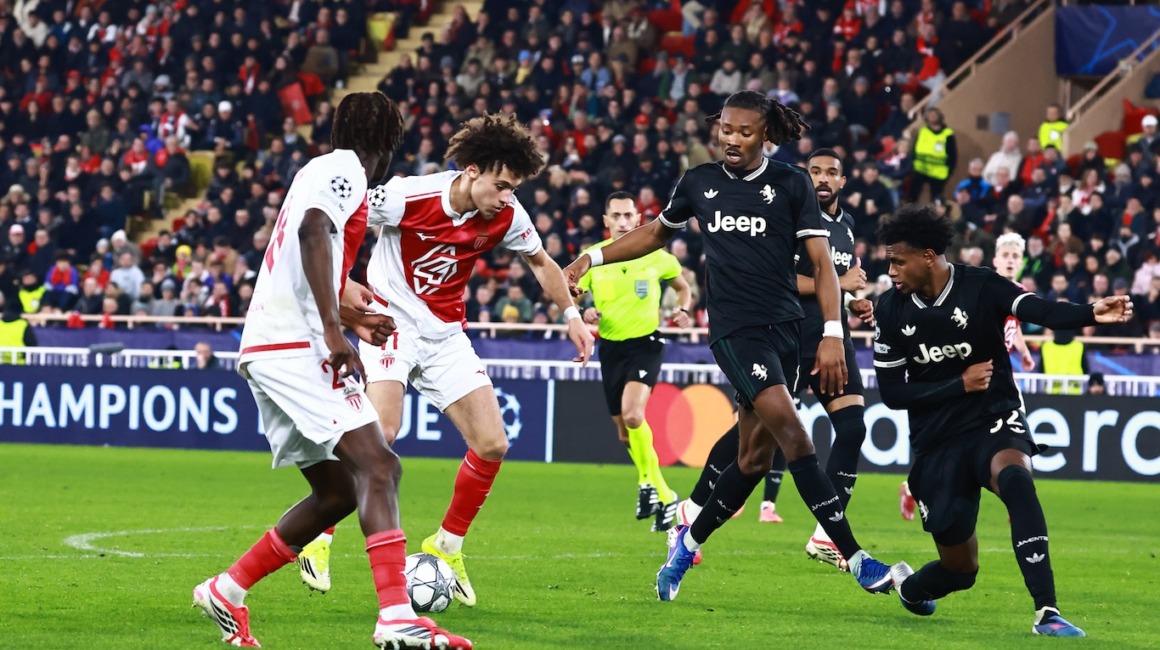
Maghnes Akliouche shoots under pressure from Khéphren Thuram during Monaco's draw against Juventus

AS Monaco were held to a 0-0 draw by Juventus on Wednesday, but it was sufficient for the Principality club to qualify for the Champions League playoffs.

Sébastien Pocognoli made reference to the deluge of rain that had beaten down on the Principality over the course of the 24 hours that preceded the game against Juventus as a metaphor for the state of affairs. “A grey period,” he referred to it as, but as the afternoon turned to evening, the clouds gave way to clearer skies, and the draw against the Serie A giants alluded to sunnier skies ahead for Les Monégasques.

The feeling, Pocognoli insisted, was not one of “relief” but in light of the “negative energy and pressure” that surrounds the squad, he told his players to “savour the evening”. The final whistle did not immediately relieve the tension in the air, as the Stade Louis II waited with bated breath the results from elsewhere. But the calculations were done pre-match, and Pocognoli knew that a point “almost ensured” qualification. So it transpired. Monaco, at times, were on the brink of elimination, with results elsewhere going against them, but not once did they fall out of the top 24 (synonymous with qualification for the play-offs) and by the end of play, they finished 21st. An encounter with either PSG or Newcastle United awaits them in the next round.

Pragmatism prevails for Pocognoli

The Monaco manager called on his players to be “intelligent” and “audacious” against Juventus. It was the former that was more required as, arguably for the first time in the Pocognoli regime, pragmatism reigned over idealism. In view of the scenario heading into the match, the Belgian set his side up in a back three with Denis Zakaria as the anchor. Post-match, he would call the captain, as well as centre-back partners Jordan Teze and Thilo Kehrer, and goalkeeper Philipp Kohn, “the guardians of the team”.

Juventus never laid a glove on Monaco, failing to register a single shot on target. The Italian side’s attack was deficient, as Luciano Spalletti was left bemoaning his side’s inability to match the host’s “physicality”. It was Juventus who came into this game with the loftier ambitions, targeting an improbable place in the top eight, which would have allowed them to skip the play-offs.

But they conceded the bigger chances, firstly from Maghnes Akliouche inside the first 60 seconds. Presented the ball by Mattia Perin, the France international could not find the target with the goal gaping. Folarin Balogun did have the ball in the back of the net minutes later, but the former Arsenal forward was adjudged to have fouled Pierre Kalulu in the build-up.

Pocognoli salutes Zakaria’s “best game of the season”

The Juve goalkeeper was worked before the break, with a close-range Vanderson effort tipped over, and it was the Brazilian again who forced Perin into an intervention with a long-range effort just before the break. Juventus tried to summon a response, bringing Kenan Yildiz and Vasilije Adzic off the bench at half-time.

Both were largely ineffective against what Spalletti called a “compact” Monaco defence. And it was the hosts who always looked the most dangerous, whenever they had the chance to spring forward. As the game ticked towards the 90, Juventus’ chances of a top-eight finish had evaporated, the result of scores elsewhere; it was clear that a point would be enough for Monaco. You got the impression that both teams were happy to call it quits just after the hour mark, and so neither side really forced the issue – a goalless draw, therefore, the logical conclusion.

It was a performance of promise, notably for Zakaria, such a key player, but so out of sorts for much of this season. “Denis played an exemplary match […] it was certainly his best match of the season,” reacted Pocognoli. He was key in securing a clean sheet, Monaco’s second in succession, following the 0-0 draw to Le Havre over the weekend.

For Kohn, the defensive showing forms a “base” for Monaco, and that is key given how shaky the foundations have been this season. Finally, there is something positive to cling to, as progression in the Champions League – and the manner of it – slightly lifts the clouds, without burning them back completely. Kohn insisted on “step by step, match by match,” and the next one, against Rennes on Saturday, will be key to lifting the mood further.

Stay updated with Monaco Life: sign up for our free newsletter, catch our podcast on Spotify, and follow us across Facebook,  InstagramLinkedIn, and Tik Tok.

Photo source: AS Monaco
First crewed Moon mission in 50 years could launch as early as next month

NASA is preparing to send astronauts beyond Earth orbit for the first time since 1972, with the Artemis II mission potentially launching in the first week of February.

NASA will simulate a test launch of its Artemis II mega moon rocket as early as Saturday 31st January, with the space agency announcing its engineers are on track or ahead of schedule. It marks a major milestone toward returning humans to the Moon.

The 10-day mission will take four astronauts further into space than anyone has travelled before, testing critical systems needed for an eventual lunar landing planned for later this decade.

Launch windows and preparations

The “wet dress rehearsal” is a pre-launch test to fuel the rocket. Any issues could force the rocket back to the assembly building for additional work.

If all systems perform as expected, the earliest possible launch date is Friday 6th February.

Due to orbital mechanics requiring the Moon to be correctly positioned, launch windows occur only one week per month. Potential launch dates include 6, 7, 8, 10 and 11 February; 6, 7, 8, 9 and 11 March; and 1, 3, 4, 5 and 6 April.

Historic crew

The Artemis II crew comprises NASA commander Reid Wiseman, pilot Victor Glover, mission specialist Christina Koch, and Space Agency mission specialist Jeremy Hansen.

Once in orbit, the North American astronauts will manually fly the Orion capsule to practice steering and alignment procedures for future Moon landings.

They will then travel thousands of kilometres beyond the Moon to test Orion’s life-support, propulsion, power and navigation systems in deep space.

The crew will serve as medical test subjects, sending back data and imagery from beyond low Earth orbit where radiation levels exceed those on the International Space Station, though remain within safe limits.

After their journey, the astronauts will experience a fiery re-entry through Earth’s atmosphere before splashing down in the Pacific Ocean off the US west coast.

No Moon landing yet

Artemis II will not land on the Moon. That milestone is reserved for Artemis III, officially scheduled for “no earlier than” 2027, though experts believe 2028 is more realistic.

Critical hardware remains unfinished, including the final selection between SpaceX’s Starship lander and a craft designed by Jeff Bezos’s Blue Origin for the lunar descent vehicle.

New spacesuits manufactured by Axiom are also not yet ready.

When Artemis III finally launches, astronauts will target the Moon’s south pole rather than the equatorial regions visited during Apollo missions.

Building a lunar presence

Following Artemis III, NASA aims to establish sustained human presence on the Moon.

Artemis IV and V will begin constructing Gateway, a small space station orbiting the Moon. Subsequent missions will add modules to Gateway while robotic rovers operate on the surface.

The Lunar Terrain Vehicle that will transport astronauts across the Moon’s surface during Artemis V and beyond is being developed by three companies, including Monaco’s Venturi Astrolab, alongside Intuitive Machines and Lunar Outpost.

More countries will participate in keeping people living and working on and around the Moon for extended periods.

50 years since Apollo

The last crewed Moon mission was Apollo 17, which landed in December 1972. In total, 24 astronauts travelled to the Moon during the Apollo programme, with 12 walking on its surface. Only five of those 24 remain alive today.

The original Moon race was driven by Cold War competition with the Soviet Union. Once America achieved that goal, political enthusiasm and funding evaporated.

The Artemis programme represents a return with different objectives: long-term presence built around new technology and commercial partnerships rather than geopolitical one-upmanship.

International Moon race

Several nations have announced lunar ambitions for the 2030s.

European astronauts will join later Artemis missions, and Japan has secured seats on future flights.

China is developing its own crewed lunar capability, targeting a landing near the south pole by 2030.

Russia continues discussing cosmonaut missions and a small lunar base between 2030 and 2035, though sanctions, funding pressures and technical setbacks make this timeline highly optimistic.

India, following its successful Chandrayaan 3 landing near the lunar south pole in August 2023, has set a goal of sending astronauts to the Moon by approximately 2040.

The race is on—but this time, the finish line is permanent human presence rather than planting a flag and leaving.

Stay updated with Monaco Life: sign up for our free newsletter, catch our podcast on Spotify, and follow us across Facebook,  InstagramLinkedIn, and Tik Tok.

Photo credit: Arya Winarto, Unsplash