

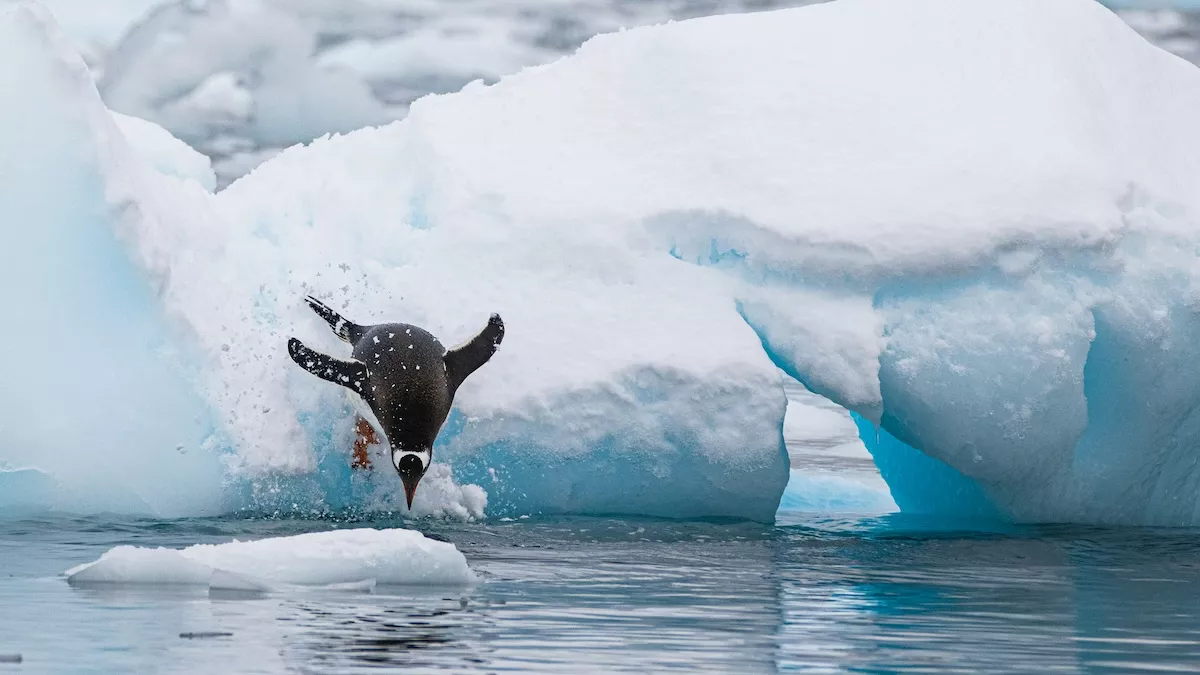
International negotiations to protect millions of square kilometres of Antarctic waters have ended without agreement for the tenth consecutive year, leaving critical habitats for penguins, seals and whales exposed to mounting pressures from climate change and commercial fishing. Despite the setback, conservation groups say progress in the final days of talks in Australia could provide a path towards a breakthrough in 2027.
The two-week meeting of the Commission for the Conservation of Antarctic Marine Living Resources (CCAMLR) concluded in Hobart, Tasmania, on Friday 30th October, without agreement on any new marine protected areas or stronger measures to manage fishing for Antarctic krill.
It marks a decade since the commission last established a marine protected area, despite longstanding proposals to safeguard some of the Southern Ocean’s most ecologically important regions.
The failure comes as scientists warn of mounting pressure on Antarctic ecosystems, where warming waters, changing sea ice and increasingly concentrated fishing activity are affecting the food sources on which marine wildlife depends.
Why Antarctic protection remains deadlocked
At the centre of the negotiations was a proposal from Argentina and Chile to establish a marine protected area covering approximately 456,000 square kilometres around the Antarctic Peninsula.
Known as Domain 1, the proposed reserve would protect important feeding and breeding habitats for penguins, seals and whales, while introducing restrictions on fishing in ecologically sensitive areas.
The peninsula is among the fastest-warming regions of the Southern Hemisphere. Its waters are also home to Antarctic krill, the small crustaceans that form a vital part of the Southern Ocean food web.
But decisions within CCAMLR require consensus among its 27 members, meaning any single member can prevent a proposal from being adopted.
The result has been years of stalled negotiations, even as governments have committed internationally to protecting 30% of the world’s oceans by 2030.
The commission has established only two marine protected areas since committing in 2009 to create a representative network across the Southern Ocean: one around the South Orkney Islands and another in the Ross Sea, agreed in 2016.
A possible breakthrough in 2027
Despite the latest failure, conservation organisations reported more constructive discussions than in previous years.
Argentina and Chile continued to champion the Antarctic Peninsula proposal, with support from other South American countries, including Brazil and Uruguay.
China also submitted a new marine protected area proposal for East Antarctica, an indication that discussions about expanding protection remain active among countries with differing interests in the region.
Crucially, several CCAMLR members agreed to continue negotiations between annual meetings, focusing on the Domain 1 proposal and revised management measures for the Antarctic krill fishery.
The aim is to resolve outstanding disagreements before the commission’s 46th annual meeting in 2027.
José María Figueres, former President of Costa Rica and chair of the conservation movement Antarctica2030, said the failure to reach an agreement should not be allowed to undermine the progress made.
“The science is clear, the proposals are ready, and the political support is within reach,” he said. “It is CCAMLR’s responsibility to protect the Southern Ocean. The world cannot wait.”
Former US Secretary of State John Kerry pointed to the agreement reached in 2016 to protect the Ross Sea as evidence that governments can overcome significant political differences.
He said countries had again moved closer to a potentially historic agreement, but warned that the opportunity could still be lost.
“Close enough isn’t enough,” he said. “History will judge this moment by whether what was outlined in Hobart is pushed across the finish line.”
Why krill fishing matters
Alongside the proposed marine reserves, negotiations focused on strengthening the management of Antarctic krill fishing.
Krill are small, shrimp-like crustaceans that feed on microscopic marine organisms and are themselves consumed by whales, penguins, seals and other species.
They are particularly important around the Antarctic Peninsula, where wildlife depends on dense concentrations of krill during feeding and breeding seasons.
Commercial fishing targets krill for products including aquaculture feed and nutritional supplements.
Conservation organisations warn that even when fishing remains within overall catch limits, concentrating activity in particular areas can reduce the food available to wildlife at critical times.
The Antarctic krill fishery reached its catch threshold early for the second consecutive year in 2026, prompting renewed calls for more geographically targeted fishing restrictions and stronger ecosystem monitoring.
The proposed reforms would distribute fishing activity across smaller management areas, introduce seasonal controls and improve monitoring of the effects on marine mammals and seabirds.
Claire Christian, executive director of the Antarctic and Southern Ocean Coalition, said the absence of new protections was particularly disappointing given the pressures already affecting the region.
“While progress was made, it is still regrettable that there are no meaningful outcomes that would increase protections for ecosystems and species increasingly under pressure from fishing and climate change,” she said.
Pressure mounts for international action
The failure to reach an agreement has prompted renewed calls for governments to elevate Antarctic protection to the highest diplomatic level.
Lord Zac Goldsmith, former British environment minister and an ambassador for Antarctica2030, said there were signs that the longstanding deadlock might finally be weakening.
“After ten years of stalemate, the deadlock does seem to be cracking, and that matters,” he said. “But penguins, seals and whales cannot feed on good intentions.”
He urged governments to use the coming months to resolve their remaining differences rather than reopen settled questions.
Geneviève Pons, vice-president of Antarctica2030 and president of Europe Jacques Delors, described the negotiations as a test of international cooperation.
“Protecting the Southern Ocean is not only an environmental priority, but also a test of international cooperation in a fragmented world,” she said.
She called on the European Union and its member states to maintain diplomatic pressure ahead of next year’s meeting.
The proposals still awaiting agreement extend beyond the Antarctic Peninsula to East Antarctica and the Weddell Sea. Together, they would protect millions of square kilometres of ocean, including krill breeding grounds and important feeding areas for whales.
Their adoption would also make a substantial contribution to the international target of protecting 30% of the world’s oceans by 2030.
For now, however, no new protections have been secured.
After ten years without agreement, the next twelve months will determine whether the diplomatic progress reported in Hobart can finally be translated into binding conservation measures.
Monaco Life is written by qualified journalists, writing original content. Sign up for our free newsletter, listen to our podcasts on Spotify, and follow us across Facebook, Instagram, LinkedIn, and Tik Tok.
Photo credit: Birger Strahl, Unsplash