

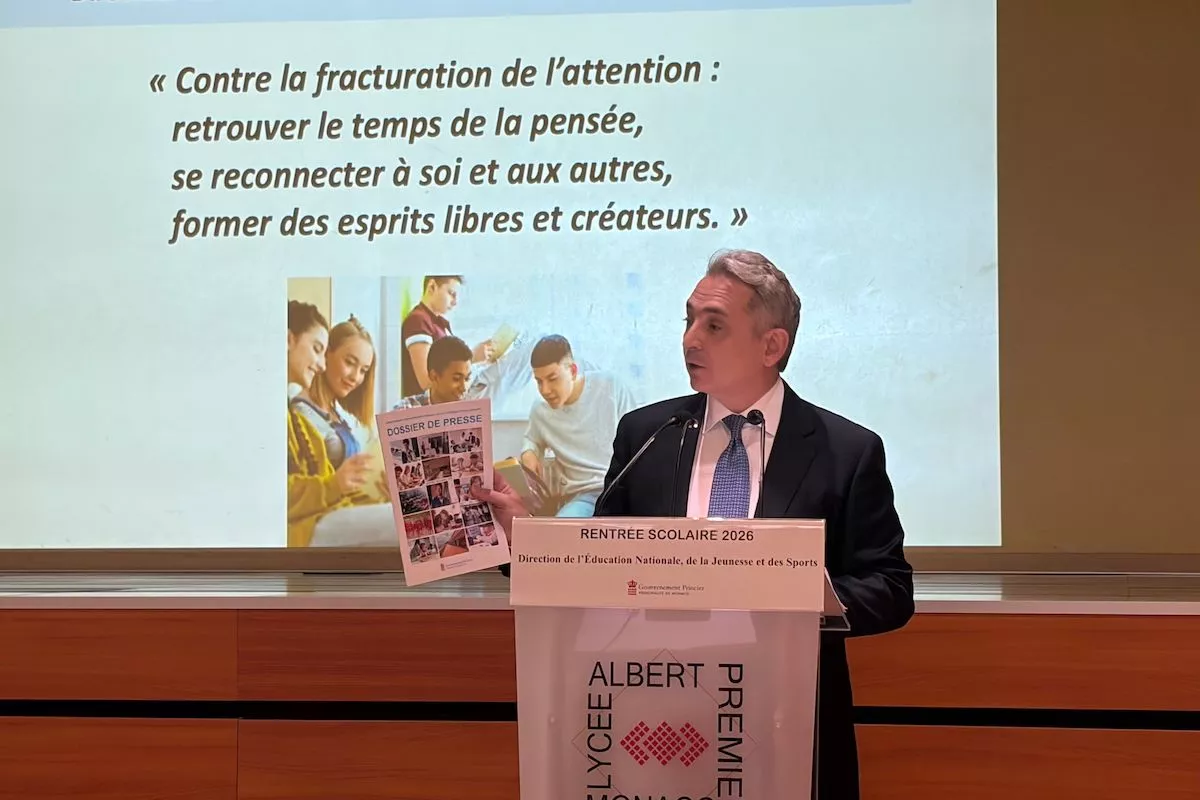
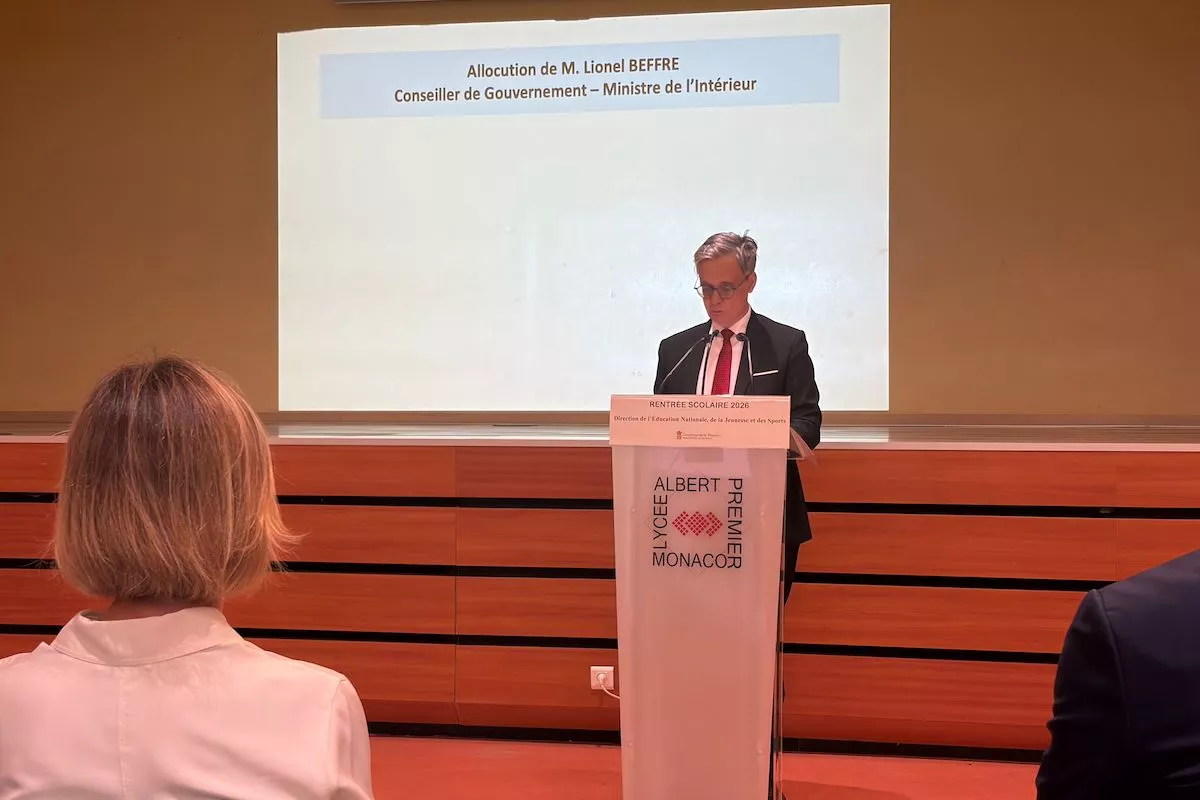
The Communication Directorate hosted a press event on Wednesday 2nd September at Lycée Albert-Ier to outline the upcoming academic term. Led by Lionel Beffre, Government Counselor and Minister of the Interior, alongside Jean-Philippe Vinci, Director of National Education, Youth, and Sports, the conference laid out the Principality’s strategic vision, priorities, and structural upgrades for the 2026–2027 school year.
Balancing innovation and academic rigour
Monaco’s education leaders have outlined a robust roadmap for the 2026–2027 academic year, focusing heavily on reversing the ‘fracturation’ of student attention, reintroducing traditional print textbooks, and maintaining high academic standards. Speaking at the press conference ahead of the new term, Minister of Interior Lionel Beffre highlighted the exceptional state of the Principality’s facilities following extensive modernisation, saying: “After a year of intensive work, students are returning to an establishment offering optimal working conditions.”
He added that authorities placed equal emphasis on essential structural enhancements and aesthetic improvements, saying that: “Special attention was given to both the unseen upgrades – such as classroom digitalisation and soundproofing – and visible transformations, including fresh painting and upgraded catering areas.”
Beffre also pointed to the recent results in academic outcomes, saying that the Principality continues to achieve exceptional academic results, noting a success rate rising to 99.5% for the baccalaureate—with 53 laureates achieving ‘Very Good’ honours—alongside a 100% pass rate for BTS students. Furthermore, 95% of terminal students secured a Parcoursup offer, while 24% gained admission to competitive institutions outside the platform, including Oxford, Cambridge, and elite French preparatory classes.
Tackling the digital ‘fracturation’ of attention
Director Jean-Philippe Vinci dedicated a significant portion of the briefing to the psychological and neurological impact of digital consumption on modern youth. Citing the reflections of philosopher Simone Veil from 1942, Vinci warned that modern schooling faces a severe challenge from digital distraction.
“We are no longer simply in the fragmentation of attention, meaning passive distraction; we are today in what we scientists call the ‘fracturation’ of attention,” Vinci explained, adding: “It fractures, like we fracture a molecule, we fracture attention, and we extract evidently the consciousness, the data, and it’s a phenomenon extremely important, subterranean, and very powerful.”
To combat this, the Principality is expanding its low-tech interventions. Following successful trials, 6th and 5th-grade secondary students will receive physical, government-funded paper manuals to use in class, allowing them to leave digital devices at home during school hours. “Print is not obsolete, but acts as a technology of attention that aids deep memorisation and allows teachers to accurately track pupil engagement,” Vinci said. He also pointed to international shifts—such as Sweden reversing its heavy reliance on digital tablets after observing dips in PISA scores—as validation for a more balanced approach between screens and paper.
Clean water, clear focus: The new academic roadmap
Building on these core philosophies, the education department has structured the new academic year around several distinct priorities. Public and private systems welcome 5,652 students this year, supported by 533 teachers and 375 non-teaching staff, with Beffre highlighting that capping class sizes remains vital to safeguarding educational quality.
Mathematics and sciences will receive renewed emphasis, building on the success of the Mathematics Olympiads which engaged over 300 students last year, while guidance counselling is also being restructured through individualised follow-ups and partnerships with bodies like the Junior Chamber of Commerce to better connect students with modern career paths.
Expanding cultural and musical education remains a major focus, as early childhood music initiatives developed alongside the Académie Rainier III expand from pilot kindergarten classes into a universal programme where professional musicians visit schools weekly.
Additionally, middle school CHAM schedules have been streamlined to give students dedicated time for daily instrument practice.
Infrastructure and catering upgrades are also moving forward; following the successful launch of the Charles III College swimming pool, works have begun on the Saint-Charles school pool ahead of a late 2026 completion, and a revamped school catering contract with SMR will guarantee larger portions, increased on-site preparation, and at least 40% organic or local produce.
With health controls successfully managing minor technical anomalies like a standard trace of legionella at Charles III College prior to term, and preparations for the upcoming Youth Games well underway, Monaco’s education authorities have ensured that schools open their doors with both security and academic rigour firmly prioritised.
Stay updated with Monaco Life: sign up for our free newsletter, listen to our podcasts on Spotify, and follow us across Facebook, Instagram, LinkedIn, and Tik Tok.
Main photo: Jean-Philippe Vinci, Director of National Education, Youth, and Sports. Photo Credit: Virginia D’Umas