

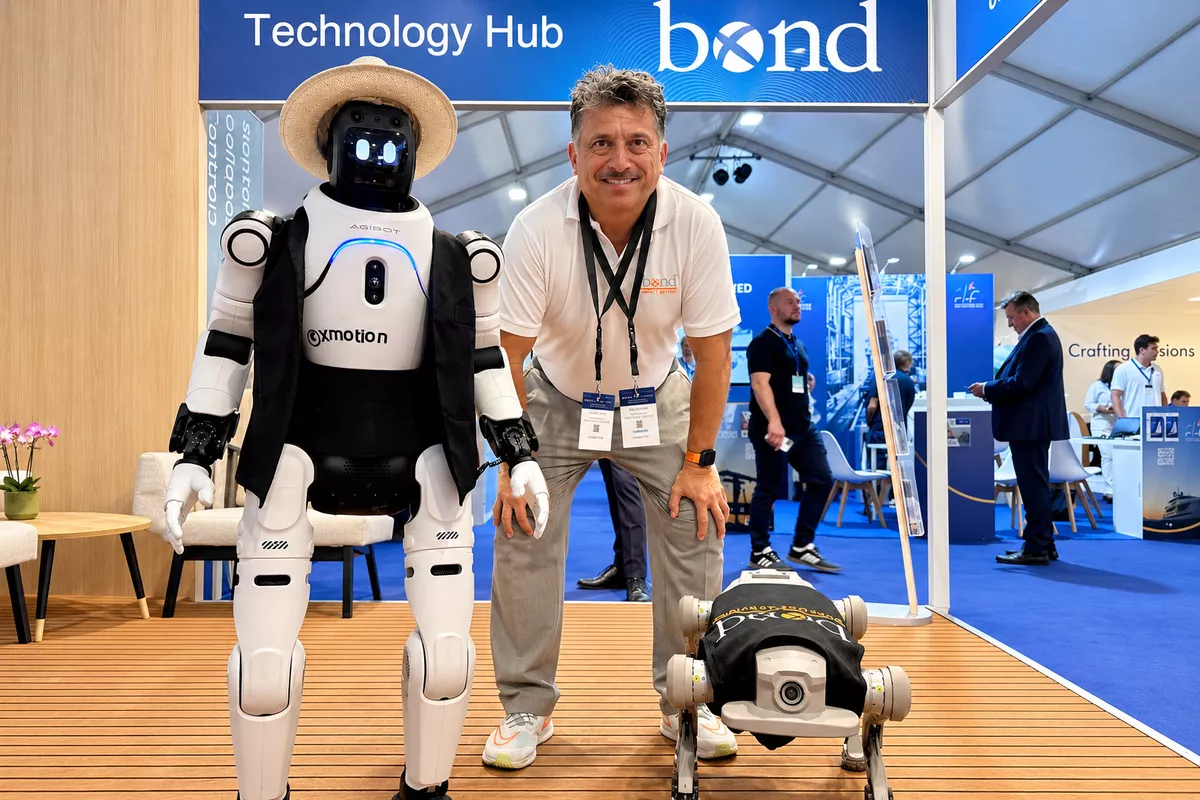
At a show where extraordinary yachts compete for attention, two of the biggest crowd-pullers were considerably smaller. A humanoid robot and a robotic dog drew visitors to Bond Technology Management’s stand throughout Monaco Yacht Show 2026, with phones raised for videos and people gathering for selfies. But behind the spectacle was a serious question: what could these machines actually do aboard a superyacht?
Inside the Quai Albert Ier tent, Bond’s stand became a gathering point for visitors curious to see the robots up close. The company had brought them to Monaco to explore how robotics could support onboard technical teams — a direction it had already begun investigating before the show.
I spoke to Will Faimatea, Bond’s founder and director, about the reaction and why a company established in yacht technology was putting robots in front of owners, captains and crew.
“We knew the robots would attract attention, but that wasn’t the primary reason for bringing them,” he tells Monaco Life. “We wanted people to think beyond the novelty and consider where robotics, AI and automation might genuinely improve operations, efficiency and safety within the yachting sector over the coming years.”
From selfies to serious questions
For Faimatea, robotics represents a potential next chapter in Bond’s work helping clients understand emerging technologies before they become mainstream. The interest at MYS suggested the industry was ready to discuss it, even if visitors approached the machines with very different expectations.
Captains wanted to know about practicality and reliability. Engineers saw possibilities for inspections and monitoring. Crew asked whether robots might replace them, or relieve them of repetitive and physically demanding work. Owners also shared their thoughts, although Faimatea prefers to keep those conversations private.
What began with people stopping to film quickly developed into enquiries about costs, operational benefits and how the technology might be adopted.
“What I noticed was that people would initially stop to look at the robots, then return later with thoughtful questions,” he says. “That suggests the conversation is moving beyond curiosity and towards genuine consideration.”
The humanoid’s appearance made it an obvious attraction, but its potential onboard roles are more restrained than the spectacle might suggest: providing guest information, assisting with inventory management or supporting security. Complex interactions with guests remain a much harder proposition.
“What I don’t see changing anytime soon is the importance of human hospitality,” says Faimatea. “The superyacht experience is built around the crew, and I don’t see a robot replicating that yet or in my lifetime.”
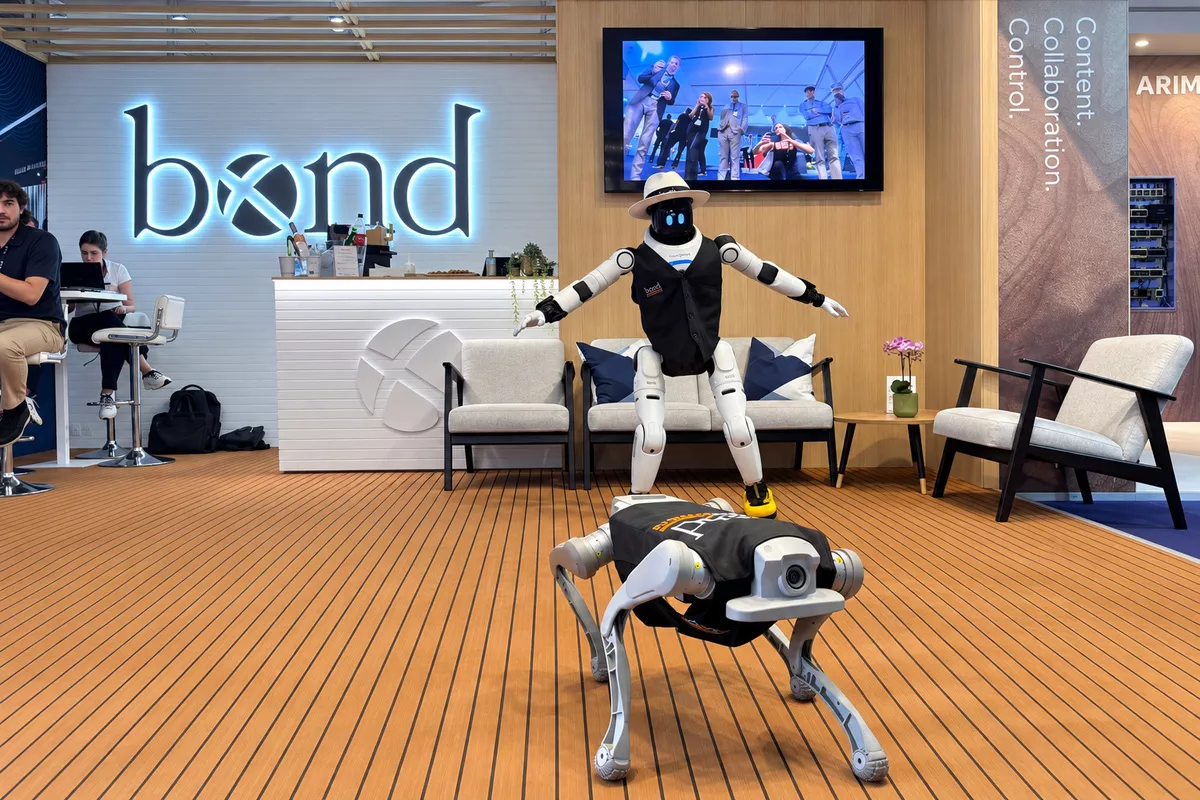
Why the robotic dog could prove useful first
The less human-looking machine may have the more immediate working future.
Faimatea sees potential for robotic dogs to undertake inspection rounds, monitor machinery spaces, carry thermal-imaging equipment, support the testing and commissioning of systems, and carry out security patrols.
These applications build on work already happening on land. Boston Dynamics, for example, offers industrial inspection systems that use its Spot robot to read gauges, capture thermal images and detect air leaks, with documented deployments involving infrastructure and energy operators.
“The robotic dog may actually have more immediate applications than a humanoid robot, in my opinion,” says Faimatea. “Inspection rounds, machinery space monitoring, thermal imaging, testing and commissioning systems, security patrols and accessing challenging areas are all practical use cases where robotics could potentially add value.”
The distinction is between a machine that looks capable and one that performs a useful, repeatable task. Inspection and data collection have already found commercial applications; sophisticated autonomous decision-making and guest interaction still require considerable development.
A much tougher test at sea
A yacht presents difficulties that a demonstration stand does not. Saltwater, humidity, confined spaces, changing weather and the movement of the vessel all complicate deployment.
“There is a huge difference between operating in a controlled environment and operating aboard a yacht underway,” Faimatea acknowledges.
He points to a recently released IP67-rated version of the robotic dog as an encouraging development for marine use. But greater resistance to water and dust addresses only part of the challenge: moving safely through a working yacht and delivering dependable results remain essential.
Privacy and cybersecurity are equally important. A robot gathering images or operational information would become another connected system aboard a vessel where discretion is often paramount. Faimatea acknowledges that these issues still need addressing, with any deployment expected to meet the standards applied to onboard communications, IT and security.
His focus is on how the technology could help the people already doing the work.
“The opportunity lies in using technology to remove repetitive, physically demanding or routine tasks, allowing crew to focus more on service, safety and guest experience,” he says.
Already finding their way aboard
Bond has been investigating robotics for around 18 months, although Faimatea stops short of announcing a dedicated yacht robotics service.
During the show, he also learned that two robots were aboard Leviathan, the 111-metre Oceanco yacht delivered in 2025 and the largest vessel on show at this year’s Monaco Show. For him, the discovery was a small confirmation that the technology on Bond’s stand was already finding its way into yacht projects.
He does not expect robots to appear on every yacht soon. Nor does he subscribe to the idea that they are either imminent replacements for everyone aboard or simply expensive toys. Their value will depend on the task, the environment and whether they can perform consistently.
The crowds in Monaco demonstrated their ability to attract attention. Their next test will be earning a place in the working life of a yacht.
“The interesting question now isn’t whether robotics will become useful,” says Faimatea, “but which applications will reach maturity first within sectors such as yachting.”
Monaco Life is written by qualified journalists, writing original content. Sign up for our free newsletter, listen to our podcasts on Spotify, and follow us across Facebook, Instagram, LinkedIn, and Tik Tok.
Main photo credit: Cassandra Tanti, Monaco Life