

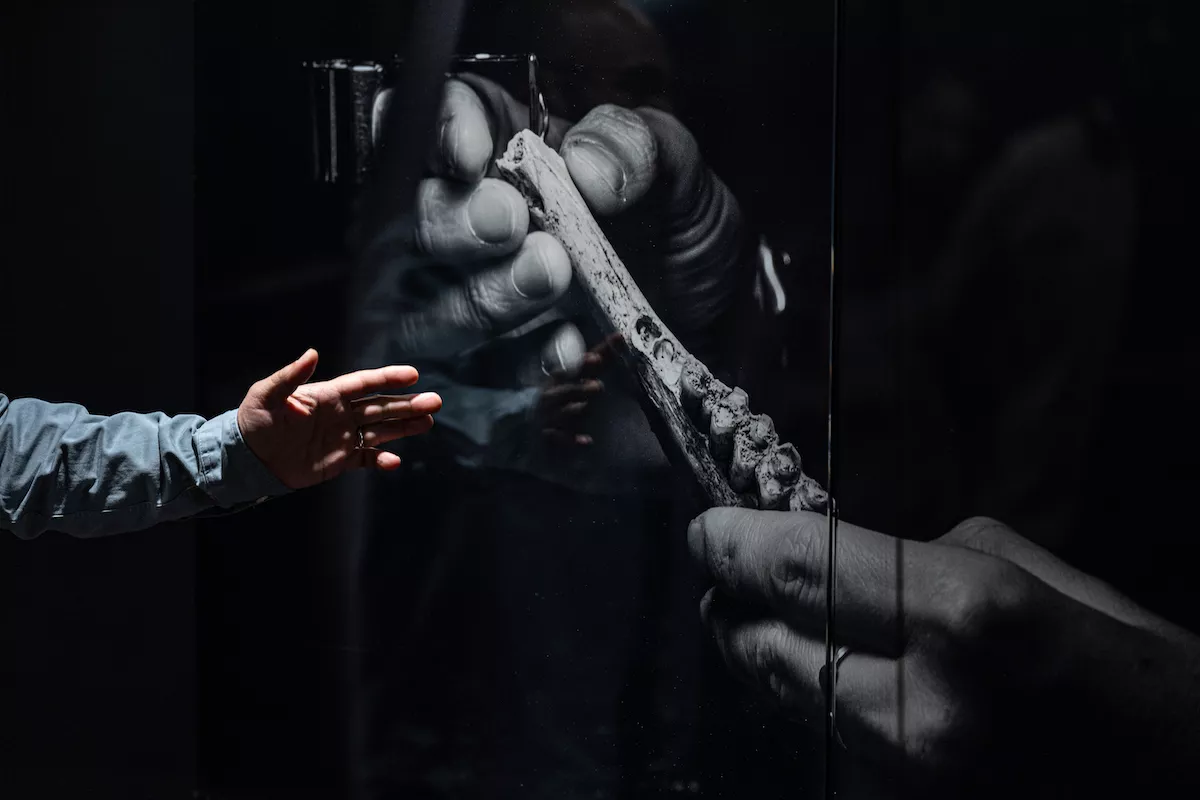
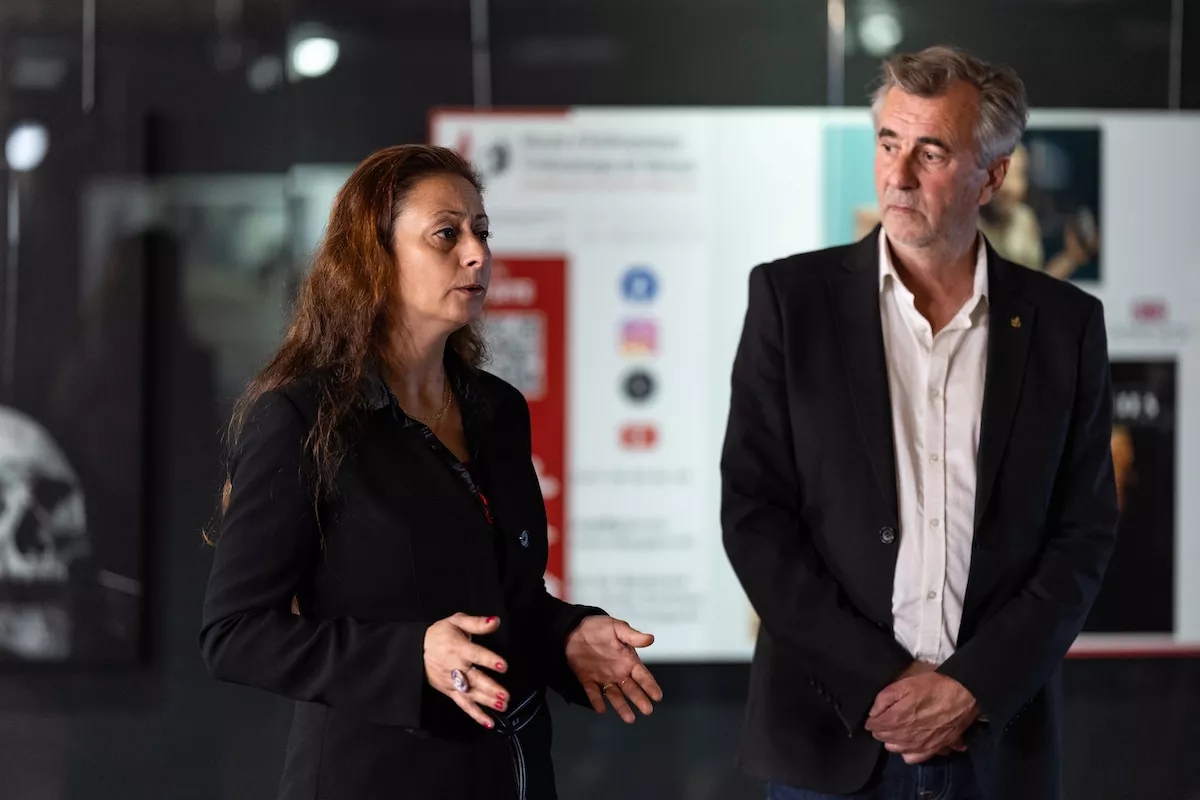
Stepping beyond the traditional museum walls, Monaco Museum of Prehistoric Anthropology Director Elena Rossoni-Notter and acclaimed photographer Stéphane Gamelin took over the Galerie des Pêcheurs on Monday 18th May to unveil Fouilles (Excavations). Presented at an exclusive press conference, this off-site exhibition strips away the dusty stereotypes of history to offer a glamorous, high-tech glimpse into the gripping reality of live archaeological fieldwork and advanced laboratory analysis.
Set to run until the end of June, the striking archaeology-focused exhibition was brought to life through the lens of photographer Stéphane Gamelin. Chosen for their blend of aesthetic brilliance and compelling narrative, the photographs offer a deeply fascinating look into the reality of modern research. The curated collection takes viewers on an immersive journey through every intricate stage of fieldwork—from the raw grit of archaeological excavation and site surveying right through to the precision of laboratory analysis.
“For my team and me, this was an exhibition where we truly wanted to break the mould. This isn’t just a traditional prehistoric museum, nor is it merely a passing tourist spot; it is a live research laboratory museum. Although it deals with prehistory, it is an incredibly modern institution where visitors will discover the cutting-edge worlds of DNA sequencing, advanced analysis, carbon dating, 3D technology, and photogrammetry,” said the museum’s director during the press conference.
The fine art of the fragment: Why every grain of history matters
“Right now, the team is actively searching—meticulously hunting for artifacts that lay undisturbed for 250 million years before the arrival of the territory’s very first Monegasque inhabitants. Once unearthed, the excavated earth undergoes a rigorous sieving process, first dry-riddled and then washed with water, ensuring absolutely nothing is missed before the remaining material is transferred to the laboratory for post-excavation analysis,” explained Olivier Notter, archaeologist and excavation mission coordinator.
Inside the laboratory, the real scientific work unfolds as each find is meticulously catalogued within an authentic excavation logbook. Every single object is precisely mapped using three-dimensional coordinates—the X, Y, and Z axes—alongside its exact orientation, inclination, dimensions, sector, and specific soil layer. Currently, the team is documenting calcites using this exact method.
This granular data is vital because the act of excavation is inherently an act of controlled destruction; by digging a site, researchers dismantle it forever. Consequently, the true skill of the modern archaeologist lies in the ability to record these precise coordinates during the dismantle, allowing the museum team to digitally reconstruct the historic living quarters and prehistoric habitats with unprecedented accuracy.
“Every element—from millimetre-accurate site plans and architectural diagrams to the bones, the small artifacts, the flint, and the surrounding stones—is interconnected. It is never a single object acting alone that defines a discovery; rather, it is the relationship between all these moving pieces that allows us to tell the true story of the past,” said the archeologist.
Capturing history through a creative lens
Stéphane Gamelin is an acclaimed photographer, author, and graphic designer based in Antibes, whose distinguished career is celebrated for bridging the worlds of evocative imagery, compelling storytelling, and historical transmission. A member of the prestigious Académie des Arts et Sciences de la Mer, Gamelin initially built his reputation within maritime communication, spending years documenting nautical and underwater worlds. From his iconic photography capturing the elegance of Les Voiles d’Antibes to authoring Le Premier Plongeur—a tribute to pioneering diver Frédéric Dumas—his work has always combined aesthetic brilliance with profound documentary meaning. His current project, Calypso Genesis, continues this maritime obsession, exploring the historic roots of the legendary RV Calypso in Antibes.
But for Fouilles, Gamelin has seamlessly transitioned his lens from the open sea to the subterranean world of archaeological research, bringing his signature rigor and emotion to Monaco’s Museum of Prehistoric Anthropology.
“The greatest challenge went far beyond the physical toll of working in the dust or dodging cave ceilings. The true test lay in bridging fine-art expression with scientific storytelling. It was never about merely documenting a scene, but finding an artistic angle that still clearly communicated the intricate research. My ultimate ambition was to immerse the viewer so deeply that they didn’t feel like an outside observer, but as if they were the archaeologist themselves,” the photographer told Monaco Life.
To achieve this deeply narrative, storytelling approach, Gamelin entirely embedded himself within the research team. He sought out perspectives that placed his camera directly in the action, jokingly recalling moments where he felt positioned right between the ancient remains of prehistoric beasts. His process required capturing the entire spectrum of the excavation, from the grand architectural scale of the site down to the most microscopic details—the texture of ancient soil layers or the steady, precise hands of a researcher.
Among the curated collection, Gamelin points to a striking black-and-white image as the definitive essence of the project. Capturing a researcher illuminated by a single, sharp beam of light cutting through the heavy dust and absolute obscurity of a cave, it was the very first photo he sent to Museum Director Elena Rossoni-Notter as a token of thanks.
It is precisely this evocative, high-art vision that has taken visitors by surprise; where many expect standard, sterile scientific documentation, they instead discover a deeply moving human story. Working entirely without the constraints of a commercial commission or financial pressure, Gamelin attributes the success of Fouilles to total creative freedom, allowing him to explore the ancient site with the uninhibited, joyful curiosity of a child.
Stay updated with Monaco Life: sign up for our free newsletter, listen to our podcasts on Spotify, and follow us across Facebook, Instagram, LinkedIn, and Tik Tok.
Photo credit : Manuel Vitali, Government Communications Department