

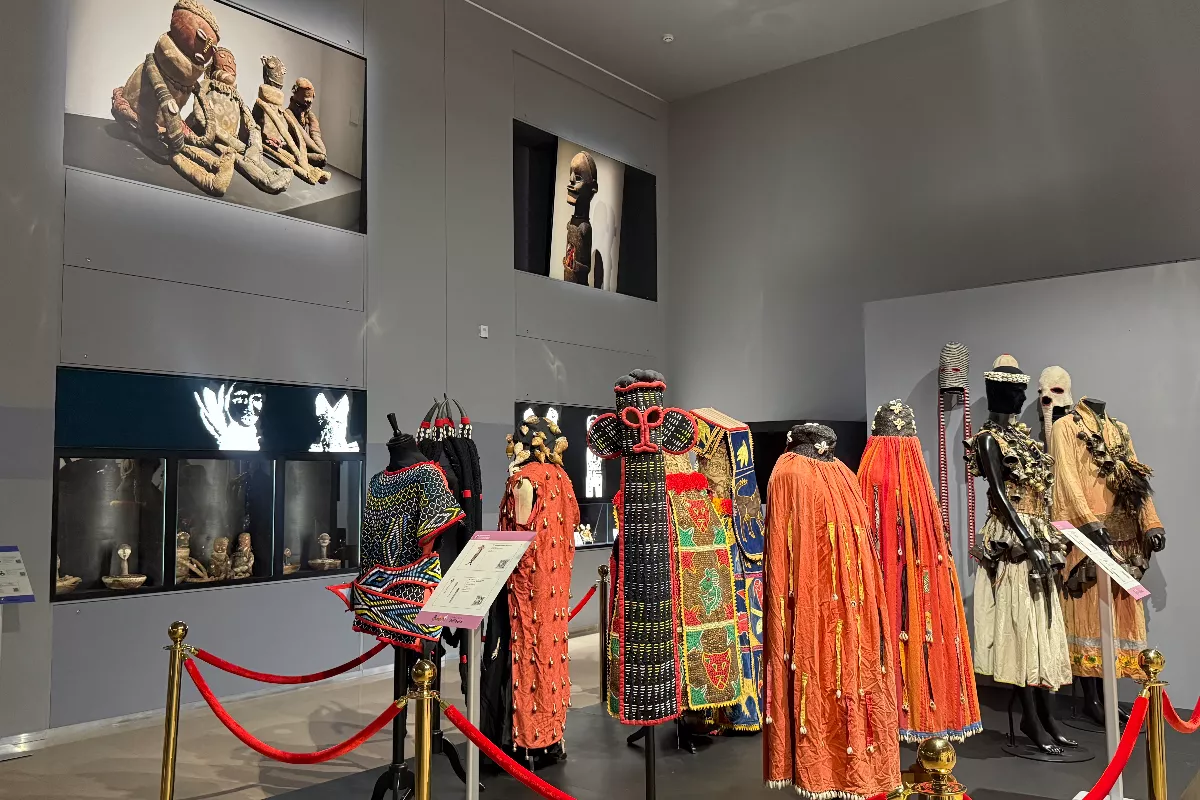
A new exhibition at Monaco’s Musée d’Anthropologie Préhistorique, running until 15th December, is inviting visitors into a world of ancient rituals, sacred objects, and beliefs that shaped the world for generations.
Titled ‘Magies d’Ailleurs – Magics from Elsewhere’, the exhibition brings together around a hundred objects, many rarely seen before, drawn mainly from sub-Saharan Africa and Oceania.
Curated by Dr Philippe Charlier and Dr Elena Rossoni-Notter, Director of the museum, it features collections from the museum and the LAAB, a research unit attached to the Université de Versailles-Saint-Quentin-en-Yvelines / Paris-Saclay.
The exhibition was previously shown in Tours, but has now been significantly expanded for Monaco, with full-scale voodoo altar reconstructions and new acquisitions, including four costumes from the GonGon societies.
“These rituals exist to create a link between generations, but also between people, nature, and the supernatural,” Dr Charlier said during a press tour. “Something that escapes us, that is very subtle.”
Blood and masks
At the heart of the exhibition is the idea that ordinary objects can become alive. Across many cultures, a carved figure or a mask was believed to cross from the lifeless world to the living the moment it was consecrated with blood.
Features were pressed into the wet surface, leaving a visible trace, or rather a sign that the object now carried its own energy. Blood was not a one-off ritual either. It was seen as ongoing nourishment, something the object needed to survive, just as the ancient Greeks believed their gods wither and die without sacrifice.
Masks tell a similar story. They were not costumes but doorways, allowing the one wearing it to be inhabited by a spirit or an ancestor. Over the years, layers of mud, blood, palm oil, and ochre – food for the spiritual being inside – would gather on their surface.
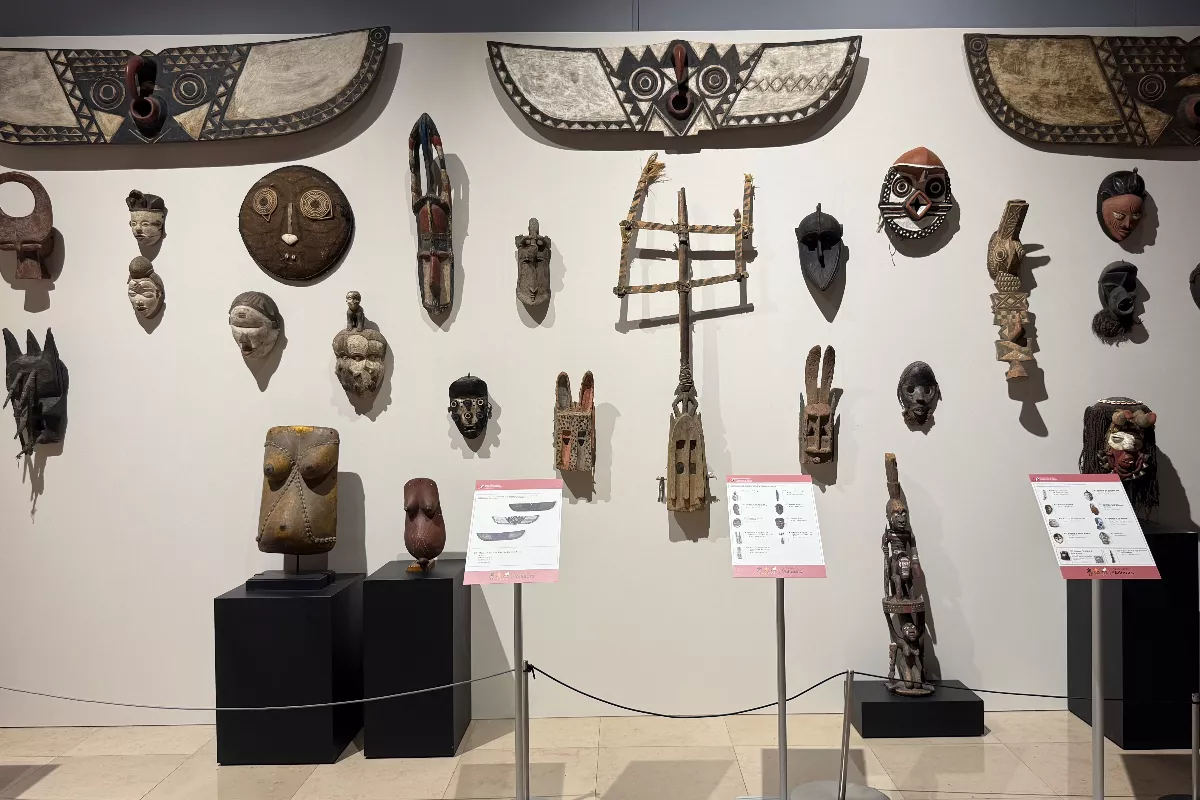
Some masks were forbidden to women, children, and the uninitiated, who could only hear the ceremony from a distance. Others abandoned any recognisable face entirely, becoming pure expressions of dread.
Thrones, bones and tree ferns
Dr Charlier singled out a carved throne from the Indonesian island of Timor. Local belief holds that wandering ghosts cause small but repeated disruptions like a car accident here or a stumble there. When the pattern is noticed, a ritual traps the spirit inside the throne.
“Tradition says the throne vibrates a little from time to time,” Dr Charlier explained, “because it is trying to get out.”
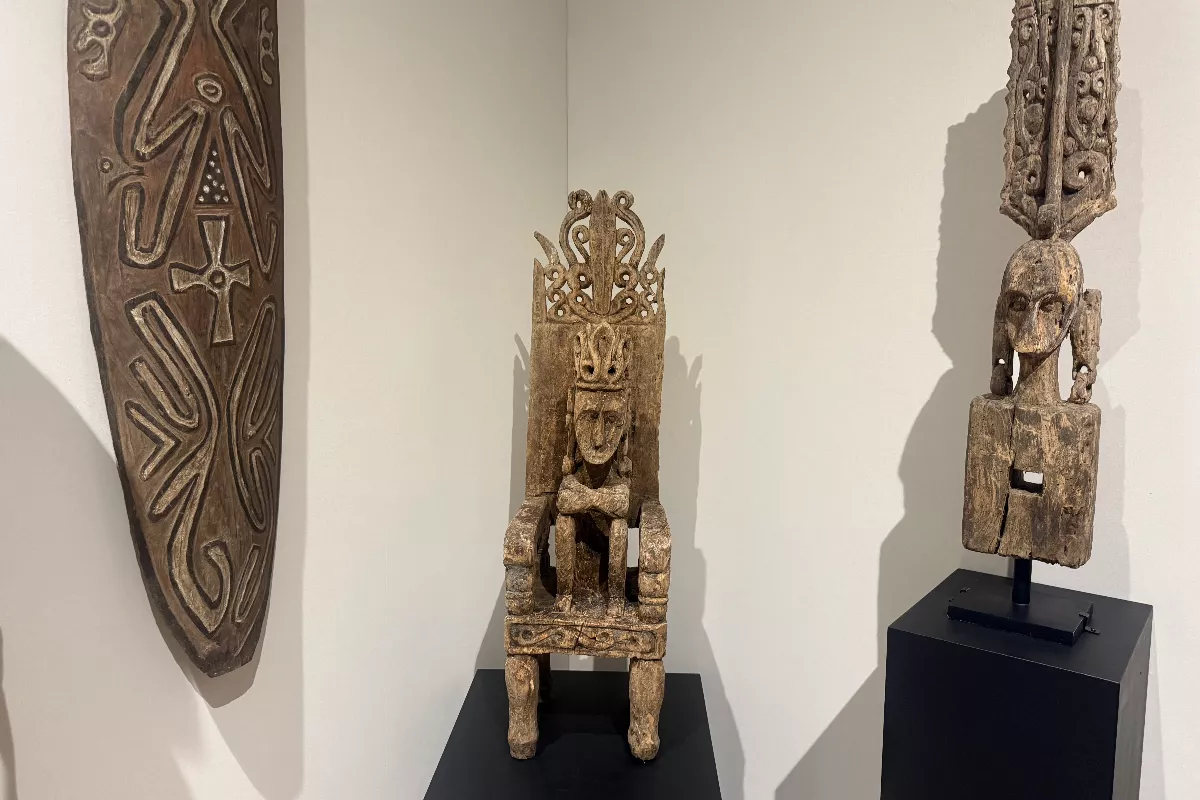
Other striking objects in the exhibition are a shield from Papua New Guinea and a votive plank from Irian Jaya that looks, at first glance, simply red and white. However, the red is ochre mixed with human blood, and the white is kaolin mixed with ground human bones. “When you are in front of this object, you see the colours,” Dr Charlier said. “But an initiate knows he is also protected by the blood and bones of an ancestor. It creates a sort of supernatural barrier.”
A carved tree from Vanuatu marks a different kind of transition. When a young man comes of age, a fern is sculpted and planted in from of the man’s house, a marker of his new status and, in a sense, a supernatural double of himself.
Secret societies
The exhibition also explores secret societies, drawing unexpected connections between the Carbonari of 19th-century Italy, Haitian voodoo’s Bizango, European Freemasons, and the Bambara guardians of the Boli in Mali. What binds them is not simply secrecy, but shared initiation rituals that create a lasting bond. Dr Charlier compared entering a secret society to medical specialisation: “When you are initiated, it is as if you were a general practitioner, and if you want to become a surgeon or a specialist, you enter a secret society. That is what it is, in fact.”
However, what needs to be noted is that these practices are not relics. The rituals on display are in many communities still very much alive. They are tools for making sense of the unknown and holding people together across generations.
Magies d’Ailleurs is open everyday from 9am to 6pm. Admission is €5 for adults, €2.50 for students and free for children under 10. Guided tours are also available by reservation only at mediationMAP@gouv.mc and cost €10 per person, with €5 for ages five to ten and free for kinds under five.
View this post on Instagram
Stay updated with Monaco Life: sign up for our free newsletter, catch our podcast on Spotify, and follow us across Facebook, Instagram, LinkedIn, and Tik Tok.
Main photo credit: Monaco Life.