

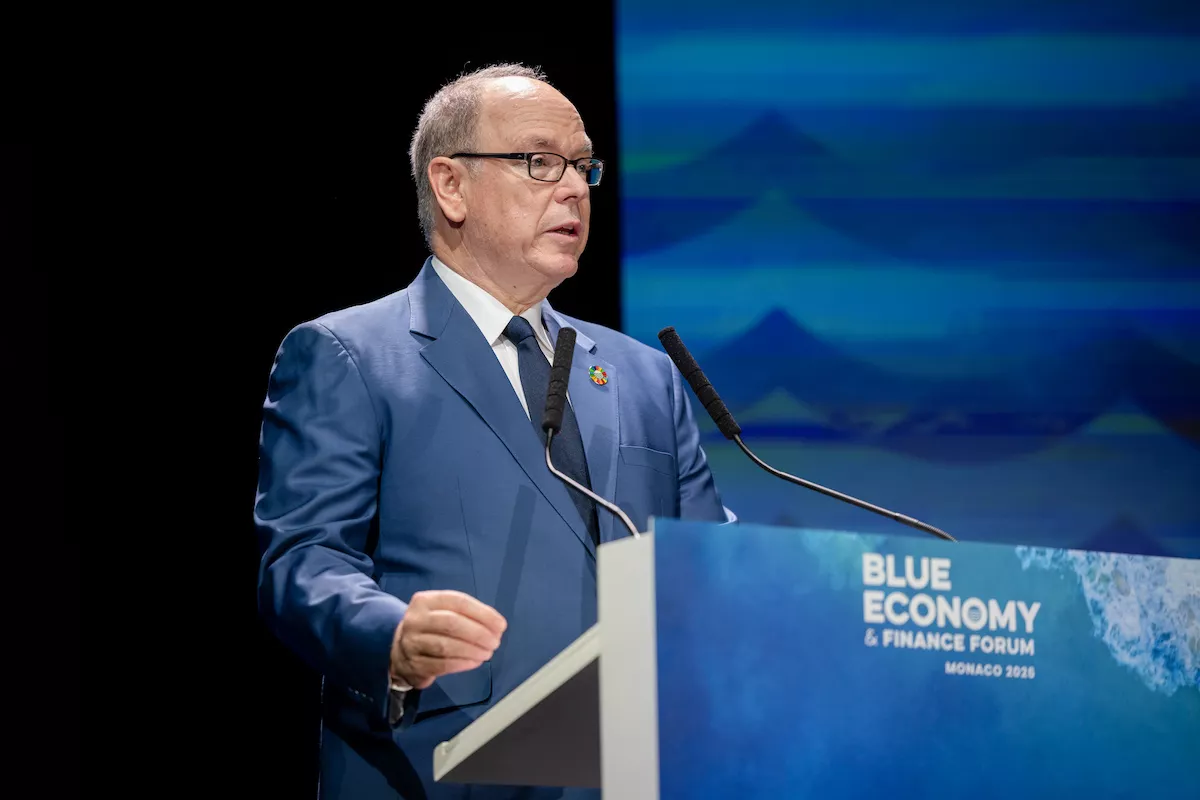
The 17th Monaco Blue Initiative and the second Blue Economy and Finance Forum brought together close to 300 participants across four days in Monaco at the end of May, drawing scientists, policymakers, institutional investors and entrepreneurs from 47 countries for what has become the Principality’s most significant annual gathering on ocean finance and governance.
The two events, held consecutively at the Oceanographic Museum and the Grimaldi Forum, are increasingly designed to work in tandem. Prince Albert II confirmed in his opening address to the MBI that from this year the forum is formally repositioned as a prelude to BEFF, with scientific and governance priorities developed at the Initiative intended to feed directly into the finance discussions that follow. “Investing in the Ocean is no longer simply responsible. It is profitable. The Ocean has become an asset class in its own right,” he said.
A data first for ocean investors
Among the announcements at the Monaco Blue Initiative, GIST Impact and Hub Ocean confirmed that the world’s first ocean risk datasets for listed equity investors will be published before the end of 2026. The datasets will cover marine protected areas and ocean-sensitive zones, providing asset-level exposure analysis for institutional portfolios. The absence of usable, science-grade ocean data has long been identified as one of the principal barriers to mainstream investment in the sector — making the forthcoming publication a practically significant development for the finance community.
Amundi and Crédit Agricole commit to natural capital
At BEFF, Amundi and Crédit Agricole announced the creation of a dedicated business line for natural capital, to be established within the next three years. The initiative is specifically designed to make ocean preservation and restoration projects investable within existing financial frameworks — a response to the $175 billion annual funding gap that delegates identified as the central challenge facing the blue economy.
The forum’s sessions also explored a range of emerging mechanisms gaining traction in the sector, among them resilience bonds, biodiversity credits, parametric insurance and outcome-based funds. On maritime decarbonisation, green shipping corridors between major ports and the electrification of port operations were identified as near-term levers, alongside technologies including wind propulsion, AI-powered routing and alternative fuels. The seaweed sector drew particular attention as a growing and increasingly profitable asset class, while discussions on food security underlined the overlooked role of small-scale fisheries, which supply up to 60% of protein consumed across the Global South.
BEFF 2026 drew 60% private sector representation across its 20 sessions, with institutional investors, venture capital and private equity accounting for 23% of attendees — a composition that organisers said reflected the growing integration of ocean investment into mainstream finance.
Stay updated with Monaco Life: sign up for our free newsletter, listen to our podcasts on Spotify, and follow us across Facebook, Instagram, LinkedIn, and Tik Tok.
Photo credit: Philippe Fitte