

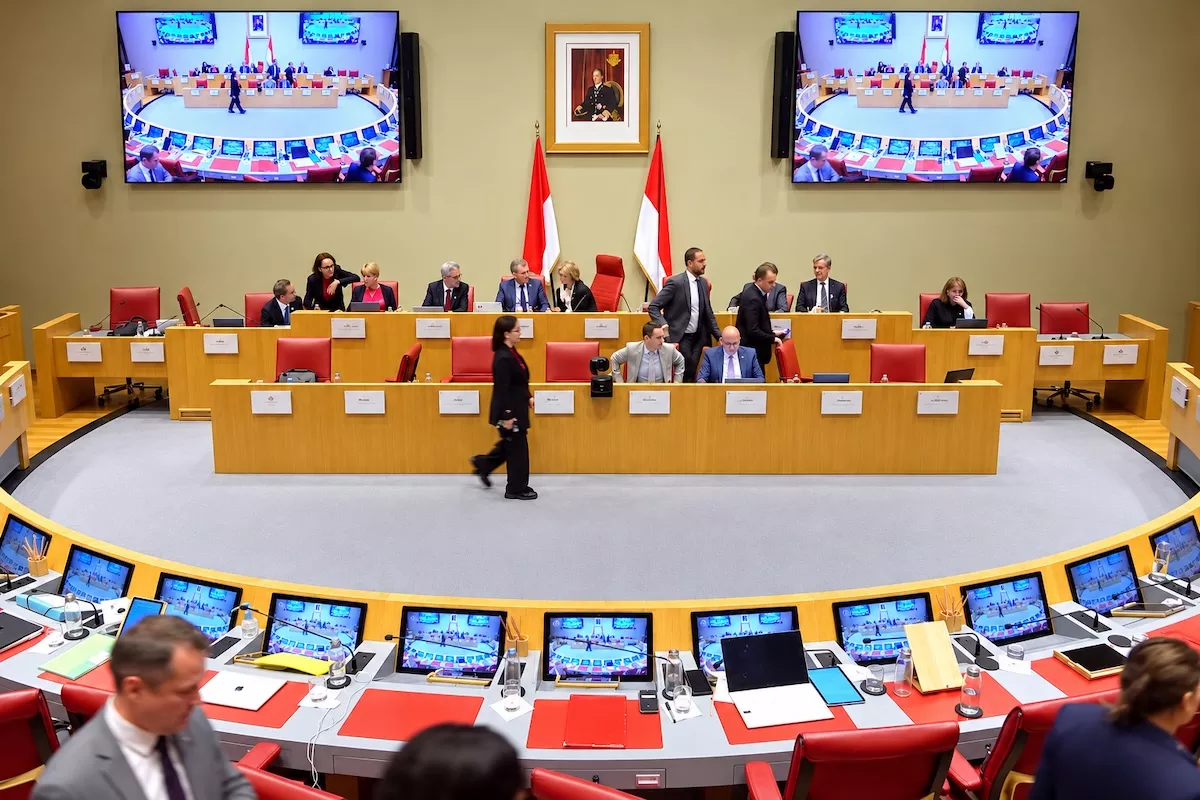
Monaco’s National Council has suspended debate on the 2026 revised budget following a sharp confrontation with the Government over housing, employment opportunities for Monegasque citizens and the Assembly’s constitutional role. The unusually tense exchange exposed deep disagreements between the two institutions, with elected representatives accusing the Minister of State of dismissing legitimate concerns raised on behalf of the Monegasque population.
The confrontation unfolded on Wednesday 7th October during the opening debate on Monaco’s 2026 revised budget. Following the Government’s response to the report by the Finance and National Economy Committee, National Council President Thomas Brezzo suspended the public sitting before bringing it to a close.
In a strongly worded statement issued afterwards, the National Council said Minister of State Christophe Mirmand’s response had significantly damaged relations between the Government and the elected Assembly, both in its substance and tone.
At the centre of the dispute are two longstanding priorities for elected representatives: protecting employment opportunities for Monegasque nationals and accelerating the construction of state-owned housing.
A constitutional disagreement
The dispute began with the Minister of State’s opening remarks, in which he reminded elected representatives that the Government derives its strategic priorities, and the confidence to carry them out, from Prince Albert II alone.
The Assembly rejected what it considered an overly restrictive interpretation of its constitutional role.
While acknowledging that it does not exercise direct oversight of government action in the conventional parliamentary sense, the National Council insisted that it remains the Government’s institutional partner in implementing public policy through its vote on the budget.
The Council invoked Article 66 of Monaco’s Constitution, under which legislation requires ‘the agreement of the wills’ of the Prince and the National Council. It also recalled Prince Albert II’s description in 2006 of the relationship between the two institutions as one of cooperation rather than confrontation.
The Council said it had no intention of assuming the Government’s responsibilities but would not accept being reduced to what it described as a mere recording chamber for executive decisions.
National priority becomes a flashpoint
One of the principal disagreements concerns the application of Monaco’s constitutional principle of national priority, particularly in public-sector recruitment.
The National Council has been pressing for greater transparency in recruitment procedures, including the creation of joint commissions and the publication of recruitment notices for senior positions when no suitable Monegasque candidate has been identified.
It argues that these measures would not impose additional costs on the State or involve elected representatives in the direct management of public services.
In his address, however, the Minister of State defended the Government’s recruitment procedures and rejected the proposed involvement of a joint commission, arguing that the constitutional separation of powers prevents the National Council from participating in the recruitment of civil servants.
He also disputed concerns over unsuccessful Monegasque applications, explaining that 50 applications cited for 2025 involved 31 individuals, several of whom had applied more than once. Of those 31, he said, 16 had subsequently joined the civil service and one had entered municipal employment.
The Minister added that Monegasque nationals account for 24% of Government administration employees but occupy 79% of senior positions.
The Government did, however, express openness to introducing a dialogue process for unsuccessful Monegasque candidates, allowing them to receive explanations about recruitment decisions.
For the National Council, these concessions do not go far enough. It described the Government’s categorical rejection of its proposals as incomprehensible and maintained that Monegasque citizens must receive priority in accessing employment in their own country.
Housing targets expose a widening divide
The second major point of contention concerns the pace of construction of state-owned housing for Monegasque families.
The National Council reiterated its demand for approximately 100 new state-owned apartments to be delivered annually, arguing that the target reflects decades of experience with housing shortages in the Principality.
Elected representatives pointed to the situation in 2018, when they challenged the Government’s reliance on statistical projections that they believed underestimated actual housing demand. Those discussions preceded Prince Albert II’s announcement of the National Housing Plan in March 2019.
Seven years later, the Council warned that the Government was returning to the same approach, with projections suggesting that approximately 40 new apartments per year would be sufficient.
The Government strongly defended its calculations.
According to the Minister of State, Monaco’s statistical agency IMSEE estimates that the Monegasque population has grown by an average of 93 people annually between 2015 and 2024, equivalent to approximately 50 new households each year.
On that basis, the Government argues that constructing 40 new apartments annually would be sufficient to accommodate 80% of Monegasque nationals in state-owned housing.
The Minister also outlined the current construction programme, including 352 apartments planned for delivery during the present five-year period and a further 144 to 158 apartments scheduled between 2030 and 2034.
However, he acknowledged that no newly built state-owned apartments are scheduled to be allocated during 2026 or 2027, with the first tower of the Bel Air development expected to be delivered in January 2028.
To address the immediate shortage, the Government plans to accelerate renovations of existing apartments, potentially making approximately 90 homes available at the next allocation commission and another 50 during a second commission in 2027.
The National Council nevertheless maintained that the proposed pace of new construction falls short of what Monegasque families need.
Government defends its €2.1 billion budget
Beyond the institutional confrontation, the Minister of State defended the Government’s wider financial management.
The revised 2026 budget anticipates a 3% increase in ordinary expenditure and a 3% reduction in revenue compared with initial estimates, reflecting higher operating costs and the decline of exceptional receipts associated with the Mareterra development.
Despite these adjustments, the Government expects to maintain a budget surplus of €5.9 million.
The Minister pointed to Monaco’s approximately €2.1 billion budget, its absence of public borrowing and its lack of personal income tax as evidence of the Principality’s continuing financial strength.
He also outlined progress on several major projects, including the restructuring of the Fontvieille shopping centre, additional rail capacity between Nice and Monaco, and the planned merger of Monaco Info and TV Monaco – with a broad outline due by the end of 2026.
However, these announcements were overshadowed by the disagreement over the Government’s relationship with the National Council.
Budget proceedings halted
In explaining the decision to suspend proceedings, the National Council cited the Minister of State’s refusal to reconsider his positions on essential issues and what it described as Government inaction on major concerns.
President Thomas Brezzo first suspended and then closed the public sitting.
The Council said the decision was intended to ensure that the legitimate demands of Monegasque citizens were properly considered by the Minister of State.
Monaco Life is written by qualified journalists, writing original content. Sign up for our free newsletter, listen to our podcasts on Spotify, and follow us across Facebook, Instagram, LinkedIn, and Tik Tok.
Photo taken from video of the National Council debate on 7th October