

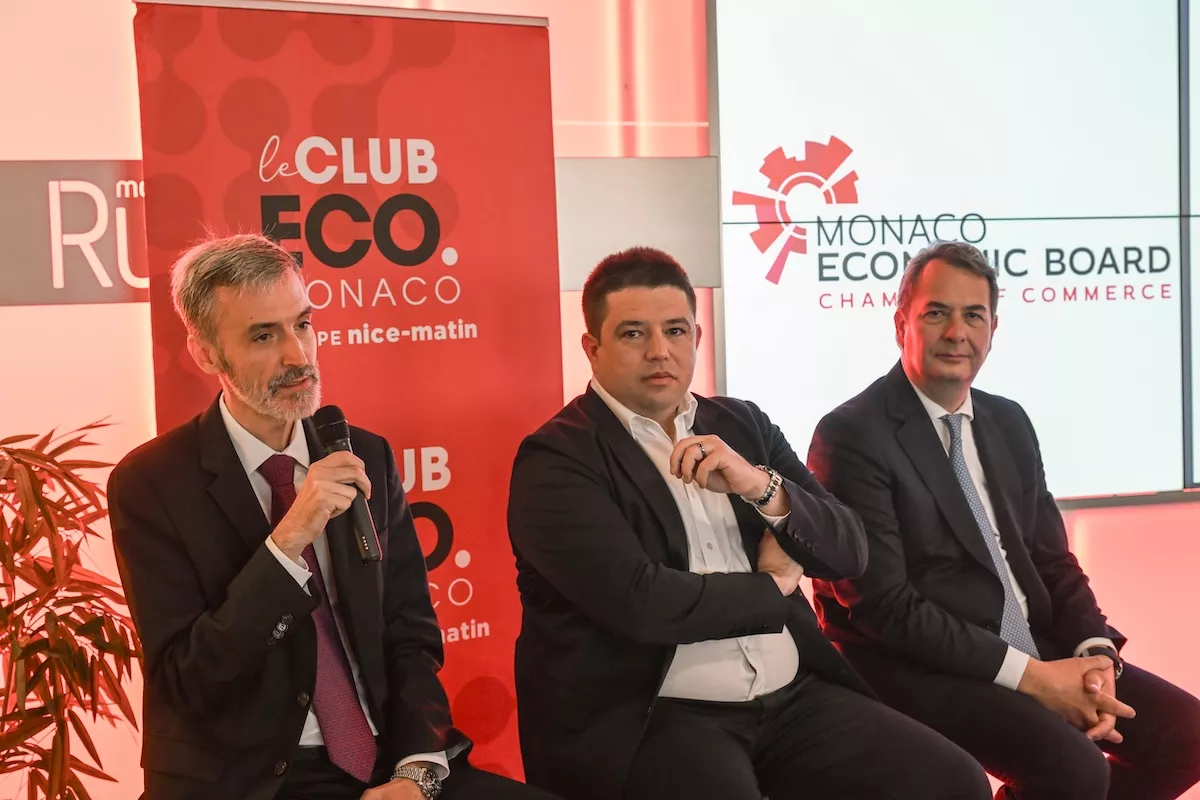
As the Principality continues its journey to exit the Financial Action Task Force (FATF) grey list, the stakes remain high, but the outlook is increasingly positive. On Friday 22nd May, a Club Eco Monaco conference, organised jointly by the Monaco Economic Board (MEB) and the Nice-Matin Group, provided a frank and pedagogical exploration of Monaco’s current ‘enhanced monitoring’ status.
The event sought to move beyond the speculation surrounding this sensitive topic, instead offering a clear-eyed view of the risks, prospects, and strategic opportunities facing the Principality.
A panel of key decision-makers was convened to demystify the process, including Frédéric Cottalorda, Government Counsellor and Minister for Finance and the Economy; Frédéric Chartier, Executive Co-ordinator of the Steering and Monitoring Committee for the national strategy to combat money laundering, terrorist financing, proliferation of weapons of mass destruction, and corruption; and Olivier Pagès, Chief Operating Officer of CMB Monaco.
A record of compliance
Frédéric Chartier opened the discussion by framing the Principality’s compliance efforts as a long-term strategic commitment rather than a temporary hurdle. He noted that Monaco is already seeing the fruits of this intense labour.
“Today, out of 40 technical compliance criteria, Monaco has achieved a score of 39 out of 40,” Mr Chartier reported.
These results are the culmination of a rigorous overhaul of the Principality’s financial security framework, requiring increased human and technical resources and deepened international cooperation. Of the 10 primary improvement measures mandated under the FATF timetable, the majority are complete, with administrative and criminal sanctions currently being finalised to align with the compliance process.
Legal and banking sector transformation
For the Government and the National Council, the strategy has been one of intensive legislative collaboration. Cottalorda confirmed that the Principality has tangible progress to report, particularly regarding the rise in convictions for financial crimes—a development that serves as clear evidence of the new legal framework in action.
This systemic upgrade has required a profound transformation within the banking sector. Olivier Pagès of CMB Monaco acknowledged the difficulties of this transition, noting that clients accustomed to high levels of fluidity have faced an increase in requests for justification.
However, the banker emphasised that these constraints have driven necessary innovation. By deploying substantial human and technological investment—including the use of artificial intelligence—the sector has modernised its processes to meet demanding European standards.
“The upgrade has also allowed us to identify projects or needs that would not have been recognised without it,” Pagès said, highlighting that the rigorous new standards have inadvertently sharpened the sector’s operational capabilities.
An asset for the future
Despite the challenges, the overarching sentiment from the panel was one of measured optimism. Cottalorda suggested that once the Principality successfully exits the grey list, the ordeal will have left Monaco with a renewed competitive advantage.
“Compliance has become one of the factors that financiers and international organisations consider when investing in a country,” he explained. “We will ultimately be able to add an extra asset to our toolkit to promote the Principality more effectively abroad.”
Stay updated with Monaco Life: sign up for our free newsletter, listen to our podcasts on Spotify, and follow us across Facebook, Instagram, LinkedIn, and Tik Tok.
Main photo from left to right Frédéric Cottalorda, Olivier Pagès, Frédéric Chartier during the Club Eco Monaco conference