

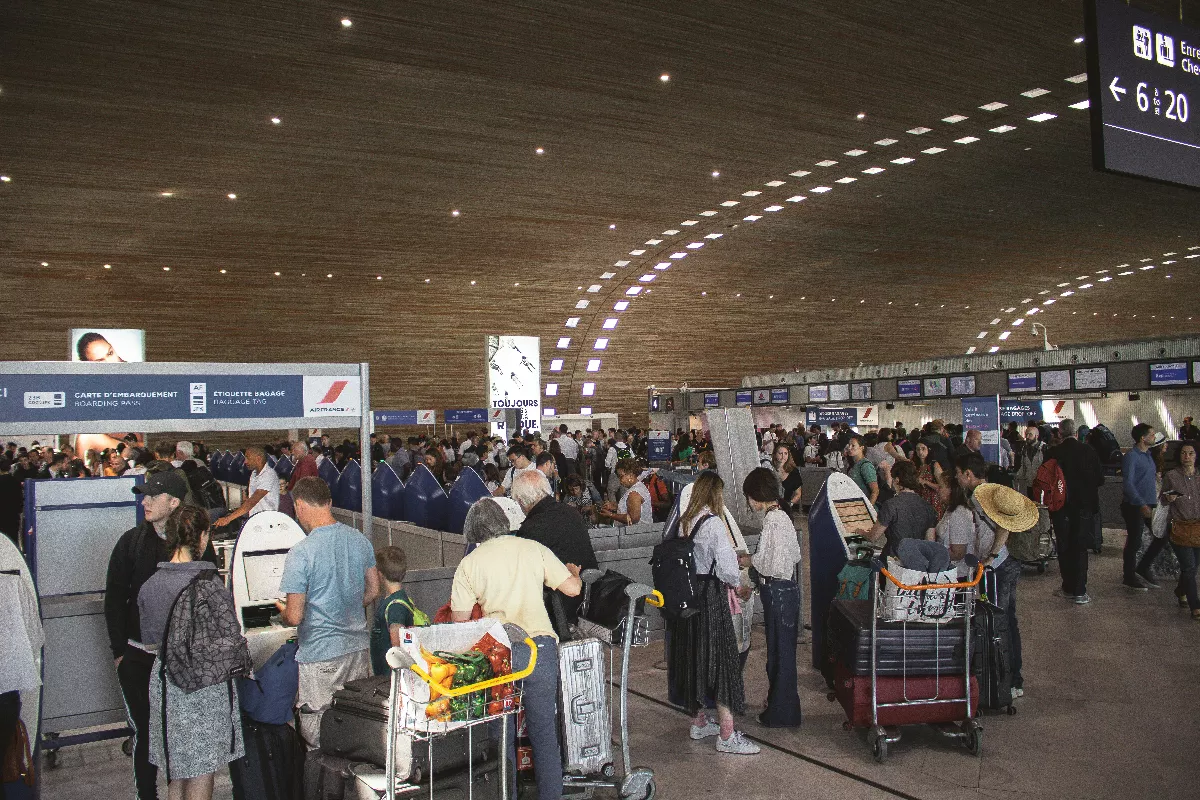
Travellers flying through Paris this summer could face extremely long queues at passport control, as the operator of Charles de Gaulle and Orly airports warns that Europe’s new biometric border system is not ready for peak season.
Paris Aéroports (Group ADP) has formally asked for the complete deployment of the Entry/Exit System (EES) to be pushed back to autumn 2026, warning that a summer launch would be “extremely risky”.
Their predictions suggest queues of between four and six hours at peak times if the system runs at full capacity during July and August.
What is the EES?
The EES is set to replace the old passport stamp with automated biometric checks like fingerprints and facial scans for all non-EU nationals crossing the Schengen zone. That means British, American, Canadian and Australian travellers, among others, will be registered each time they enter or exit Europe.
The system has been rolling out in stages since October 2025 and is due to be fully active across Schengen from 10th April 2026.
The reason behind the concern
Border processing times have risen by 70% at airports where EES is already operating, according to ACI Europe. Queues of two to three hours have already been reported at Amsterdam Schiphol and Frankfurt during busy periods, and in Lisbon wait times reached seven hours before authorities suspended the system for three months.
Those figures are all the more alarming given the system was operating at just 10% of its eventual capacity when they were recorded.
In a joint letter to EU Commissioner for Internal Affairs Magnus Brunner in February, ACI Europe, Airlines for Europe and IATA warned that unless immediate action is taken, the peak summer months could see queues of four hours or more.
The three organisations said that there was “a complete disconnect between the perception of the EU institutions that EES is working well, and the reality, which is that non-EU travellers are experiencing massive delays and inconvenience.”
Why the system is struggling
ACI Europe, Airlines for Europe and IATA have identified three issues: chronic understaffing at border control, unresolved technology issues particularly around border automation, and very limited uptake of the Frontex pre-registration app among Schengen states.
Furthermore, regular system breakdowns have further undermined the reliability of operations at many airports.
Charles de Gaulle handled more than 7.1 million passengers in July 2025 alone. ADP says the testing carried out so far bears no relation to those kinds of volumes.
What Brussels has allowed
The European Commission moved in early February to give member states some flexibility. After 10th April, countries will be able to partially suspend EES for 90 days, with a possible 60-day extension.
However, ACI Europe, Airlines for Europe and IATA warned that suspension mechanisms may no longer be available after early July, and urged the Commission to confirm that flexibility would reman in place until the end of October 2026.
What travellers should do
Non-EU passengers through Charles de Gaulle and Orly this summer should allow at least three and a half hours before an international departure and a minimum of three hours for any connecting flight involving a non-Schengen route.
Self-service pre-registration kiosks are available at both airports before the passport queue and are free to use.
Meanwhile, flights within the Schengen area are not affected. Regional airports such as Nice, Lyon and Marseille are likely to see less disruption than those in Paris.
Stay updated with Monaco Life: sign up for our free newsletter, catch our podcast on Spotify, and follow us across Facebook, Instagram, LinkedIn, and Tik Tok.
Main photo credit: Connor Danylenko, Pexels.