

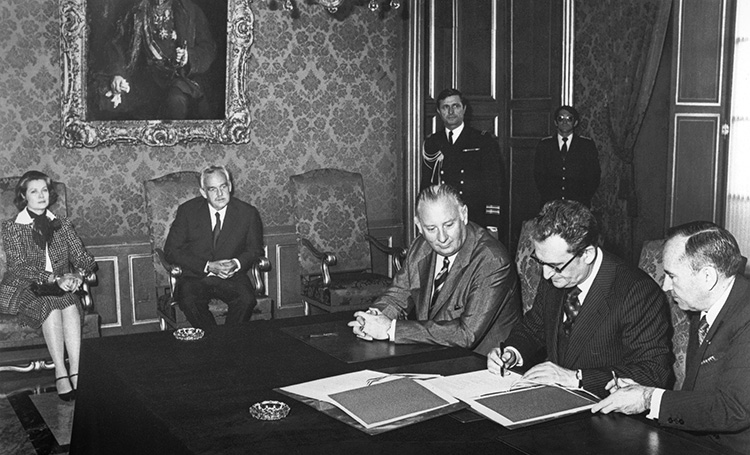
The Ramoge Agreement turns 50 this year, and the anniversary of one of the Mediterranean’s most enduring environmental partnerships will be marked by a programme of scientific, institutional and public events running across Monaco, France and Italy throughout 2026.
The accord takes its name from the initials of the three points that originally defined its zone of operation — Saint-Raphaël, Monaco and Genoa — though its reach has since extended from Marseille to La Spezia. It was signed on 10th May 1976 in the throne room of the Prince’s Palace, in the presence of Prince Rainier III and Princess Grace, born out of a call Rainier had made six years earlier at a plenary assembly in Rome, where he urged France, Italy and Monaco to act collectively to protect their shared sea. At the time, Jacques-Yves Cousteau was serving as secretary general of the Commission Internationale pour l’Exploration Scientifique de la Méditerranée, where Rainier himself presided. “The Mediterranean’s coastal states must wait no longer,” Rainier declared. “They must act to safeguard their sea.”
The Ramoge Agreement became the first concrete regional accord for the protection of the Mediterranean, translating into action the commitments made by coastal nations at the Barcelona Convention.
Five decades of action
In its early years, the accord relied on Prince Rainier’s own vessel — converted into a floating laboratory in 1975 and entrusted to the Centre Scientifique de Monaco — to run the first sea campaigns, analysing water quality and identifying pollution sources between Antibes and Bordighera. Water treatment plants were built in the Ramoge zone in the 1980s as a direct result of those findings.
The agreement’s most operationally significant moment came in 1991, when the oil tanker Haven exploded off Genoa in the worst oil spill the Mediterranean has ever seen, carrying 144,000 tonnes of hydrocarbons. The disaster prompted Ramoge to create the Ramogepol plan in 1993 — a shared anti-pollution response mechanism — which has since been activated three times, most recently in 2018 when a collision between the Ulysse and the Virginia off Cap Corse allowed 90% of spilled hydrocarbons to be recovered.
Over five decades, the accord has collected more than 600 tonnes of marine debris — the equivalent of 50 refuse lorries — from 20-plus sampling sites, conducted three deep-sea exploration campaigns across 18 sites using remotely operated vehicles, identified 67 zones of ecological or biological interest covering 3,060 square kilometres, and contributed to the creation or extension of five marine protected areas. More than 40 technical documents, maps and educational tools have been published.
What 2026 holds
The anniversary year opened in March with the launch of the international photography competition Ramoge — L’Homme et la Mer, open until 31st October and under the auspices of the FIAP, in collaboration with the Académie d’Art Photographique de Monte-Carlo.
The centrepiece of the celebrations falls on 26th June in Monaco, when representatives of the three states will gather at the Prince’s Palace for an institutional ceremony, followed by the inauguration of a commemorative exhibition at the Ministry of State — produced in collaboration with the Monaco National Archives and the Palace Archives — and a live Ramogepol anti-pollution exercise at sea. The day closes with a public conference at the Musée Océanographique and a virtual reality experience taking audiences into the deep-sea canyons of the Ramoge zone. A commemorative postage stamp will be cancelled by Prince Albert II.
A travelling version of the exhibition opens at the Gare Maritime in Genoa on 28th May and moves to France in September, likely to Marseille. A deep-sea exploration campaign aboard the research vessel Alfred Merlin, operated by the French Ministry of Culture’s underwater archaeology department, is planned for late July, probing ecosystems down to 500 metres in French, Italian and Monegasque waters. Previous campaigns have found evidence of significant human impact at depths exceeding 2,000 metres, including waste accumulation in the Monaco Canyon.
In September, a workshop dedicated to Posidonia oceanica — the endemic Mediterranean seagrass that covers close to 50% of coastal seabeds, produces oxygen and protects coastlines from erosion, yet loses around 2% of its surface area each year to anchoring — will present an updated guide to its preservation, twenty years after the last edition. The year closes on 4 December with the photography competition awards ceremony in Monaco.
Stay updated with Monaco Life: sign up for our free newsletter, catch our podcast on Spotify, and follow us across Facebook, Instagram, LinkedIn, and Tik Tok.
Photo source: RAMOGE