

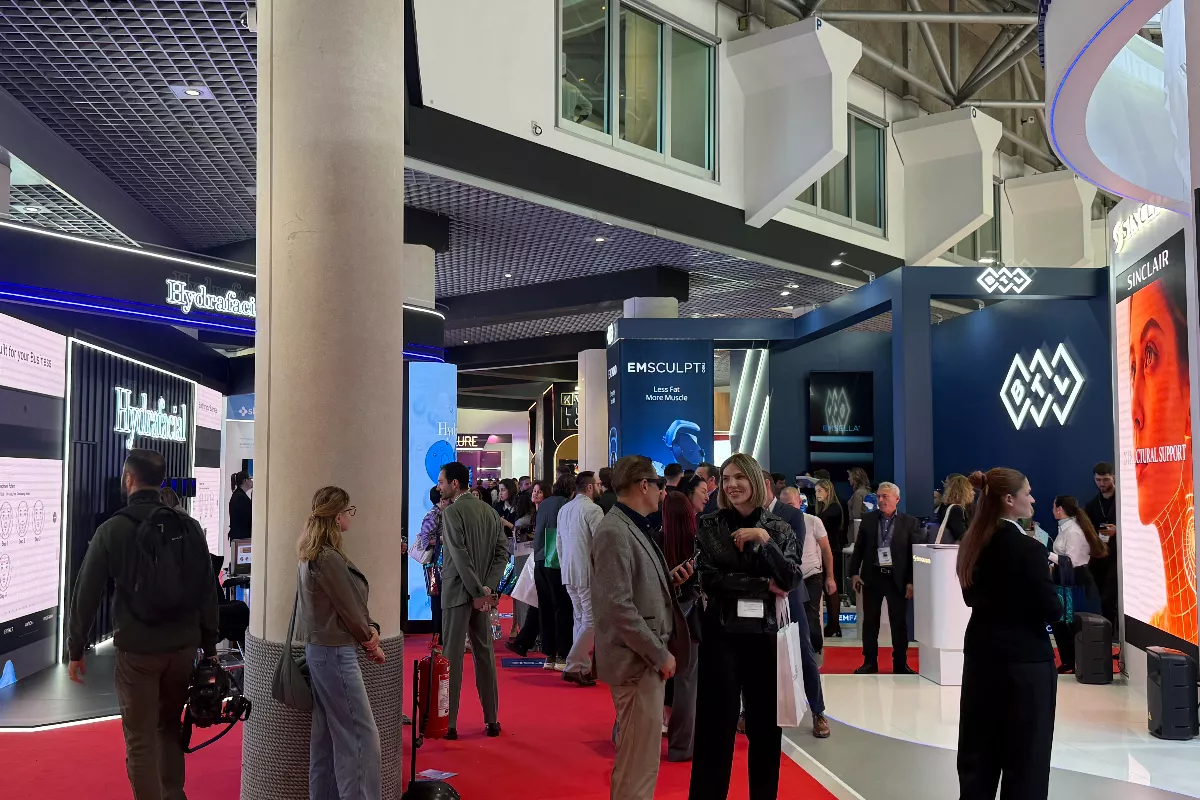
Thousands of doctors, industry professionals and visitors descended on the Grimaldi Forum in Monaco for the Aesthetic and Anti-Ageing Medicine World Congress – better known as AMWC – running from 26th to 28th March.
Every parking space in the district was taken. Queues of attendees lined the entrance. Inside, 18,000 delegates from 140 countries moved between a thousand brand stands and 12 conference rooms running back-to-back sessions on everything from GLP-1 weight treatments to AI-powered facial analysis.
However, while the congress celebrated that wanting to look better, live longer and feel good in your skin is legitimate, even admirable, it also made clear there are limits – and knowing where they lie matters.
And so, amid the industry optimism, one voice cut through with a different message.
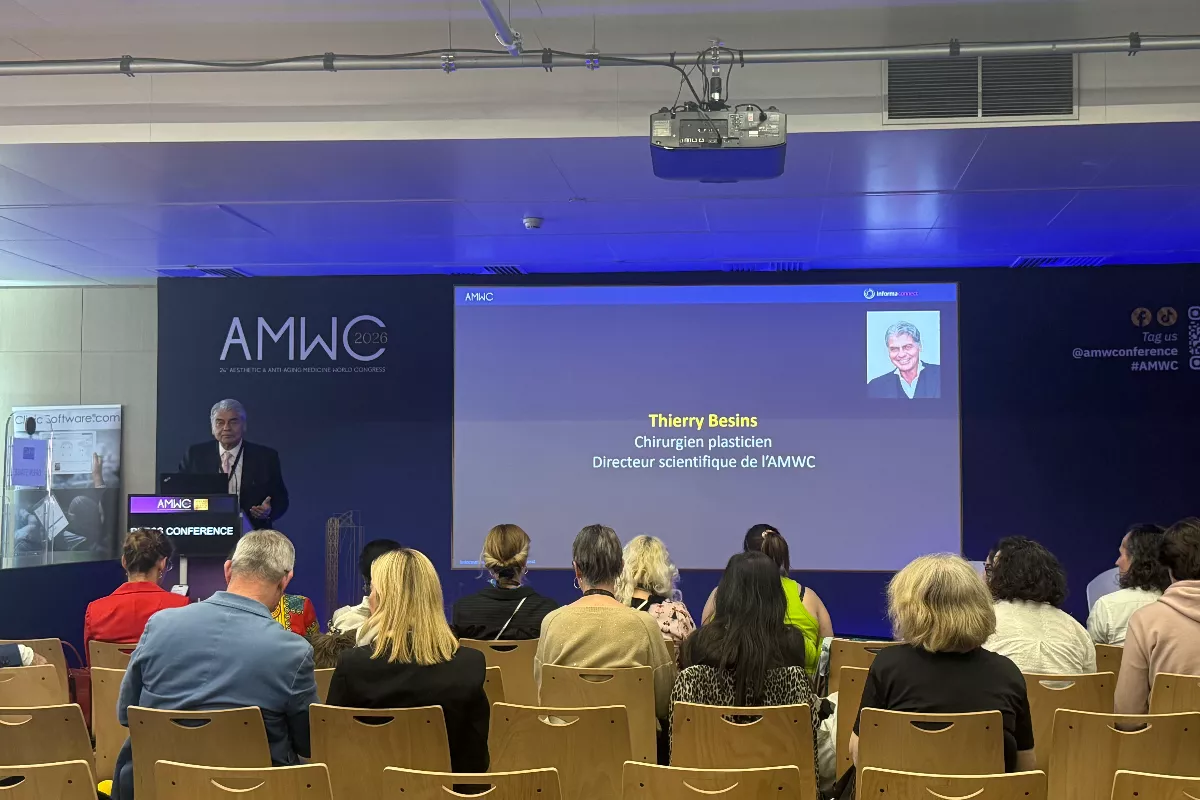
Câline Majdalani, clinical psychologist and author of ‘Treating Body Dysmorphic Disorder – The Appearance Obsession’, took to the stage not only to celebrate the industry’s advances, but to issue a warning…about its darkest corners.
Body Dysmorphic Disorder (BDD) is an obsessive compulsive disorder in which sufferers become consumed by perceived physical flaws that others either don’t notice or consider entirely trivial.
It affects around two per cent of the general population, a figure Majdalani described as alarming. “Two per cent in psychiatry is enormous,” she said. “That’s tens of millions of people worldwide.” The numbers, she added, are rising sharply, and almost certainly undercounted, because patients are too ashamed to disclose it.
The link to social media is, in her view, direct and devastating. “Social media is today the reference for young people,” she said speaking to Monaco Life in an exclusive interview. “These altered and filtered images create a kind of allergy to imperfection. When you see something normal – a line, a texture on your face – you feel it’s unbearable and you want to change it.”
She cited research showing that even brief exposure to images only slightly more attractive than one’s own reality is enough to reduce self-satisfaction, a mechanism social media exploits relentlessly and at scale. The more you scroll, she argued, the worse you feel.
A disorder with deadly consequences
The consequences reach far beyond dissatisfaction. BDD has one of the highest suicide rates of any psychiatric disorder. “It is the highest suicidal risk in psychiatry,” Majdalani said.
What makes this directly relevant at an aesthetic congress is where these patients end up. More than 70 per cent of BDD sufferers seek cosmetic procedures, not to enhance their appearance, but, as Majdalani put it, “to repair themselves from inside.” The treatments bring no lasting relief. Additionally, many gravitate towards unqualified injectors and low-cost procedures, fully aware of the risks but too distressed to care.
On the other hand, the thousands who filled the Grimaldi Forum are testament to a discipline that has become, as congress co-founder Catherine Decuyper put it, “a major pillar of modern medicine.” Wanting to correct an imperfection, protect your skin, or add years of vitality to your life is not vanity. It is, increasingly, simply good medicine.
But medicine has limits. And Majdalani’s warning was ultimately about dosage. “It’s about how much you emotionally invest your time and energy in your beauty,” she said. “You cannot invest everything in a single dimension of your identity.” When aspiration tips into obsession, when the consultation room becomes a substitute for the therapist’s couch, the industry has a responsibility to recognise the difference.
To conclude, she drew a sharp distinction between legitimate aesthetic aspiration and something altogether different: “There is a difference between improving your appearance and a chronic dissatisfaction, where suffering speaks the language of appearance rather than expressing itself directly.”
Stay updated with Monaco Life: sign up for our free newsletter, catch our podcast on Spotify, and follow us across Facebook, Instagram, LinkedIn, and Tik Tok.
Main photo credit: Monaco Life