


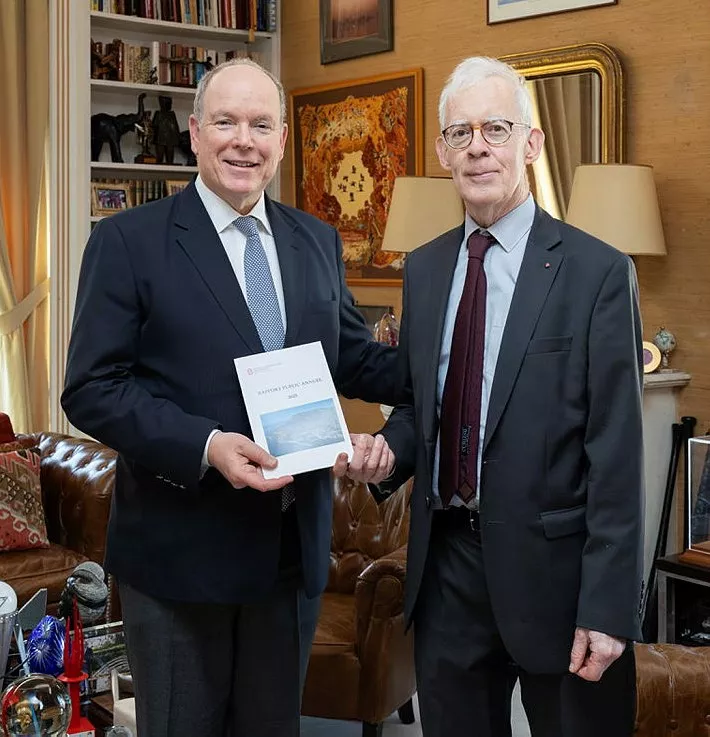
Monaco’s financial and insurance sector has become an increasingly central driver of the Principality’s corporate tax revenues, according to the 2025 Annual Public Report of the Commission Supérieure des Comptes, presented to Prince Albert II on 16 March 2026.
The report, covering the state’s budgetary and financial management for the 2024 fiscal year, shows that corporate tax receipts — known as bénéfices commerciaux — reached €334.4 million, a rise of 43.7% on the previous year and a level not seen in a decade. The financial and insurance sector accounted for close to 65% of that total, up from 55% the year before. The fifteen largest corporate taxpayers alone contributed €194.5 million, an increase of €68.8 million.
The finding points to a potential shift in Monaco’s fiscal structure. While the Principality has long relied on VAT as its primary source of revenue — it still represents 51.5% of total state receipts — the growing weight of financial sector profits is reshaping the tax base in ways the report’s authors treat with some caution.
A record surplus built on evolving revenue drivers
The 2024 budget closed with a surplus of €192.7 million on the general budget, and €310.3 million across all state operations including special treasury accounts — the strongest result in recent years. Revenues grew by 5.8% to €2.3 billion, driven by VAT receipts of €1.2 billion and the surge in corporate tax.
However, the report notes that recent years benefited from exceptional revenues linked to the Mareterra land reclamation project, which generated significant VAT income from real estate transactions. In 2024, VAT from property transactions fell by €86.4 million as these revenues wound down, marking the end of a particularly strong cycle of real estate-driven receipts.
VAT holds steady, customs duties fall
Beyond corporate tax, the broader tax picture is mixed. Total VAT receipts, which include both domestic collections and Monaco’s share from France under the bilateral fiscal convention, edged down by 1.3%, though non-property VAT grew by 7.6%, reflecting continued economic activity in sectors including temporary employment services, construction and retail.
Customs duties fell 14.3%, partly due to changes in collection arrangements with French authorities.
Legal transaction revenues — covering property transfer duties and other civil acts — rose 7.1% to €249 million, though property transfer duties themselves fell by 6.9% as the volume of high-value transactions declined.
Expenditure rising, retirement costs flagged
On the spending side, ordinary expenditure reached €1.26 billion, up 4.9%. Personnel costs grew by 5.2% to €412.4 million, with government headcount rising by 46 to reach 3,923.
The Commission notes that more than one in two civil servants benefited from an individual advancement measure in 2024, and raises concerns about the long-term cost trajectory of the public sector pension system.
Early retirement remains common among Monégasque civil servants, with 60% of those who retired in 2024 doing so before the standard age of 65, at an average age of 57. The report highlights that pension costs are largely financed by the state budget, with employee contributions covering only a limited share of total expenditure.
The Commission reiterates its call for further analysis of the system’s long-term sustainability.
Commission’s broader warnings
The report, compiled by the Commission Supérieure des Comptes under President Christian Descheemaeker and presented to the Sovereign Prince on 16th March, covers not only public finances but also audits of Monaco’s public car parks, the National Housing Plan for Monégasques, the new Princess Grace Hospital Centre and the Office de Protection Sociale.
See also:
Monaco’s outstanding tax bill hits €291 million, figures reveal
Stay updated with Monaco Life: sign up for our free newsletter, catch our podcast on Spotify, and follow us across Facebook, Instagram, LinkedIn, and Tik Tok.
Main photo credit: Cassandra Tanti