

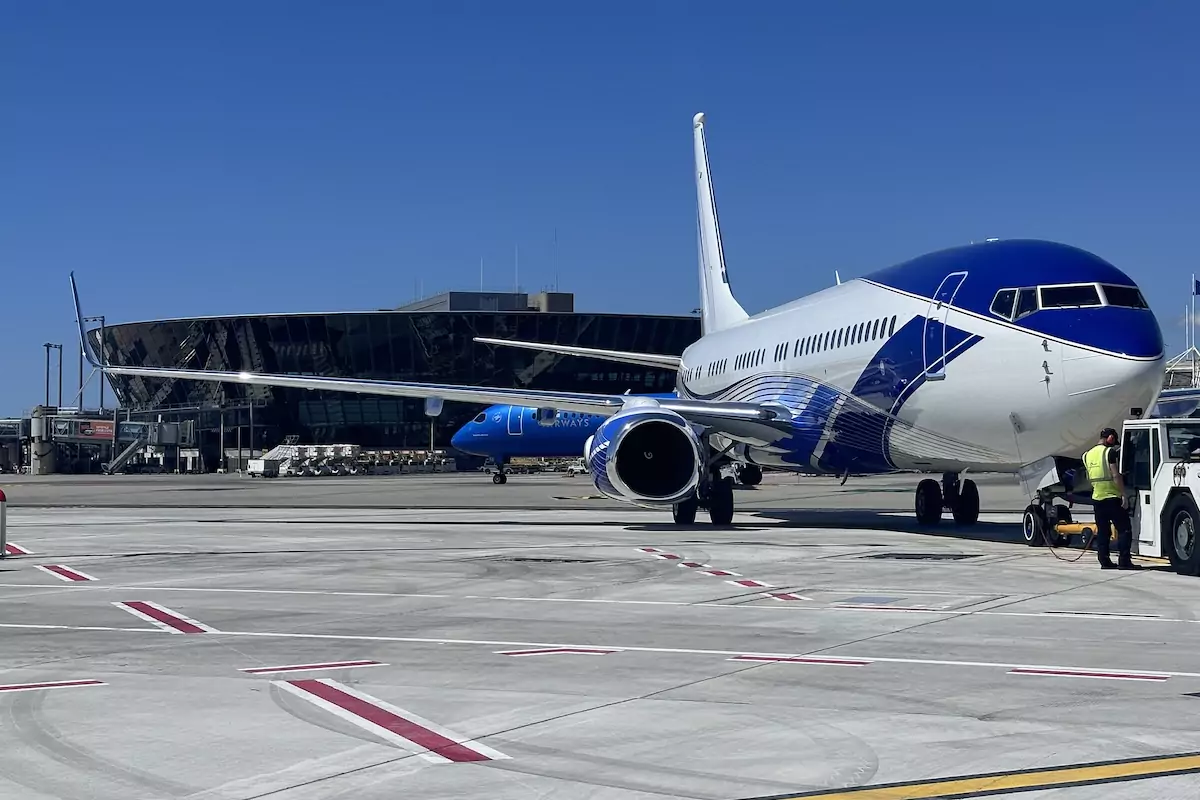
The French Riviera is preparing to build the fuelling infrastructure for a new generation of zero-emission business jets, in one of the first concrete moves to ready an airport network for hydrogen-powered flight.
The plan comes under a partnership, announced on 3rd September, between the French aircraft developer Beyond Aero and Aéroports de la Côte d’Azur, Europe’s second-largest airport operator for business aviation, which runs Nice Côte d’Azur, Cannes-Mandelieu and Golfe de Saint-Tropez. After nearly three years working together, the two are now mapping out a phased rollout of hydrogen infrastructure timed to the first aircraft expected in the early 2030s.
Why business aviation goes first
There is a logic to starting here. Private aviation is among the most carbon-intensive ways to travel — by Beyond Aero’s reckoning it produces roughly ten times more CO2 per passenger than a commercial flight — which makes it an obvious target for cleaning up. It is also, counter-intuitively, a sensible place to begin: the volumes are small next to commercial aviation, so the fuelling infrastructure can be modest, targeted and scaled gradually, rather than the vast build-out an airline fleet would demand.
A jet that emits only water
Toulouse-based Beyond Aero, founded in 2020, is developing ‘One’, a six-to-eight-seat aircraft whose electric propulsion is driven by hydrogen fuel cells — a design that emits only water vapour in flight. The company says it has completed France’s first crewed hydrogen-electric flight and gathered more than $900 million in letters of intent for over 100 aircraft. If it meets its timeline, ‘One’ would be among the first hydrogen-electric business jets to enter service, in a category so new that European regulators are still writing the rules for it.
The infrastructure problem
The harder half of the equation is on the ground. A hydrogen aircraft is useless without somewhere to refuel, yet few will build fuelling stations before the aircraft exist — a chicken-and-egg problem that has slowed cleaner aviation for years. The Riviera partnership is an attempt to develop both in step, working through how hydrogen would be sourced, stored, distributed and pumped into aircraft, and what it would cost.
“Infrastructure preparation must keep pace with aircraft development,” said Eloa Guillotin, co-founder and CEO of Beyond Aero. “Working with Aéroports de la Côte d’Azur, we are basing our plans on concrete scenarios tailored to business aircraft volumes and utilising currently available technologies. This phased approach is essential to ensure safe, realistic operations from the moment the first aircraft enter service.”
A pragmatic first step
The preferred approach relies on compressed gaseous hydrogen, using technology already available at industrial scale. It would be produced off-site near the airports and trucked in by tube trailer to a distribution station — supply that could also feed other regional needs and help seed a local hydrogen ecosystem. Two refuelling methods are under study: a fixed point beside a dedicated parking area, and a mobile vehicle to transfer hydrogen to the aircraft, both meant to hold down early costs while capacity grows. Cannes-Mandelieu, a busy business-aviation hub, has emerged as the likeliest first site.
“Our role is to anticipate the needs of future operators while ensuring the safety, performance, and cost-efficiency of our infrastructure,” said Franck Goldnadel, Chairman of the Executive Board of Aéroports de la Côte d’Azur. “This partnership enables us to translate our environmental ambitions into concrete, phased operational solutions.”
Monaco Life is written by qualified journalists, writing original content. Sign up for our free newsletter, listen to our podcasts on Spotify, and follow us across Facebook, Instagram, LinkedIn, and Tik Tok.
Photo credit: Cassandra Tanti