

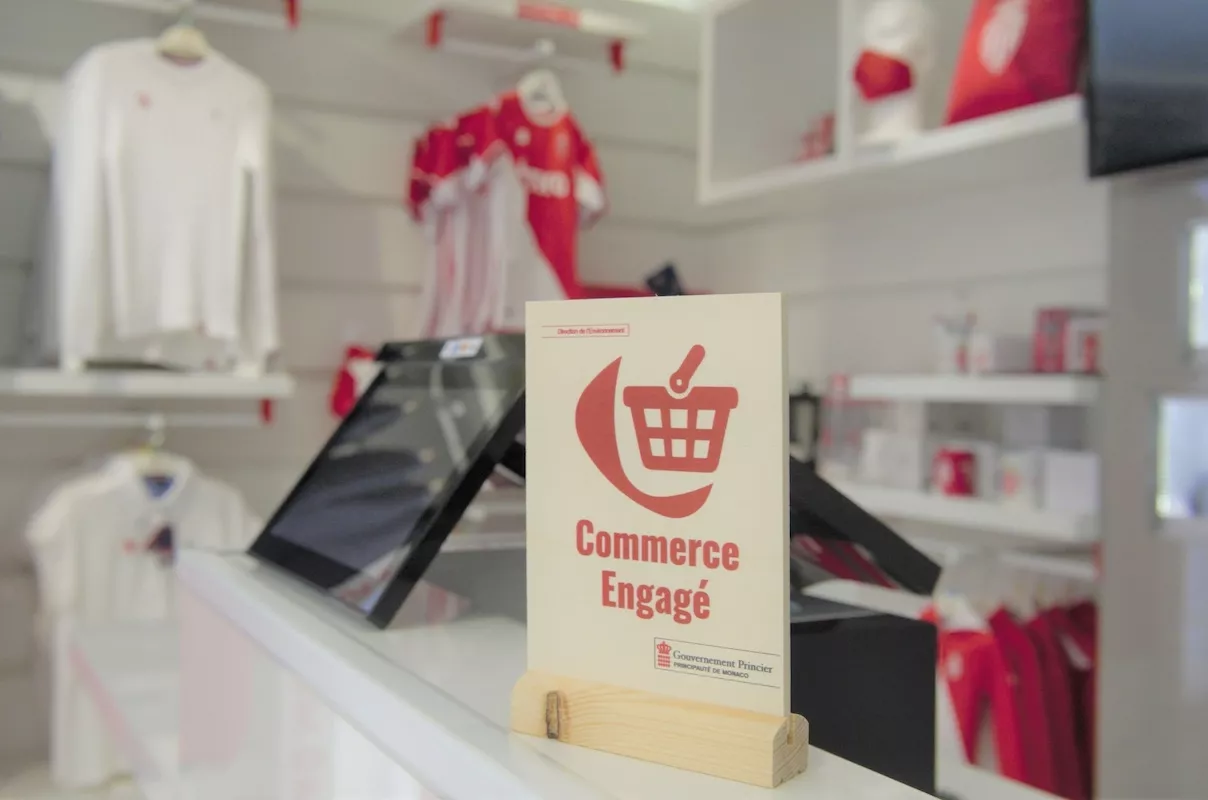
Ten years after Monaco created a label to steer its shops and restaurants away from single-use plastic, more than nine in ten of the merchants who have signed up say they have stopped handing out plastic bags altogether, one marker of a decade-long shift in the everyday habits of the Principality’s businesses.
The Commerce Engagé label, and its later counterpart for the restaurant trade, Restaurant Engagé, are run by Monaco’s Direction de l’Environnement alongside the French association Ecoscience Provence, which originally devised the scheme. The anniversary is being marked with an exhibition at the Galerie des Pêcheurs, running until 31st August, that traces the programme’s progress towards the target set by Prince Albert II of zero single-use plastic by 2030.
From a plastic-bag study to a ban
The starting point was a 2014 study, commissioned from Ecoscience Provence, into the plastic bags Monaco’s traders were handing out. It set out some stark context: roughly three-quarters of marine litter is plastic, and a single plastic bag takes around 450 years to break down. Of the 150 Monegasque businesses surveyed, most said they were ready to act, with the great majority already worried about the environment and convinced their customers felt the same.
That groundwork fed into an international conference on Mediterranean plastic pollution, held at the Yacht Club de Monaco in 2015, where the Prince announced that single-use plastic bags would soon be banned. The ban took effect on 1st June 2016, and the Direction de l’Environnement handed a reusable organic-cotton bag to every Monegasque household, some 22,000 in all, along with a guide to the new rules. The label itself was created the same year, with the first businesses signing up in 2017, among them Cornerstore on place de la Mairie, the Principality’s first Commerce Engagé.
What businesses sign up to
The label is built around four commitments: offering alternatives to disposable bags, reducing waste, improving practices over time, and communicating the changes to customers. In 2019, a dedicated Restaurant Engagé label was added for the food trade, tailored to its particular pressures around food waste, disposable tableware and used cooking oil.
The scheme has advanced in step with a steadily tightening set of regulations. Plastic straws were banned from January 2019, making Monaco one of the first states in the world to do so, followed by disposable plastic cups, plates and cutlery. From 1st September 2026, disposable plastic boxes, trays and salad bowls for ready-to-eat food, whether eaten in or taken away, join the list, with a new fact sheet issued to help businesses adapt.
What it has meant in practical terms
The clearest gains show up in the bins and at the till. According to the programme’s own 2025 assessment, 94% of member merchants have completely done away with plastic bags, and 80% of their waste is now sorted, up from 60% in 2020. Among member restaurants, 96% offer an alternative to disposable tableware. A separate study carried out with the electricity and gas utility SMEG found that power use in labelled restaurants fell by 7% across 2024 and 2025, at a time when consumption across restaurants generally rose by almost 10%.
The individual stories are more telling still. At the florist A Fleur de Pot, changing the greenery in its bouquets from fern to eucalyptus cut around 40 litres of biowaste and trimmed costs. The delicatessen Piam U Frescu began charging for cutlery and watched the amount it gave out fall roughly sixfold. The Oceanographic Museum’s shop reduced its paper-bag use threefold within a year simply by charging 20 cents for them, while the charcuterie Botega Renzini Norcinarte roughly halved the disposable items it handed out once customers had to pay for them.
The programme also reports a quieter effect on local trading. Around 40% of members were already sourcing or working locally when they joined; three years on, that figure rose to 82%. In 2025 alone, the network logged some 1,400 good practices and 96 fresh commitments.
A community that has kept growing
The network now counts 90 labelled establishments, 51 shops and 39 restaurants, having passed the symbolic milestone of 100 combined members in 2022. It amounts to more than 200 hours of hands-on support a year and, by the programme’s count, over 1,500 actions launched, held together by an annual gathering of the businesses involved.
A socio-economic study conducted for the tenth anniversary grouped members into three broad types: a cautious 12% who test the approach before committing, a majority of 53% who build up gradually, and an enthusiastic 35% who arrive already convinced and often set the pace for the rest. Satisfaction runs high, with 87% of members describing themselves as satisfied or very satisfied, and the support judged useful by 89% of restaurants and 73% of shops. The scheme has also drawn attention beyond Monaco, having featured in the Principality’s sustainable development reporting to the United Nations.
The road to 2030
With four years left to run on the Prince’s target, the Direction de l’Environnement says the focus now is on holding the course, embedding the habits already formed and widening the circle of businesses taking part, with continued emphasis on cutting waste at source, reuse, the fight against food waste and shorter local supply chains.
“Ten years on, the story continues, and it is being written together,” writes Valérie Davenet, Monaco’s Director of the Environment, in the exhibition’s foreword.
See also:
Monaco to ban disposable plastic food containers from September
Stay updated with Monaco Life: sign up for our free newsletter, listen to our podcasts on Spotify, and follow us across Facebook, Instagram, LinkedIn, and Tik Tok.
Photo source: AS Monaco