

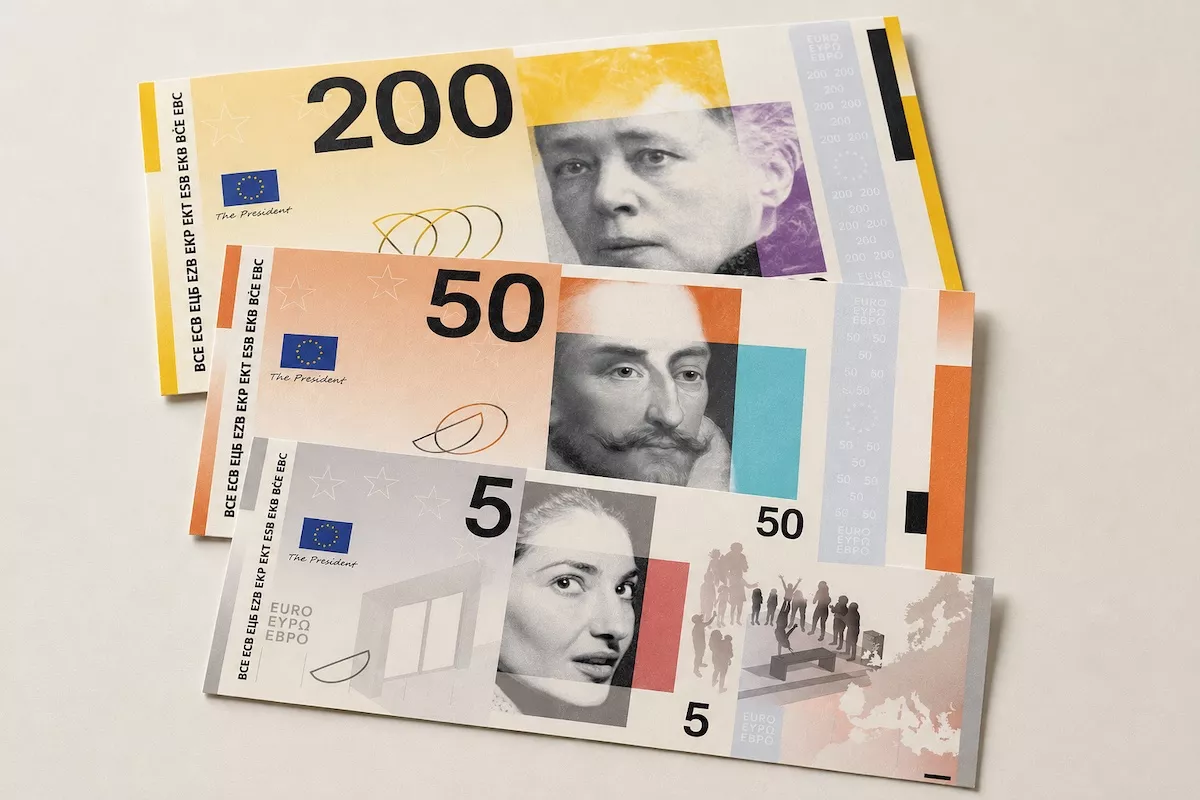
The European Central Bank has revealed 10 possible designs for the next generation of euro banknotes, and everyone is being invited to help choose the winner.
The public survey is open to people of all ages, nationalities and countries of residence. Citizens, residents and expatriates can therefore all participate, whether or not they live within the European Union.
Voting remains open until 11.59pm CET on 21st September 2026. Participants can view each proposed series and register their preferences through the ECB’s online survey, available in all 24 official EU languages.
European culture competes with rivers and birds
The shortlisted designs are based on two themes: European culture and Rivers and birds.
The cultural proposals feature prominent Europeans on the front of each denomination. Maria Callas appears on the €5 note, Ludwig van Beethoven on the €10, Marie Curie Skłodowska on the €20, Miguel de Cervantes on the €50, Leonardo da Vinci on the €100 and peace campaigner Bertha von Suttner on the €200.
The reverse sides depict shared cultural spaces and activities, including street performances, music festivals, schools, libraries, museums and public squares.
The alternative nature theme follows Europe’s rivers from mountain springs to the sea. The designs feature birds including the wallcreeper, kingfisher, bee-eater, white stork, avocet and northern gannet, while European institutions appear on the reverse.
New banknotes remain several years away
More than 1,200 designers applied to take part in the Europe-wide competition. Of these, 25 were invited to develop proposals before an independent jury selected the final 10.
The ECB’s Governing Council is expected to choose the winning series around the end of 2026, taking into account public preferences, expert recommendations and technical assessments.
The new notes will not enter circulation immediately. The selected designs must undergo further development, security testing and production, meaning it will take several years before they reach the public.
Existing euro notes will retain their value and continue circulating alongside the new series. The denominations will remain €5, €10, €20, €50, €100 and €200, while their principal colours and dimensions are also expected to remain broadly unchanged.
The redesign will introduce improved security and accessibility features and seek to reduce the environmental impact of producing and circulating cash. It will be the first complete redesign of euro banknotes since the currency was introduced in physical form in 2002.
Monaco Life is produced by qualified, multi-media journalists writing original content. See more in our free newsletter, listen to our Podcasts on Spotify, and check us out on Facebook, Instagram, LinkedIn and Tik Tok.
Main image of designs created by Monaco Life