

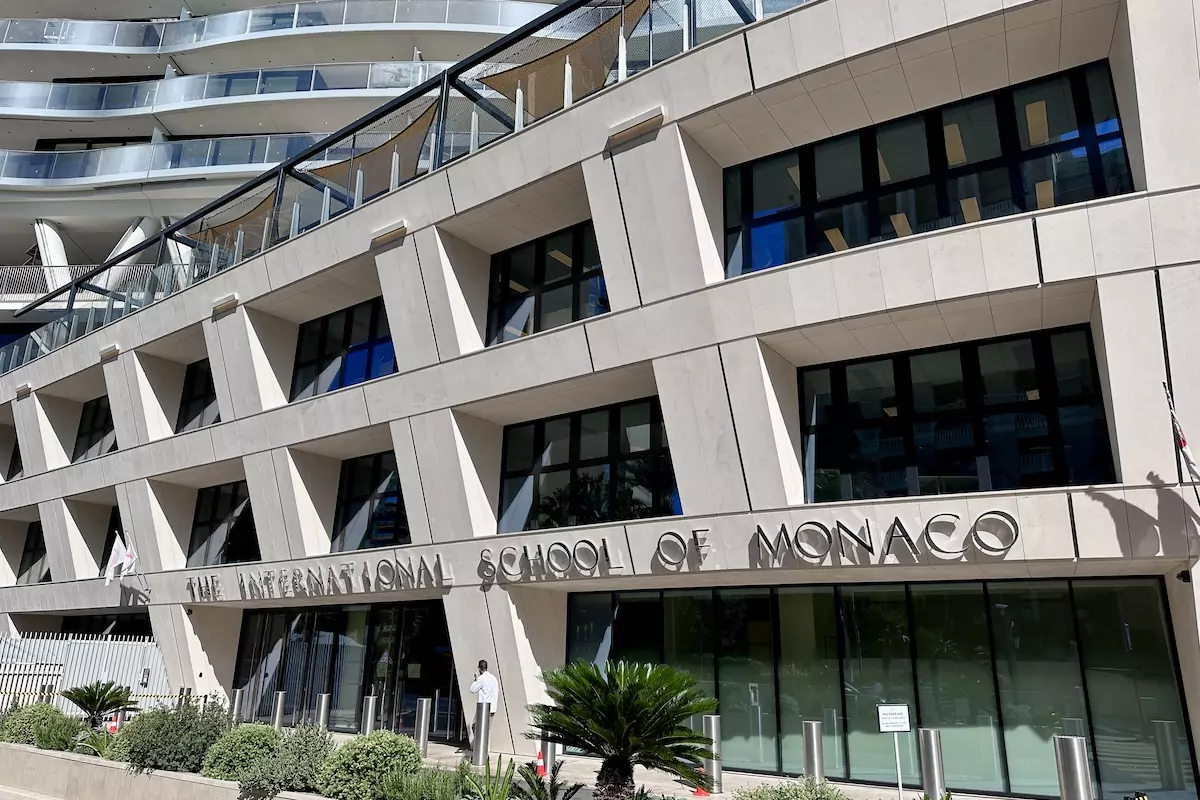
Monaco’s private school sector has grown 20% over the past decade, driven largely by the expansion of international schools catering to the Principality’s cosmopolitan population, whilst public school enrolment has declined to its lowest level in ten years.
The 2025-26 academic year saw 6,566 students enrolled across 16 schools, with private institutions now educating 2,427 students compared to 4,139 in public schools, according to statistics released by IMSEE in December. The private sector added 89 students this year whilst public schools lost 88 students, continuing a trend that has reshaped Monaco’s educational landscape.
International schools reshape the sector
The opening of the British School of Monaco and the expansion of the International School of Monaco into larger premises explains much of the recent growth. Between 2022-23 and 2023-24, these two schools alone accounted for 102 of the 113 additional students registered across Monaco’s entire education system.
The International School of Monaco now serves 848 students, making it the third-largest school in the Principality after the Institution François d’Assise – Nicolas Barré (1,182 students) and École Saint-Charles III (1,125 students). The British School has grown to accommodate 399 students.
This expansion responds to Monaco’s increasingly international character. The student body represents 92 nationalities, with French students comprising 38 percent, Monegasques 20 percent, Italians 12.7 percent, British 5.9 percent and Russians 2.4 percent.
Nationality patterns reveal distinct educational preferences. British students show the strongest preference for private education, with three-quarters attending private institutions. In contrast, Monegasque, French and Italian students remain predominantly in public schools, though private schools are gradually gaining ground even among these traditionally public-leaning groups.
Public education contracts
Whilst private schools flourish, public education faces sustained contraction. Public school enrolment has dropped from around 4,350-4,400 students in 2019-20 to 4,139 students in 2025-26, the lowest level of the decade. The decline accelerated from 2020-21, with the steepest drops coinciding with the pandemic period and subsequent expansion of private alternatives.
The public sector still educates 63% of Monaco’s students and includes the Principality’s largest schools. However, the trend suggests public institutions are losing market share to private alternatives offering international curricula, English-language instruction and globally recognised qualifications.
Monaco residents favour private schools
Students living in Monaco show stronger preference for private education than those commuting from neighbouring communes. Among Monaco residents, 74.6% of those in private schools live in the Principality, compared to 65.7% in public schools.
For the 23.6% of students commuting from Beausoleil, Cap-d’Ail, La Turbie and Roquebrune-Cap-Martin, the pattern reverses: they represent 26.6% of public school students but only 18.4% of private school enrolment.
Nearly 70% of all students live in Monaco, reflecting the Principality’s appeal to international families seeking quality education in a compact, multilingual environment.
Diverse educational offerings
Monaco’s 16 schools accommodate varied educational needs. Elementary education serves 2,071 students (31.5%), whilst secondary education accounts for 3,511 students (53.5%). Secondary students are split between collège with 1,848 students, academic and technological tracks with 1,336 students, and vocational programmes with 282 students.
Additionally, 63 students benefit from adapted education through specialised programmes, representing 1% of enrolled students.
The system maintains gender balance with 50.7% boys and 49.3% girls across all schools.
See also:
Inside the new state-of-the-art International School of Monaco campus