

In partnership with the Princess Grace Foundation-USA, Monaco Life proudly presents a monthly series spotlighting the lives and artistic contributions of the Foundation’s remarkable Award winners.
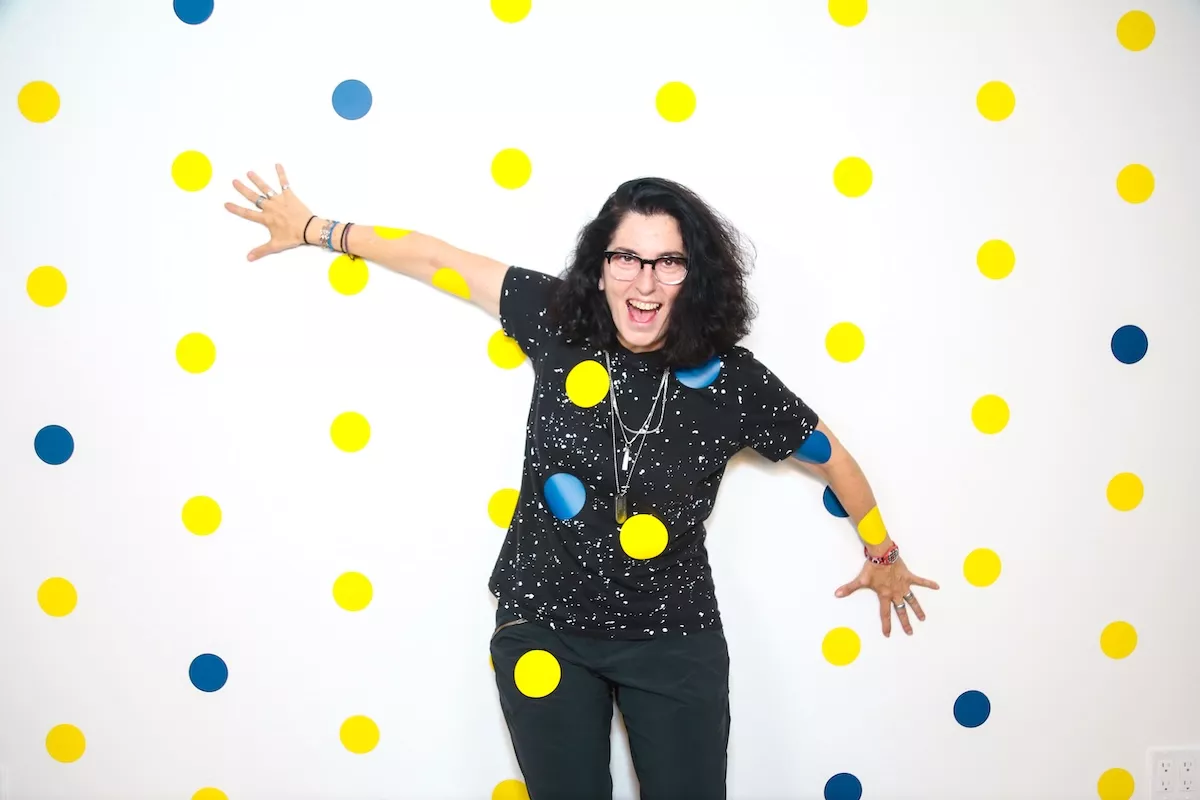
For acclaimed director, writer, and theatre-maker Tina Landau, storytelling has always been more than a craft—it’s a way of understanding the world. Known for her visionary productions that merge theatre, music, movement, and immersive staging, Landau has built a career defined by bold artistic risk and deeply collaborative creative spaces.
A Princess Grace Award winner early in her career, Landau has gone on to shape some of American theatre’s most memorable productions, including The SpongeBob Musical and Floyd Collins, while also directing celebrated plays at Chicago’s Steppenwolf Theatre Company and beyond. Her work continually pushes the boundaries of what live performance can be—blending spectacle with intimacy, experimentation with emotional truth.
In this conversation, Landau reflects on the confidence the Princess Grace Award gave her at a pivotal moment, the fearless instincts she developed during her years at Yale and Harvard’s American Repertory Theater, and why the ephemeral nature of theatre continues to draw her back again and again.
On the Princess Grace Foundation-USA
You received a Princess Grace Award early in your career — what did that recognition mean at the time?
Everything. It said to me quite simply, “Continue.” I remember thinking, “Someone somewhere thinks I merit this, so maybe I do? I guess I must. Huh. I might be okay.”
The Princess Grace Foundation is rooted in legacy — when you think of Princess Grace herself, what does she represent to you as an artist?
Someone who appreciated and championed the arts and understood their importance in the fabric of daily life. Her dedication to the arts and her philanthropy, both in her lifetime and obviously beyond, are unmatched, and I can’t tell you how much that’s meant to me, along with generations of other artists. So she represents, first, “support.” This is the primary ingredient the arts need in order to exist in a society. Then too I’d say, “taste.” The invitation to be discerning. A penchant for excellence. She represents the “crème” when we say the “crème de la crème” — and who doesn’t want a little, or aspire to be a little, “crème?”
On Her Career & Artistic Growth
When did storytelling first take hold of you — and when did directing become the way you knew you had to do it?
As early as I can remember. By age six, I was walking around telling people I was going to be a director. Like those little kids in the movie Annie Hall, who might hold a briefcase and look at the camera and say, “I’m an accountant.” That was me — so serious and intentional, but just a kid. I was so lucky that my parents were in the entertainment industry, and we lived just outside NYC, so I went to see Broadway shows before I could even remember. I started creating my own shows the way so many little kids do: by myself, with nothing but imagination, in ‘the basement.’
You trained at Yale and later at Harvard/A.R.T. How did those formative years shape your artistic instincts and sense of risk?
I was just recently going through containers of all my old, saved archives, going all the way back to high school when I began directing in earnest, and in looking at my folders from Yale College, I was astounded at how brave and audacious I was. Perhaps a bravura and wildness that can only be born of youth. You just don’t know any better, and you haven’t been told enough yet what you can’t do or aren’t supposed to do — so you just do it! I was thinking how I’d love to tap more into that original fire and instinct — and energy I had when I was in college. It fueled me long and far, that’s for sure.
Your work often blends theatre, music, movement, and ensemble — what pulls you toward that kind of storytelling?
I’ve always loved music — it’s my first language in a way. I played piano from when I was very young. I was lucky here, too, because I had a piano teacher who did not say, “Learn these scales — and now this classical piece of music.” She came in and asked me, “What’s your favorite song? Would you like to learn how to play it?” And that’s what we did. So I was enthused and stuck with it. Music has always provided a soundtrack to, and expression of, my life. I think of everything I direct as a piece of music — even if it only seems to be ‘a play’ to others. For me, theater is always potentially a “Gesamtkunstwerk,” the German word for “total work of art,” meaning when many forms of art come together to form a brand-new whole. Theater’s not a script or a set of characters or a plot. It’s a palette that holds sound, light, space, story, theme, color, time, action, movement, imagery, and so much more — and so when I ‘paint,’ why not use all that’s available to me on the palette?
What’s the hardest part of directing for you — starting, shaping, or letting go?
Starting can be exhilarating, but it’s also never less than terrifying. Not the preparation stage, but the actual beginning of rehearsals, when so many eyes are on you, expecting you to lead, to inspire, to know. Thank goodness, the older I’ve grown, the more tools I’ve acquired for navigating that first day anxiety. But still, the hardest part is actually, and almost always, letting go. Theater is an art of impermanence — and so something is always born, and then something always passes and is no more, ever.
What’s your creative process at the start of a new project? What’s the first question you ask?
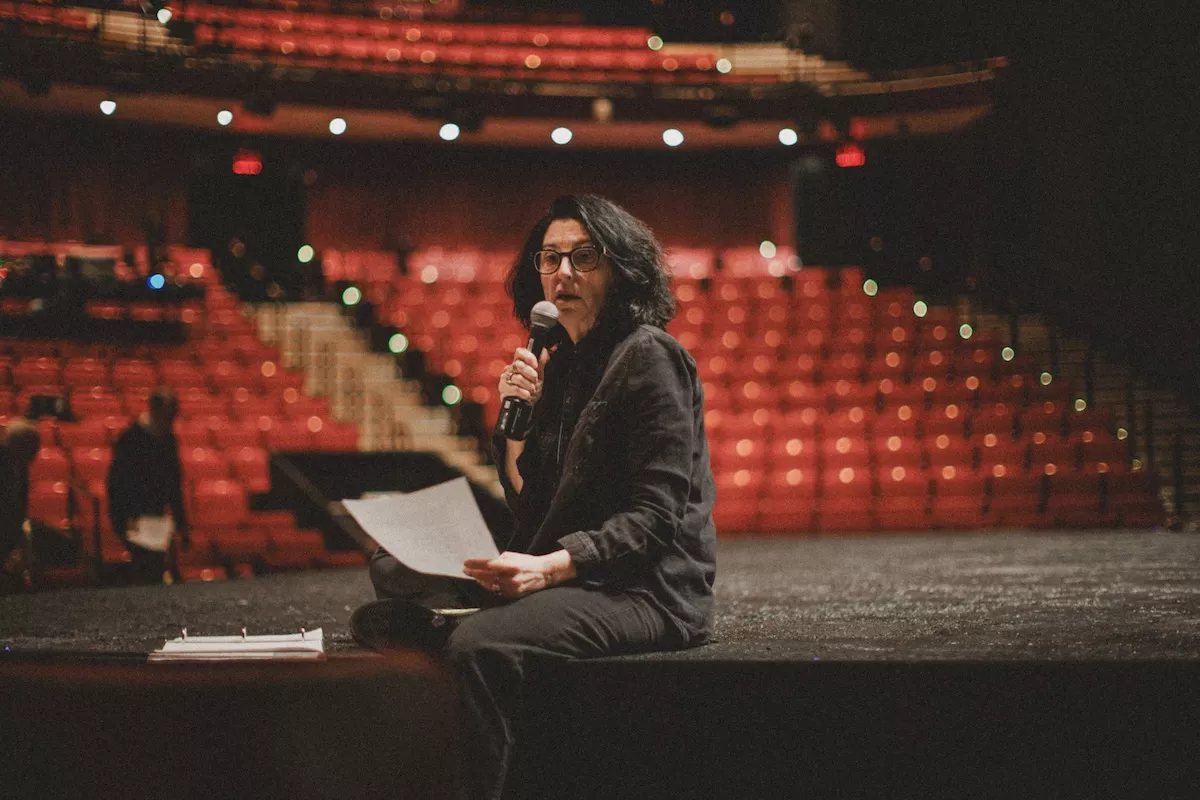
I start by dreaming and free associating. I collect images. I listen to music. I start to assemble a world which feels somehow OF the piece. So by the time I meet designers, it’s less, “This is what it means, and this is what we’ll do,” and more, “Enter, immerse yourself in this collection of stuff I’m offering, find your own way in here.” And the first question I always ask is “Why?” Why do this now? What makes the time, energy, and money that a theater and our audiences will pour into this worth their while? Why is it necessary?

You’re known for building powerful rehearsal rooms. What makes a collaboration truly work for you?
Trust. Openness. Play. Willingness to make a mess. Firm and true belief that 20 hearts-and-heads can dream of and create something deeper and more surprising and more alive than what one person can alone.
You’ve directed and/or conceived major works, including The SpongeBob Musical, Floyd Collins, and significant plays at Steppenwolf. Which project felt like a true artistic turning point for you?
The Time of Your Life by William Saroyan, which I directed at Steppenwolf, then Seattle Rep, and A.C.T in San Francisco. I started that process during a low period: 9/11 had just happened, I had just turned 40, a project I had pinned all my hopes on had just gotten cancelled, and I didn’t know why doing theater mattered at all. So I had nothing to lose. I remember telling the cast on the first day that all I cared about was making something radically alive and mind-blowing and that if we didn’t aim for that I’d rather just go home — and that, in order to do that, I was saying “F – you” to the critics, to trying to please an audience, to rules, to propriety, to everything except my gut and instincts. And that’s how I worked. And that’s where and how I learned Saroyan’s words, “In the time of your life, live” — which I now have tattooed on my arm.
On Life Beyond the Stage
Since this interview will appear in Monaco Life, we love to highlight the principality’s allure. If you could bring one of your productions to Monaco, which would you choose—and why?
Maybe SpongeBob. Come on, Monaco and SpongeBob?! That’s what life is like: two things that don’t seem to go together yet do.
On What’s Next
What are you working on next, and what’s exciting you right now?
I’m gearing up to direct a play I wrote with Tarell McCraney at the Vineyard in NYC, called Ms. Blakk for President, and also a play at Steppenwolf next season, called The Comeuppance by Branden Jacobs-Jenkins. But most of my time now is devoted to a few big projects that will likely take 2-5 years to come to fruition. The theater world, and people’s interest in it, is shrinking. And so I’m intentionally heading into territory that is gigantic, ambitious, risky, event-driven, environmental or immersive, explosive, joy-filled — in the hopes that such things may actually keep “liveness” alive for a little longer.
After everything you’ve done, what still drives you back to the theatre?
Ancora imparo. Meaning, “I am still learning.” Michelangelo said this at age 87 while he was working on St. Peter’s Basilica. I aspire to that. Always learning. About how to make theater, which, of course, I still really have no idea how to do. And learning about others and the world I live in. I’ve always said the theater is my great ongoing graduate school. So I explore, I develop, I open up, I take in More and Different, I become more a part of a community, more a citizen of the world, I expand, I surrender to a reality larger than myself, I find solace in that — connection.
Follow Tina Landau on Instagram @TinaLandau and on Facebook @TinaLandauNYC.
Stay updated with Monaco Life: Sign up for our free newsletter, catch our podcast on Spotify, and follow us across Facebook, Instagram, LinkedIn, and TikTok.
All photos provided