

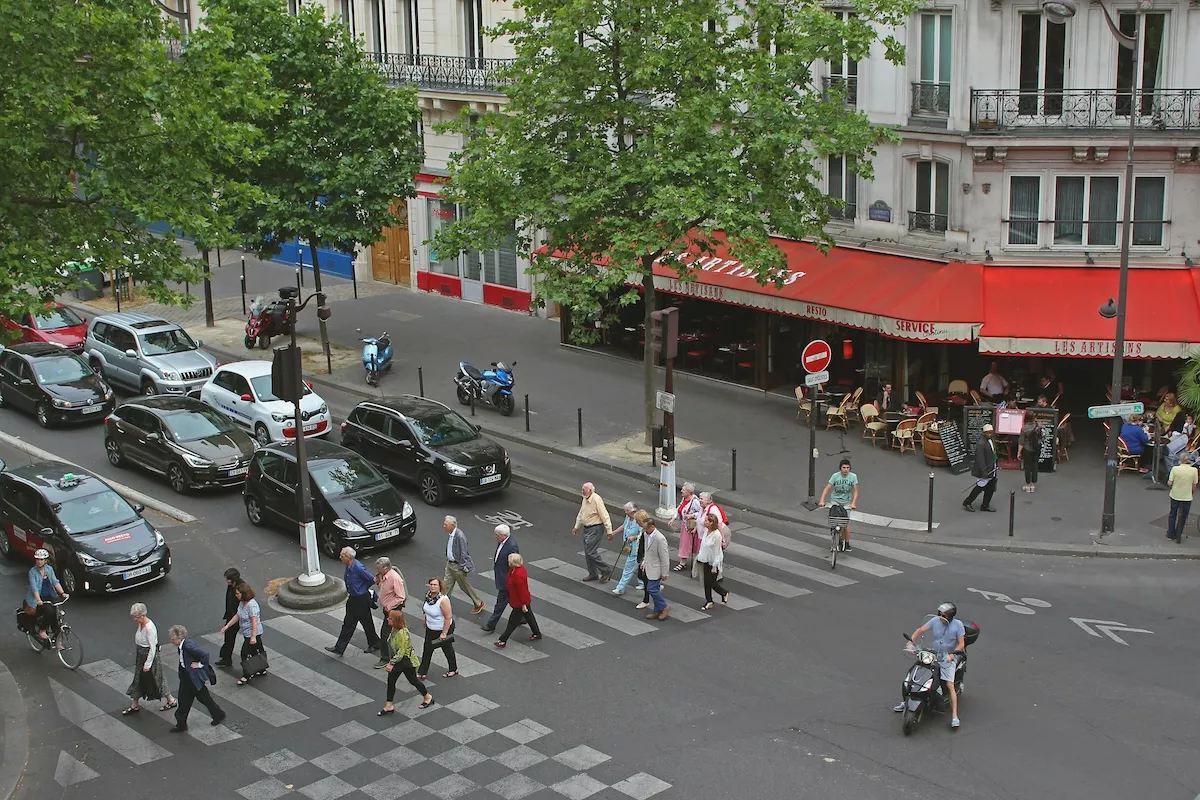
Louis Sarkozy has called for removing traffic lights, road markings and signage to make drivers more responsible, citing European examples where accident rates dropped after signalisation was simplified or eliminated.
Speaking on RMC on 3rd December, the son of former French president Nicolas Sarkozy responded to a new VINCI Autoroutes study showing widespread rule-breaking by European road users. The fifth edition of the study, surveying 12,000 Europeans including 2,400 French respondents, found that 58 percent of French drivers fail to use indicators, 40 percent of cyclists admit running red lights, and 70 percent of pedestrians cross against signals.
“The solution here, as elsewhere, is more freedom, not less. What kills motorists is dependency,” Sarkozy said from his Menton home studio, where he regularly broadcasts commentary.
Naked roads concept
Sarkozy advocates for what he termed “an immense simplification of our roads: remove traffic lights, white lines, signage panels. In short: make citizens responsible for their own driving, instead of delegating it entirely to the highway code.”
The concept draws on “naked roads” pioneered by Dutch engineer Hans Monderman, which relies on fear of other road users to heighten attention and caution. According to Le Figaro, Sarkozy argues that without signalisation, drivers slow down, observe more carefully and anticipate better.
“Look at the survey: 95 percent of road users fear the behaviour of others. Naked roads use precisely this fear,” he said. “When there are no pavements, no traffic lights, no white lines, everyone pays more attention, citizens take responsibility, and what researchers call ‘implicit negotiation between users’ emerges. They become two to three times more cautious.”
International examples
Sarkozy cited Drachten in the Netherlands, where removing signalisation reportedly reduced accidents by 40 percent. He also claimed that London’s Kensington High Street saw a 44 percent accident reduction over three years after simplifying signalisation.
The philosophy contrasts sharply with French metropolitan traffic management. “When you make people responsible, they naturally become slower, more attentive and more generous with each other,” Sarkozy said. “It’s exactly the opposite of Parisian bureaucratic authoritarianism: you increase freedom and observe improved behaviour.”
He acknowledged one limitation: “It seems the only real problem with these ‘naked roads’ is that they work less well for elderly people and the visually impaired, but that’s about it.”
Road safety context
The VINCI Autoroutes study highlighted that nearly one in two road deaths in Europe involves vulnerable users such as pedestrians, cyclists or motorcyclists. The foundation’s research reveals a significant gap between traffic regulations and actual behaviour, with substantial percentages of all road user categories admitting to rule violations.
Sarkozy’s proposal represents a radical departure from current French road safety policy, which has increasingly relied on automated enforcement, reduced speed limits and expanded signalisation. The naked roads concept has been implemented in limited areas internationally, primarily in residential zones and town centres rather than main roads or motorways.
The approach remains controversial among traffic safety experts, with proponents citing reduced accident rates in trial zones whilst critics question applicability to high-traffic areas and express concerns about vulnerable road users including the elderly, visually impaired and children.
Stay updated with Monaco Life: sign up for our free newsletter, catch our podcast on Spotify, and follow us across Facebook, Instagram, LinkedIn, and Tik Tok.
Photo credit: J Shim, Unsplash