

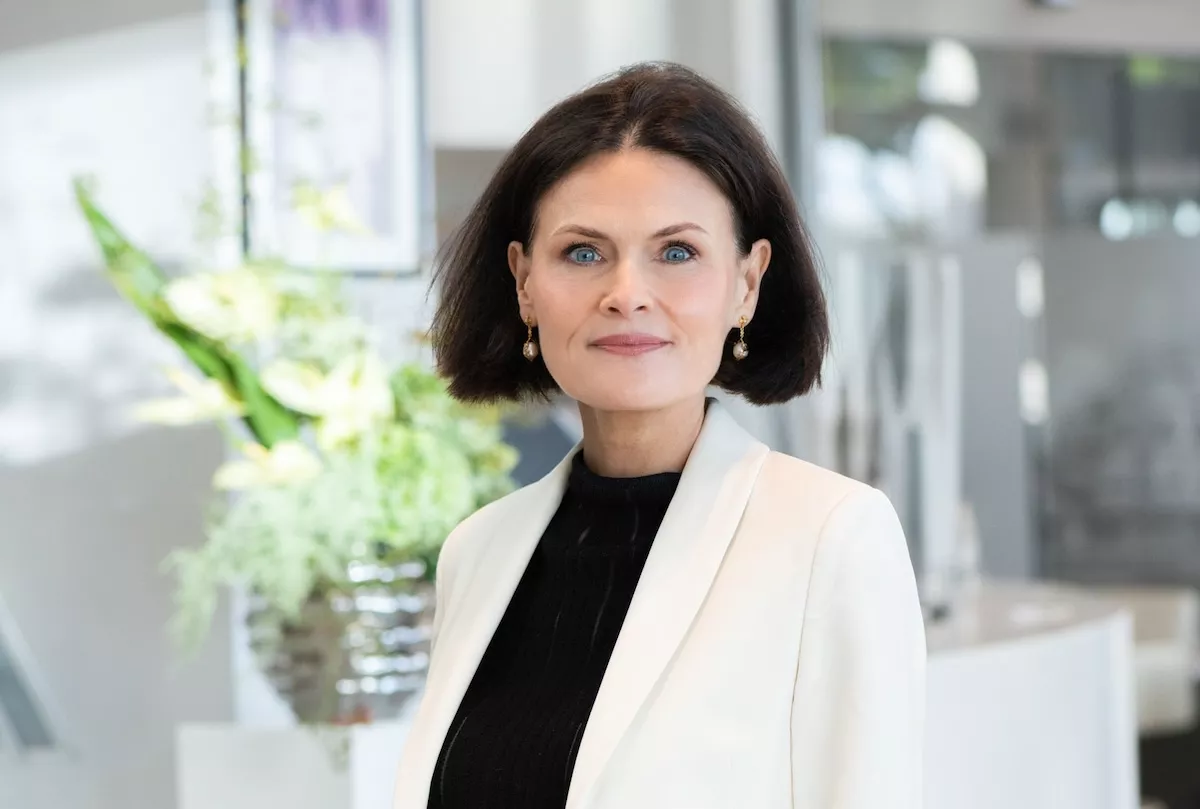
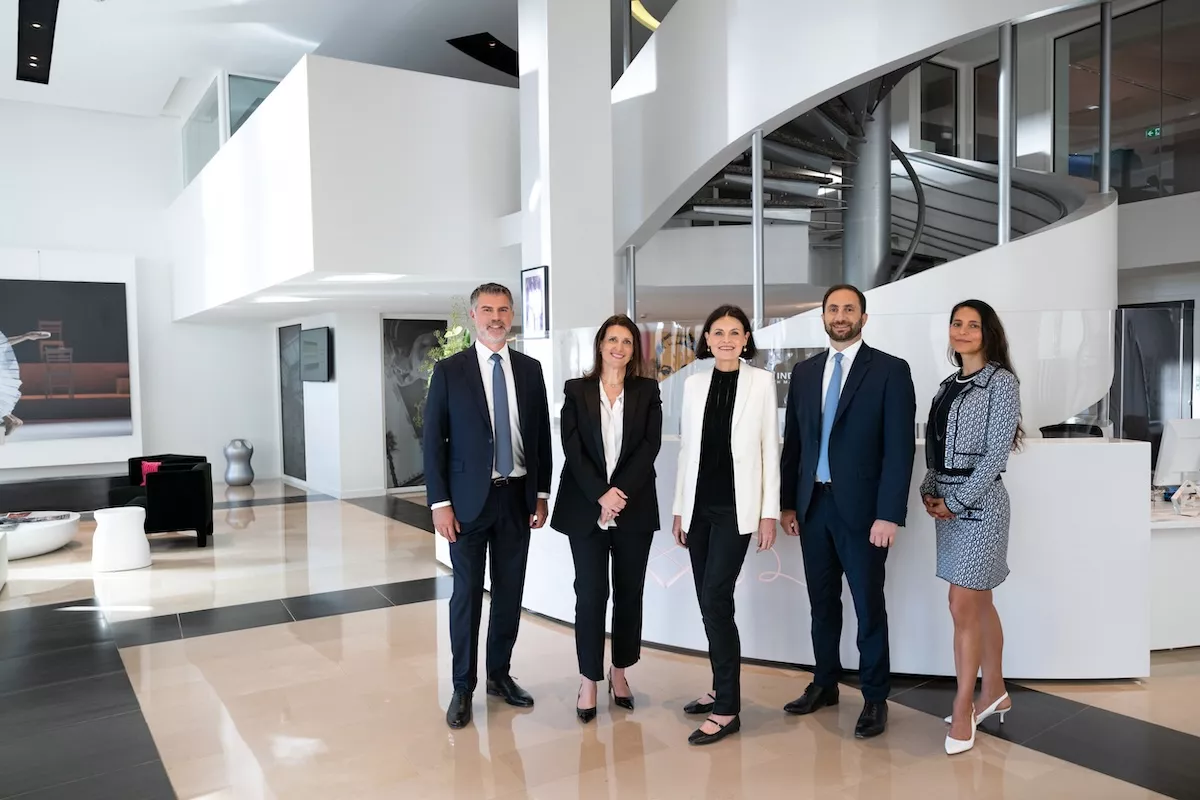
Almost a year after taking the helm of CFM Indosuez Wealth Management, Monaco’s only listed bank, Bénédicte Chrétien faced the press for the first time on Tuesday — and she did not do it alone. Rather than address the room from the front, the chief executive sat surrounded by her senior leadership team and handed each of them the floor in turn. It was a deliberate signal of the more collaborative way she intends to run a 104-year-old institution now navigating some of the deepest changes its industry has faced.
Bénédicte Chrétien, who took over last October from Mathieu Ferragut, arrived after more than two decades in wealth and asset management and, most recently, a spell as group head of human resources at Crédit Agricole — the people-first background that colours much of her thinking.
Chrétien’s new strategy sets out six priorities for the bank, with ‘Client at the Heart’ at the top of the list. It calls for a more integrated advisory model in which the private banker acts as a conductor, drawing together an increasingly specialised orchestra of experts for each client.
Not a pyramid, but a collective
Chrétien was emphatic that the bank is no longer led from a single desk. Its executive committee has been renewed by 80% since she arrived — younger, and now 62% women — and she framed that collective as the point rather than a by-product.
“This bank is not run by one man or one woman alone,” she said. “There is no providential man or woman. There is a team that, through the diversity of its experiences, profiles and skills, balances itself positively.” Bringing that team to the microphone, instead of speaking for it, was the demonstration.
A clientele in transformation
The urgency, as Chrétien tells it, comes from three shifts striking wealth management at once. The first is the great wealth transfer: by 2030, she said, around 30% of the world’s wealth will change hands, half of it in the United States and a quarter each in Europe and Asia. The second is a new generation of clients who want more than returns. “How can my wealth have an impact on the world — now, but also in 20 or 50 years?” is the kind of question they now ask, she said.
The third she called genuinely new: the rise of women’s financial power. In 2015, women held 31% of global wealth; by 2026 that had climbed to 41%. It is a shift mirrored in the bank’s own leadership, with a female chief executive and deputy chief executive, and an executive committee that is now majority women. Where the priorities of the next generation and of women converge, Chrétien argued, is on a demand for meaning and measurable impact. It is this that she brands “the bank of meaning” — the case that preserving and growing family wealth must now sit alongside purpose, from the blue economy to sustainable building and education.
The human, augmented by technology
On technology, Chrétien was pointedly unromantic. Artificial intelligence, she said, is now simply the norm — every bank will have it — so it cannot be what sets one apart. “The real differentiator is the human being augmented by technology,” she said, reaching, for her largely Anglophone audience, for a line she attributed to Steve Jobs: “I would trade all of my technology for an afternoon with Socrates.”
Sophie Couve de Murville, the bank’s Global Head of Advisory, explained what this looks like in practice. AI already allows the bank to produce instant consolidated reporting across complex structured-product positions and monitor more market signals than any analyst could track alone. During one recent client review, she said, the technology revealed that a portfolio which appeared well diversified was actually heavily concentrated in technology once its underlying US and Asian exposures were analysed. Yet even within her own field, she added, AI still combines “extremely advanced” analysis with “beginner’s errors”.
“What still makes the difference is intuition – particularly an understanding of how markets will react,” said Couve de Murville. “At this point, AI is not yet able to reproduce that.”
Scale, and a bigger footprint
The platform behind the strategy is substantial. CFM Indosuez is the largest employer in Monaco’s financial sector, with more than 400 staff, some 60 private bankers — average age 45, 40% of them women — and what it says is the largest trading room in the Principality, run by 50 multilingual specialists. It is the only listed bank among the 25 in Monaco, and part of Crédit Agricole, the world’s ninth-largest banking group. It was again named Best Bank in the Principality by Global Finance this year, the tenth year running.
That footprint grew in March with the acquisition of BNP Paribas’ wealth-management clients in Monaco, alongside the arrival of 37 staff. Deputy chief executive Sophie Armando said the measure of such a deal is not the assets but the handover: clients, she recalled, told the bank, “On Friday, we were with BNP Paribas; on Monday morning, we were with CFM Indosuez. It happened transparently and seamlessly, and for us that was a tremendous reward.”
Co-Head of Wealth Management Vincent Cartillier said CFM Indosuez had built an increasingly international private-banking team to reflect its clientele, with nearly 20 nationalities represented and around a dozen foreign languages spoken among its bankers. “We are a bank that is profoundly Monegasque by our history and our roots,” he said, “but resolutely international by our set-up and our clientele.”
For Cartillier, however, that international reach must extend across generations as well as borders. “Our objective is simple: to be the bank of the family, not merely the bank of one generation,” he said. That responsibility requires advisers to know not only their clients, but also their children—and to understand how the next generation’s needs, expectations and attitudes towards wealth are evolving.
Making it work across the bank
Turning all of this into the daily work of 400 people is, Chrétien acknowledges, the harder task. The conductor model only functions if the specialists are within reach, so the bank’s transversal wealth-engineering, financing, real-estate and investment-advisory teams are built to plug directly into each private banker rather than sit in silos. Investment experts now join client meetings as a matter of course, Couve de Murville said, and for its largest clients, the bank assembles a dedicated team of bond, equity and other investment specialists who work together and review the portfolio monthly, operating in effect as an in-house family office.
The second lever is generational. With a long-serving cohort of bankers retiring, Chrétien has been deliberately recruiting younger “digital natives” with a real appetite for AI, then pairing them with the bank’s most seasoned advisers. The technology, she argues, the newcomers bring naturally; the human craft of reading a family’s story “cannot be improvised”, and has to be handed down. “Every family is unique and every family carries its own story,” she says. “It is human intelligence – with its subtlety, discernment, free will and responsibility – that ultimately enriches the solution we offer.”
Training is continuous, particularly in compliance, where regulatory monitoring, staff education, controls and audits form a permanent cycle. Chrétien wants compliance treated not as a checklist but as a culture – and, for Monaco’s only listed bank, a source of trust and competitive advantage.
Underpinning it all is a conviction shaped by Bénédicte Chrétien’s years in human resources: two of her three stated ambitions are to be the first choice not only for clients but for staff, because, she insists, one is impossible without the other. Look after employees’ wellbeing, the logic runs, and they will advise clients better. Each acquisition, the BNP integration included, becomes a chance to rebuild the bank’s own operating model and, in her words, to “question ourselves and look at ourselves with humility”.
For all that structure, CFM Indosuez’s new CEO is clear that the hardest part is cultural – that shifting the habits of a 104-year-old institution can be neither forced nor left to drift. Eleven months in, she measures progress less by reorganisations than by how many employees have embraced the changes. “I believe we have brought 80% of our teams on board,” she said. “Cultural transformation of this scale requires time – but it must not take too long. I give it two years.” It is an unusually concrete deadline for a change of that kind, and a telling one: patience, but with a clock running.
It amounts to a wager that a century-old institution can be run less as a pyramid than as an ensemble, and that the way to keep increasingly demanding clients is to look after the people serving them. Almost a year in, with her team assembled around her, that is Chrétien’s strategy — and, just as deliberately, her message.
Monaco Life is written by qualified journalists, writing original content. Sign up for our free newsletter, listen to our podcasts on Spotify, and follow us across Facebook, Instagram, LinkedIn, and Tik Tok.
Main photo source: CFM Indosuez Wealth Management