

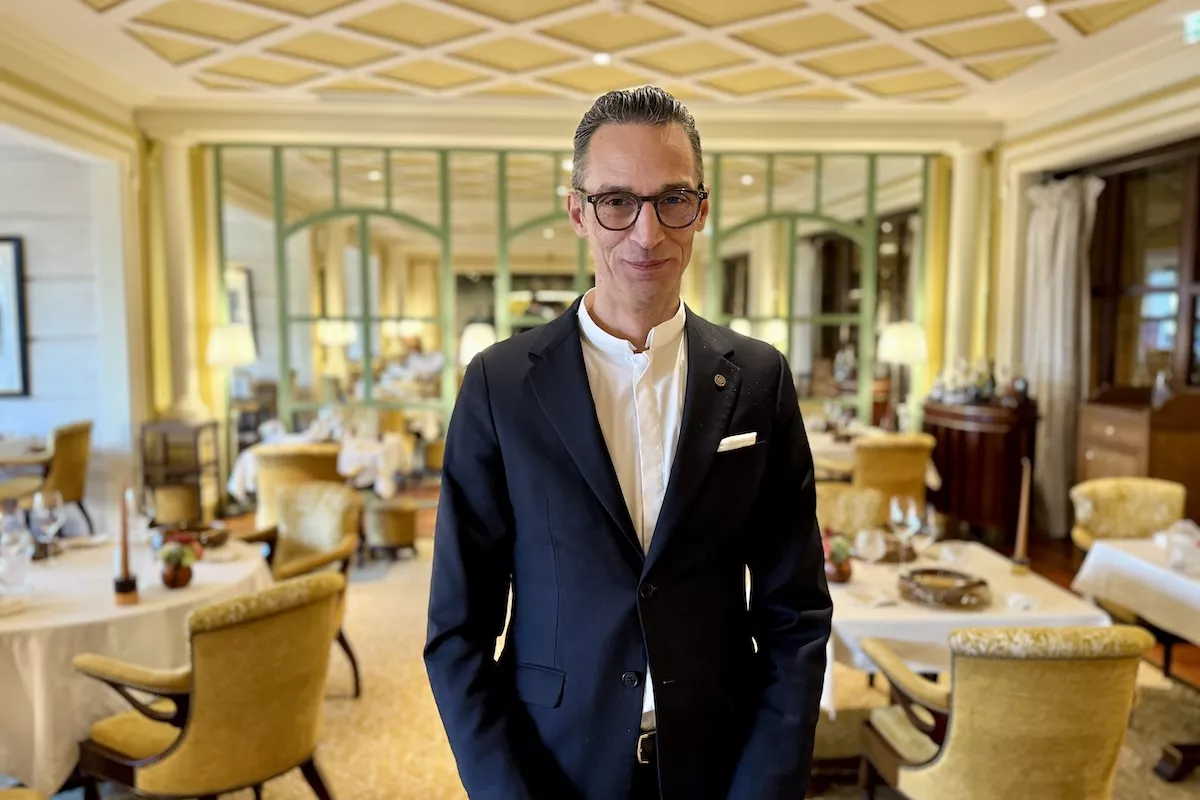
Marco Tognon almost missed his own moment. When his name appeared on the big screen at the Michelin Guide ceremony held in Monaco on 16th March — the first time the prestigious event had taken place in the Principality — he couldn’t quite make it out. “Chef Cussac said to me, ‘Marco, it’s time to go,’ and I said, ‘Where?'” he recalls, laughing. “I couldn’t see my name on the big screen.”
When it registered, the emotion was immediate. Tognon, Director of Les Ambassadeurs by Christophe Cussac at the Hôtel Métropole Monte-Carlo, had just been named recipient of the Michelin Guide’s Service Award — recognition that the Guide itself described as going to someone who “personifies meticulous, elegant and deeply human service”.
“I did receive an invitation, but I didn’t know I would win the award,” he says. “I was so proud. To get the recognition from the Michelin Guide – I am so very happy and I will be happy for a very long time.”
The award, he is quick to add, belongs to more than just him. “It is so great for the team. They are working so close to me every day, every step of the way, since I arrived in Monaco three years ago.”
A career built across the great rooms of Europe
To understand what Tognon brings to a dining room, it helps to trace where he has been. His career reads like a map of European fine dining over the past three decades — beginning at El Toulà in Rome, moving to the Savoy Grill and The Ritz in London, then to La Bastide de Saint-Antoine in Grasse and Le Calandre in Padova, one of Italy’s most celebrated restaurants, where at the time the chef held three Michelin stars at just 28-years-old.
From there, six years at Le Cinq at the Four Seasons Paris, followed by a long chapter at Le Bristol — five years, including four as deputy director of the three-starred Epicure. Then Le Gabriel at La Réserve Paris, Restaurant Apicius, and Restaurant David Toutain, before Monaco came calling.
“I have always aimed to get a lot of experience, and a lot of different experiences,” he says. “It took me eight years in the position of number two to be ready to be number one.”
He spent more than half his life in Paris, arriving in France in 2001 after his time in the UK. Monaco, when it came, felt like a natural destination. “Monaco is prestigious, very safe, where the quality of life is something you can only dream of. I am still so happy here. To be a waiter in Monaco — it makes me very proud.”
The human side of the floor
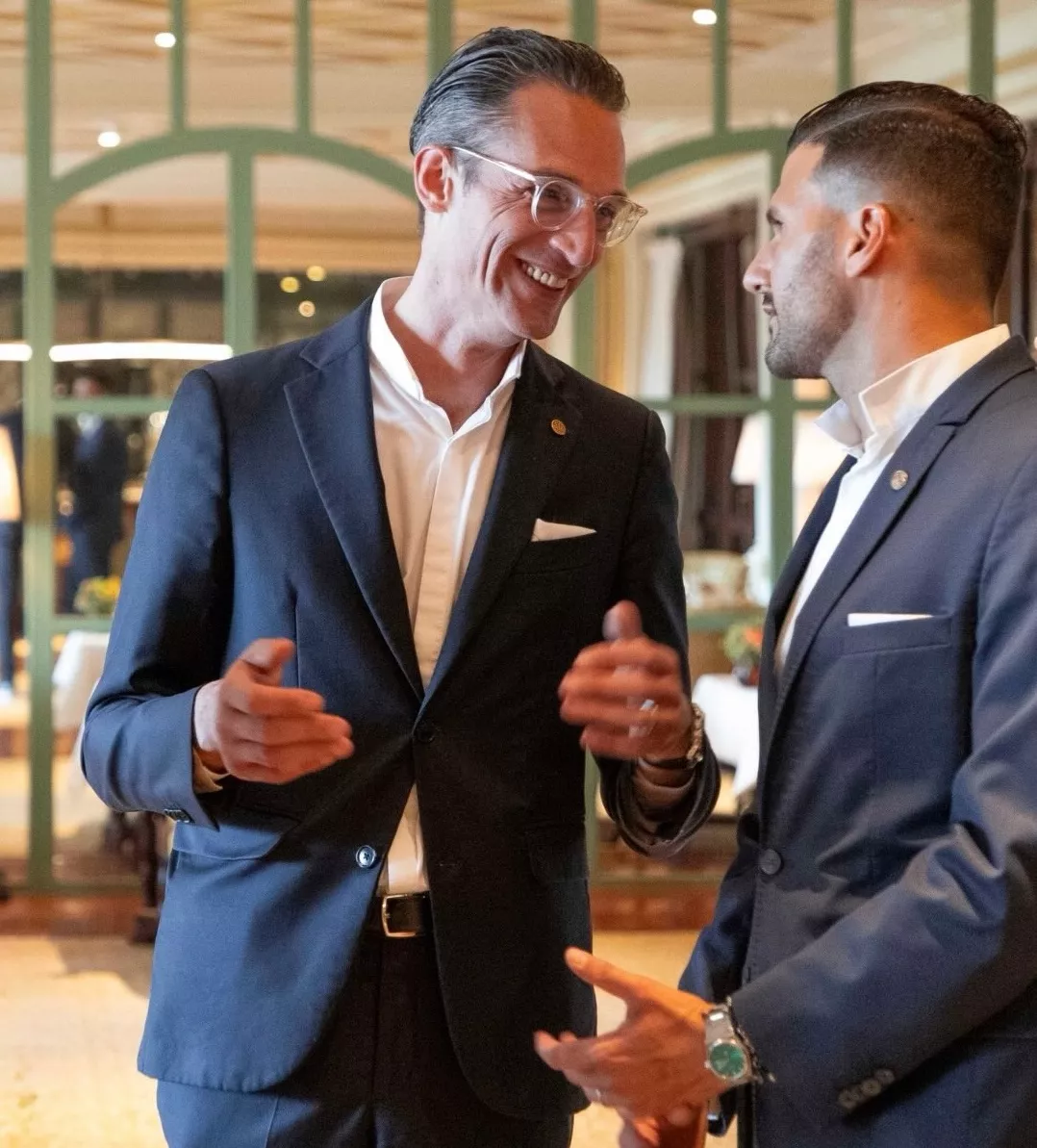
Ask Tognon what he loves about his work and the answer comes without hesitation. “I love the human side of it. I love it because you never get bored. I love it because it keeps you humble. I carry on the floor because I like to see our guests. I like to see happy people.”
He extends this beyond the professional. “We are also maîtres d’ outside of work — we are maîtres d’ in life.”
In a two Michelin-starred restaurant, expectations are inevitably high. Some guests book months in advance, arriving with a clear vision of how the evening should unfold. For Tognon, meeting those expectations begins well before a dish reaches the table, rooted instead in the overall experience. “When you go to a restaurant, you don’t go only to eat. You go to drink, to enjoy the ambiance, the experience. Sometimes guests come back as soon as they can, and that is a nice reward. It tells me we have done our job properly.”
For him, however, true loyalty is not secured by cuisine or setting alone, but by the human connection established throughout the visit. He points to the importance of creating a sense of belonging that extends beyond technical excellence. “I like to think that people come back to Les Ambassadeurs by Christophe Cussac because yes, it is two Michelin stars, yes because the service is nice — but I like to think also because they feel welcome. You create a relationship with your guests, with your smile, how you talk to them. It is very important — but it is also very exciting. You cannot have an unsatisfied guest.”
After three years, many of those guests have become something more than regulars. “Over that time, of course you get to know them — their names, their stories, who they are. And vice versa. So that is nice. It is like they are not a guest anymore.”
The details that define excellence
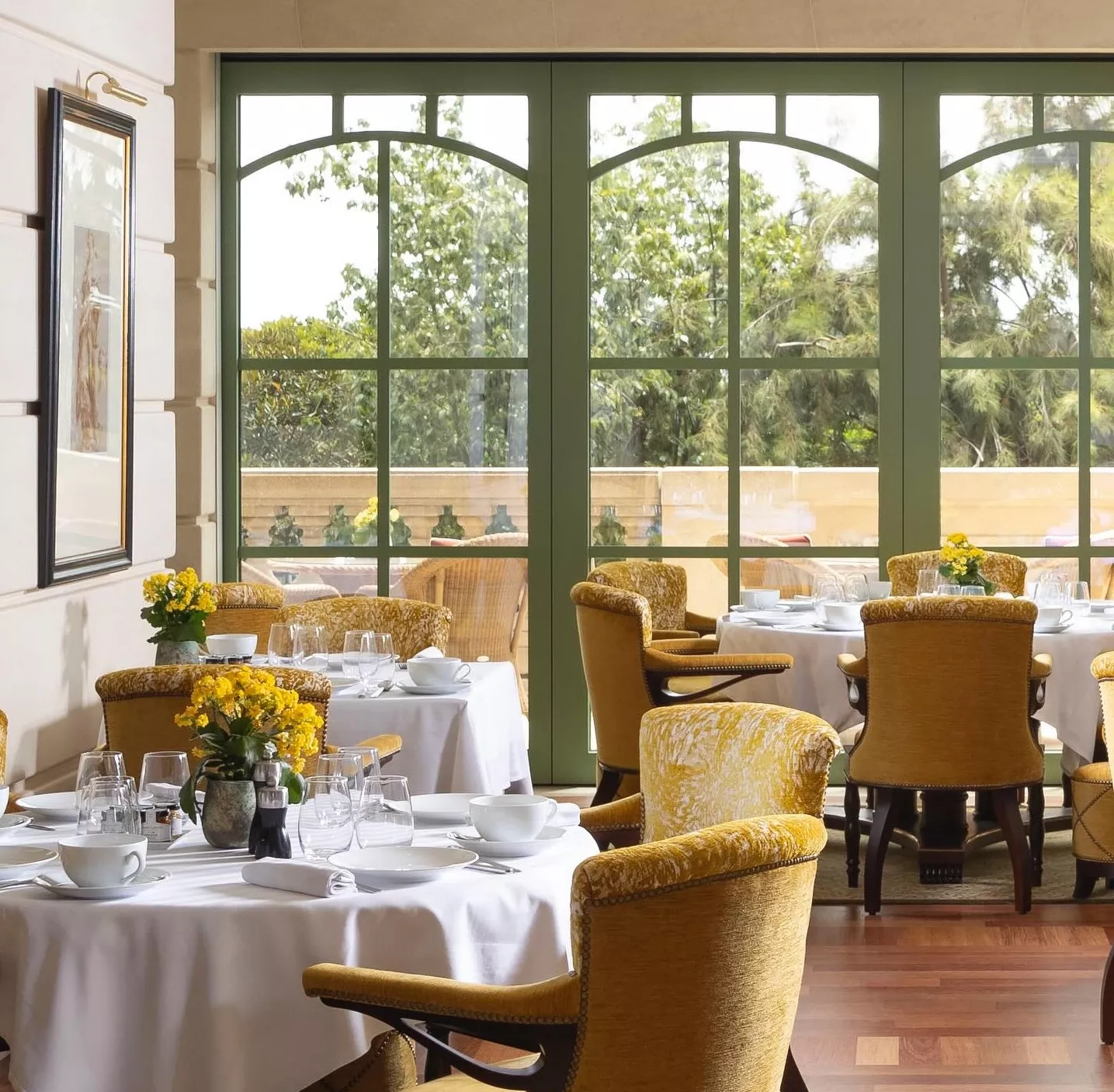
At this level, Tognon says, service is a discipline built on details that most guests will never consciously notice — which is precisely the point. “If you are on my left and I serve with my right, I am going to see you smile. But if I serve from the right and you are on my left, I cannot see your expression.” These are small things, he says. “But these are all part of the experience.”
He is equally deliberate when it comes to how dishes are presented at the table, drawing a clear line between guidance and restraint. Service, he explains, begins with interpretation — ensuring the chef’s vision is clearly conveyed and understood before the meal unfolds. “It is very important to understand the philosophy of the chef and transfer that to the customer. We have communication with the kitchen, we invite part of the team to introduce themselves — it is important to explain the menu well.”
Once that foundation is in place, however, the approach shifts. For Tognon, the moment a dish is served should be uninterrupted, allowing guests to engage with it instinctively rather than through repeated explanation. “But at the moment of service, we do not say anything anymore. The guest came, they read the menu, we explained it well. At the moment the plate goes down, we do not repeat what they are eating.”
The brigade at Les Ambassadeurs is a multinational team covering breakfast and dinner across two distinct shifts, with no split shifts. Around 20 in total. “I cannot work without them,” he says simply. “Everyone has a place — but everyone is a key person. Here, with Christophe Cussac, we all have the same uniform. So when a guest puts up their hand, they don’t really know who is who, who is responsible for what. Every person is a key member of the team, and everyone has to be able to smile, be compassionate, give the answer to a question.”
On the future of the profession
Tognon entered hospitality at a time when, as he recalls, the path felt binary: university or work. He chose the latter without hesitation and, decades on, remains steadfast in that decision. “I consider myself still learning every day. You don’t take anything for granted.”
That mindset now shapes how he views the future of the industry, particularly when it comes to guiding the next generation. For Tognon, technical skill alone is not enough; the way knowledge is passed on matters just as much. “If you are nice, the message will be received in a nice way.”
He is also clear-eyed about the demands of the profession, yet speaks of it with a sense of belonging rather than sacrifice. “Yes, it is a hard industry. But it is our industry. It is all we know and love. I don’t ask what time I can go home. I ask myself what time I can arrive at work.” That commitment, he adds, is not lost on guests. “Because the customer feels that — they feel our presence, our happiness.”
Recognition from the Michelin Guide, which has presented its Service Award only since 2018, marks a significant milestone. In a city hosting the ceremony for the first time in its 126-year history, the honour went to a professional who has spent more than three decades shaping a style of service defined less by formality than by feeling.
For Tognon, the distinction ultimately reflects something shared — the trust of his guests, the consistency of his team, and the quiet, daily discipline of getting the smallest details right. It is in the returning faces, the unspoken understanding across the dining room, and the sense that each service matters as much as the last, that his work finds its meaning.
Stay updated with Monaco Life: sign up for our free newsletter, catch our podcast on Spotify, and follow us across Facebook, Instagram, LinkedIn, and Tik Tok.
Main photo by Cassandra Tanti