

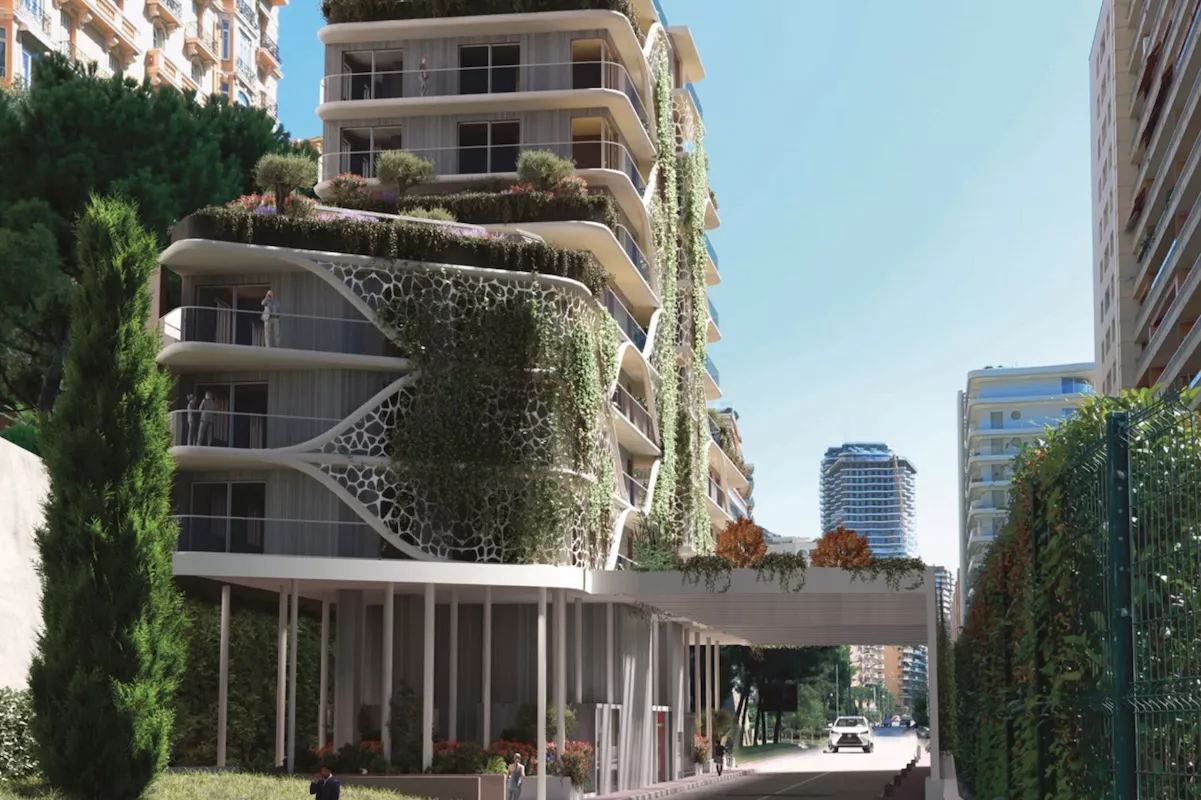
Monaco’s Larvotto Supérieur development — a state housing project delivering 35 domanial apartments on boulevard du Larvotto — has cleared another legislative hurdle, with the National Council voting on 2 April to authorise the decommissioning of embankment, pavement and road parcels needed for construction to proceed. The project will also house 94 parking spaces and a data centre for Monaco Telecom.
The vote comes as part of Monaco’s second phase of domanial housing investment, first outlined to the National Council in mid-2025. Since Prince Albert II launched the programme in 2019, the Principality has committed €1.5 billion to public housing, delivering 633 new apartments and targeting a situation where nearly three-quarters of Monegasques live in state-owned properties by the end of the decade. Larvotto Supérieur is one of five major developments in the current pipeline, alongside Bel Air, Hector Otto, Résidence Héméra and La Luciole.
A constrained site, carefully designed
The project occupies a plot of 1,080 m² on a steeply sloping site with a drop of around 17 metres, hemmed in by boulevard du Larvotto on one side. The constraints of the terrain have directly shaped both the scale and the architecture — and have set a ceiling on the number of units the site can realistically accommodate.
When the Finance Commission asked the government to examine whether additional floors could increase the yield beyond 35 apartments, Equipment, Environment and Urban Planning Minister Céline Caron-Dagioni was unambiguous. “The configuration of the site — marked by the topography of the terrain, the narrowness and landlocked nature of the plot, and the immediate proximity of boulevard du Larvotto — constitutes a set of significant constraints that have been fully taken into account in defining the programme adopted,” she told councillors.
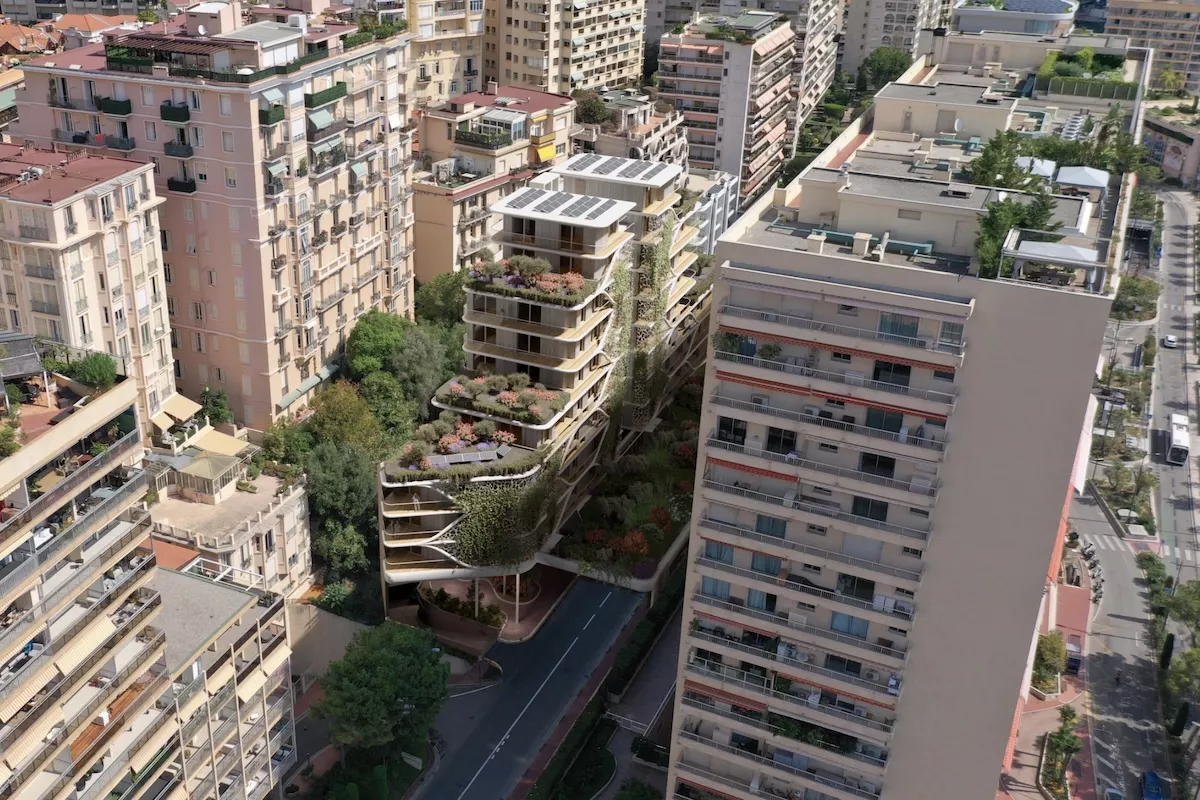
The building is designed in several curved slabs with softened edges and set-back balconies running its full length, a composition intended to reduce the impression of mass from the street. A central opening splits the building into two distinct sections, creating visual transparency through the structure and avoiding a solid-block effect. External vertical circulation — open rather than enclosed — adds lightness and improves ventilation while also providing clear access for emergency services.
A double-skin green façade of climbing plants wraps the exterior, varying in density to regulate light and privacy through the seasons. Apartments are designed to be adaptable, with load-bearing structures integrated into party walls to allow flexible internal layouts over time. All units are dual-aspect, with continuous balconies and recessed sections providing usable outdoor space. The project is targeting HQE and BD2M environmental certification and uses a hybrid timber-and-concrete structure.
Delay confirmed, completion now late 2028
Despite the legislative progress, the government confirmed at the 2 April session that the timeline has slipped. Recent geotechnical reassessments have led to the building being reclassified as a sensitive structure, a designation that carries additional technical requirements and could extend the construction period by around four months. Completion is now estimated for the final quarter of 2028.
The government also ruled out adding height to the building to increase the unit count, concluding that even a modest upward extension would deepen the canyon effect along boulevard du Larvotto and create overlooking issues for neighbouring properties, with lasting consequences for the quality of life in the area.
Stay updated with Monaco Life: sign up for our free newsletter, catch our podcast on Spotify, and follow us across Facebook, Instagram, LinkedIn, and Tik Tok.
Main image source: Abba Architects