

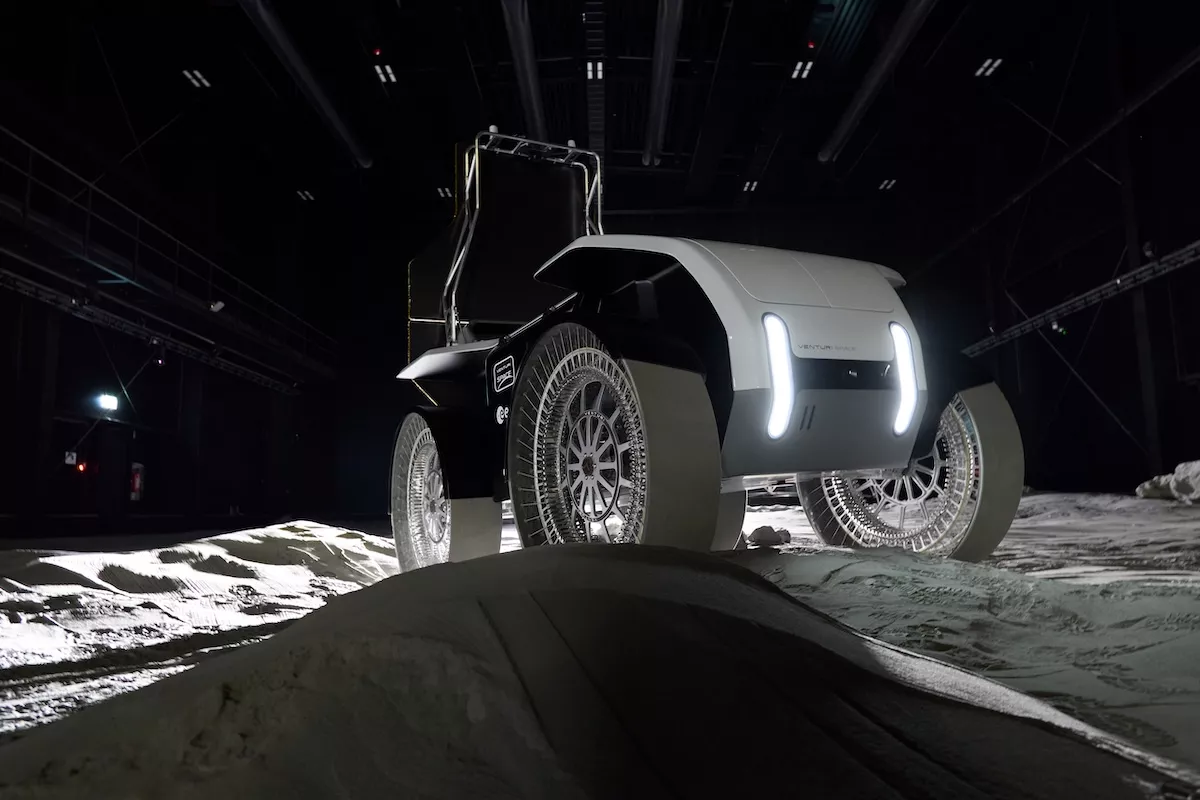
Venturi Space’s European lunar rover Mona Luna has completed a test campaign at the European Space Agency’s LUNA centre in Cologne, Germany, showing remarkable adaptability to challenging lunar terrain conditions. The tests, conducted five months after the rover’s unveiling at the Paris Air Show, represent a significant milestone for the Monaco-based company’s lunar mobility programme.
The 750-kilogramme rover, designed across Venturi Space’s three sites in Monaco, Switzerland and France, demonstrated performance exceeding initial expectations during the trials. Mona Luna is being developed to explore the lunar surface and test technologies for sustainable lunar mobility.
Performance exceeds projections
The rover’s four-wheel-drive and four-wheel-steering system, combined with passive-damping suspension, enabled it to climb and descend slopes of up to 33 degrees. The test results confirmed several key capabilities: exceptional contact area of the hyper-deformable wheels on both loose soil and rolling terrain, traction levels surpassing forecasts, effortless traversal of large rocky obstacles, dynamic stability on slopes meeting programme requirements, and excellent operational performance of onboard electronic systems.
The wheel technology builds on intensive testing conducted at NASA between 2022 and 2025, which validated the hyper-deformable wheel concept for lunar applications.
Technology sharing with FLIP rover
The Mona Luna rover demonstrated exceptional performance on slopes and loose soil at ESA’s Luna facility, five months after its Paris Air Show debut. incorporates technologies scheduled to operate on the Moon next summer aboard another rover called FLIP, developed by North American company Venturi Astrolab, Venturi Space’s strategic partner. Both vehicles will share the same hyper-deformable wheels, batteries, heating systems and temperature sensors. FLIP will also use Venturi Space’s mechanical system for exiting the lunar lander, and both rovers feature bodywork designed by Sacha Lakic.
Toulouse facility expansion
Parallel to the MONA LUNA development programme, Venturi Space continues expanding its industrial ecosystem. The company will lay the first stone of its flagship facility next spring: a site exceeding 10,000 square metres in Toulouse, adjacent to France’s Centre National d’Études Spatiales. The facility is scheduled to employ 150 engineers by the first half of 2028, working on Mona Luna’s design and manufacturing in collaboration with Swiss and Monegasque entities responsible for hyper-deformable wheels, heating systems, cryogenic materials, the rover-lander egress system, and high-performance batteries.
Industry perspectives
Daniel Neuenschwander, director of Human and Robotic Exploration at ESA, observed the tests at the Luna facility. “I was truly impressed by the way Mona Luna handled Luna’s challenging terrain,” he said. “Watching its wheels deform and adapt to the regolith, slopes and rocks… it is remarkable. If Mona Luna were to be selected for one of our missions, it would be a tremendous opportunity for Europe.”
Gildo Pastor, president of Venturi Space, expressed pride in the achievement. “Seeing Mona Luna operate on the legendary Luna site is a profound source of pride,” he said. “This rover demonstrates the performance of our wheels, our suspension systems, our electronics… and therefore the quality of the work achieved by all our teams in Toulouse, Monaco and Switzerland. We know we have only completed 1% of the journey that, I hope, will take us to the Moon.”
Dr Antonio Delfino, director of space affairs at Venturi Space, explained the test focus. “These driving tests were primarily dedicated to locomotion,” he said. “We wanted to understand how Mona Luna behaves on loose soil, on slopes and when facing significant obstacles. The results exceed our expectations. The ability of these wheels to ‘float’ on the surface is essential to avoid becoming bogged down in lunar regolith.”
Facility context
The ESA-DLR Luna facility in Cologne, inaugurated in September 2024, recreates lunar surface conditions with a 700-square-metre testbed containing 900 tonnes of basalt-derived regolith simulant. The facility features adjustable lighting to simulate lunar day-night cycles and polar lighting conditions, making it a crucial resource for testing both human and robotic lunar mission technologies.
Mona Luna is designed to support ESA and CNES missions to the lunar South Pole, with deployment targeted for 2030 aboard Europe’s Argonaut lander, launched by an Ariane 6 rocket.
Stay updated with Monaco Life: sign up for our free newsletter, catch our podcast on Spotify, and follow us across Facebook, Instagram, LinkedIn, and Tik Tok.
Photo source: Venturi Space