

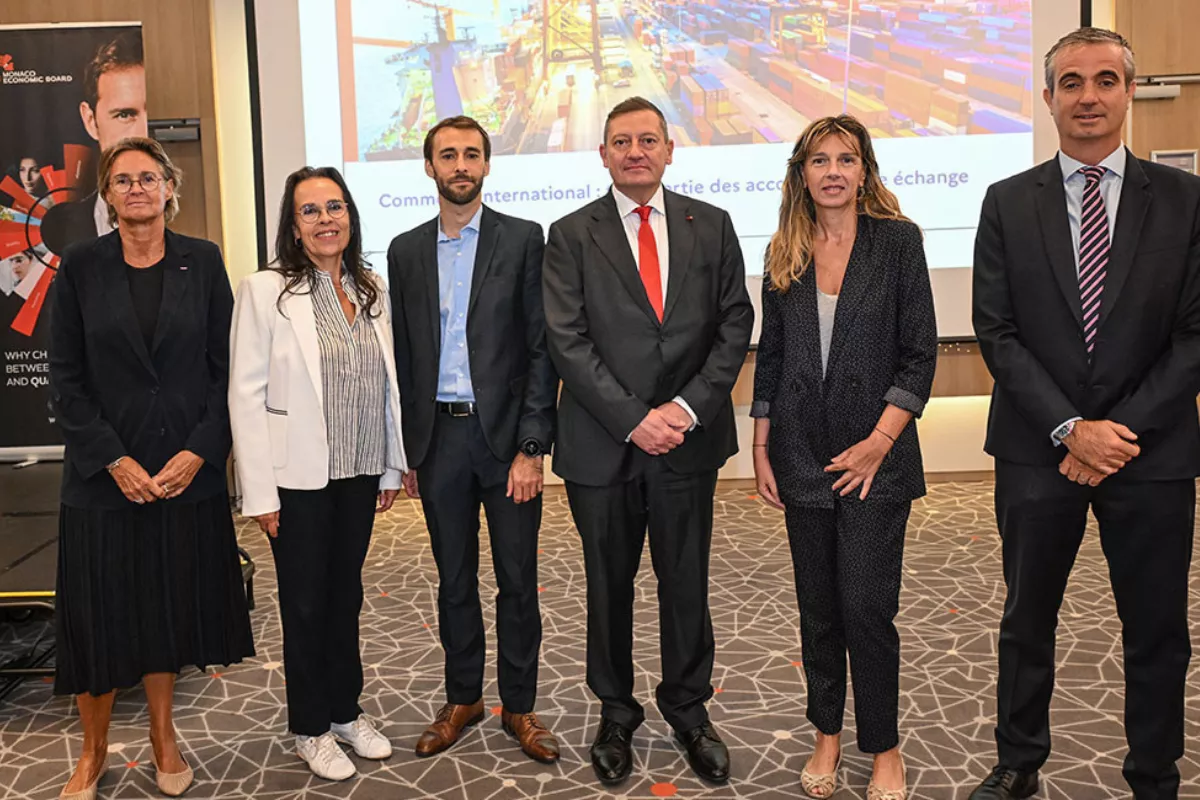
Around fifty import-export stakeholders gathered at the Novotel Monte-Carlo on Tuesday, 29th September, for a briefing hosted by the Monaco Economic Board (MEB), the Economic Action Unit of the Nice Customs Office, and the Monaco Customs Office to examine practical growth opportunities within the European Union’s expanding network of trade agreements.
Under the 1963 Franco-Monegasque Convention, France and Monaco operate within a customs union, meaning French regulations apply directly across the Principality. This framework positions Monegasque enterprises to leverage the EU’s extensive trade network, which spans 48 agreements with 79 partner countries and accounts for nearly half of all European trade.

Navigating new markets and tariffs
During the briefing, Étienne Pollet, Business Adviser within the Nice Economic Action Unit, highlighted recent trade treaties enacted with New Zealand, Kenya, and Chile, alongside upcoming prospects scheduled for 2026 and 2027. Advanced negotiations are currently underway with major economic blocs and nations, including MERCOSUR, Indonesia, Australia, and India. The primary objective of these pacts is to reduce or eliminate customs duties in heavily protected markets.
Despite these advantages, tariff preferences frequently remain underutilised by commercial operators due to complexity and a lack of familiarity, leading to billions of euros in missed savings across Europe. Experts emphasised that unlocking these benefits requires mastering the strict criteria governing the ‘origin of goods’—distinct from basic provenance—which relies on precise goods classification and sufficient transformation criteria.
Safeguarding operations and compliance
To help businesses legally secure operations and forecast international costs, customs authorities offer complimentary EU-wide support mechanisms. Participants were introduced to Binding Tariff Information (BTI) and Binding Origin Information (BOI). Furthermore, officials recommended utilising Access2Markets, the European Commission’s digital platform designed to verify trading conditions for specific countries.
The session highlighted the ongoing collaboration between Monaco Customs and the International Formalities service of the Monaco Chamber of Commerce, providing local companies with essential support for secure international expansion.
Stay updated with Monaco Life: sign up for our free newsletter, listen to our podcasts on Spotify, and follow us across Facebook, Instagram, LinkedIn, and Tik Tok.
Photo Credit: Sébastien Darrasse / MEB