

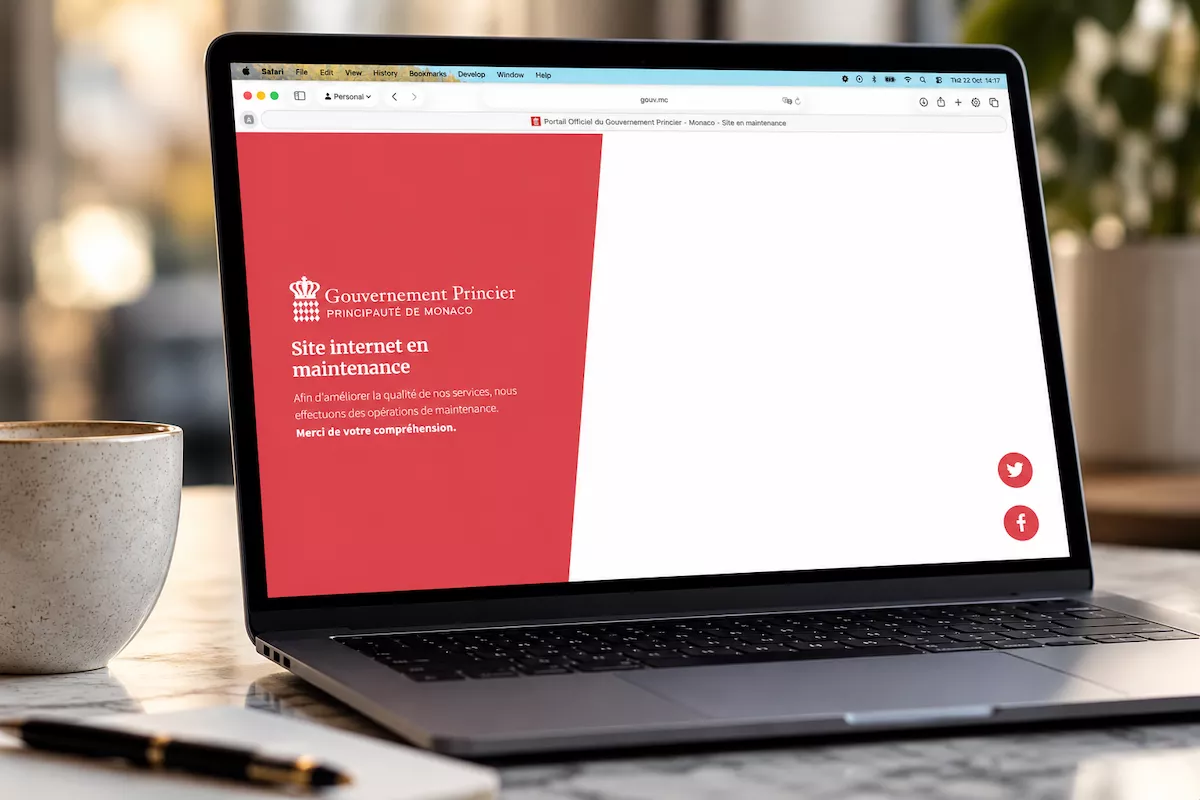
The Prince’s Government has confirmed that its Directorate of Information Systems and Infrastructure (DISI), in coordination with the Monaco Digital Security Agency (AMSN), took the precautionary decision to suspend external access to government websites following the identification of critical vulnerabilities in PHP, a programming language widely used to power websites.
The government says its websites remain accessible to staff through internal workstations, but the public will be unable to access them until the necessary security updates have been applied.
No timetable has been given for their restoration, with access expected to return progressively as the affected systems are secured.
AI uncovers major security weaknesses
The international alert follows the discovery of two critical vulnerabilities in PHP, technology used by an estimated 70% of websites worldwide to manage essential functions such as logins, databases and online transactions.
The flaws were identified through research involving OpenAI, Google-owned cybersecurity company Wiz and cybersecurity startup Calif, highlighting the growing role of artificial intelligence in uncovering weaknesses in widely used software.
Researchers warned that the vulnerabilities could potentially allow attackers to execute malicious code remotely and compromise affected servers.
OpenAI described the findings as among the most significant cybersecurity discoveries in recent memory.
Emergency software updates were released on Wednesday 21st October, prompting website administrators and public authorities to begin securing potentially vulnerable systems.
The situation has also raised broader questions about AI’s rapidly expanding capabilities in cybersecurity. The same technology helping researchers uncover weaknesses before they can be exploited is also becoming increasingly capable of assisting malicious actors.
Government websites taken offline across Europe
Monaco is among several European countries affected by precautionary shutdowns.
In neighbouring France, authorities temporarily restricted access to prefecture websites following warnings about the PHP vulnerabilities, while other European government and public-service websites have also been affected by emergency security measures.
The precautionary shutdowns do not necessarily indicate that the websites have been hacked. In Monaco’s case, the government has explicitly described its decision as preventive.
Municipal services also disrupted
Monaco Town Hall separately confirmed on Wednesday 21st October that its website and those of several municipal establishments had been temporarily taken offline.
The affected sites include the Jardin Exotique, Académie Rainier III, Espace Léo Ferré and the online magazine Monaco Vivre Ma Ville.
During the interruption, residents cannot access online administrative procedures, forms or appointment-booking services through the affected websites.
However, appointments already booked with the Civil Status and Nationality Department remain valid, while requests for official documents submitted before the shutdown have been registered and do not need to be repeated.
The websites of the Médiathèque Caroline and the École Supérieure d’Arts Plastiques remain accessible.
Residents requiring municipal assistance are advised to contact the relevant departments by telephone or email.
Both the Prince’s Government and Monaco Town Hall say their technical teams are working to restore services as quickly as possible, with security checks and software updates taking priority before public access resumes.
Monaco Life is written by qualified journalists, writing original content. Sign up for our free newsletter, listen to our podcasts on Spotify, and follow us across Facebook, Instagram, LinkedIn, and Tik Tok.
Image created by Monaco Life