

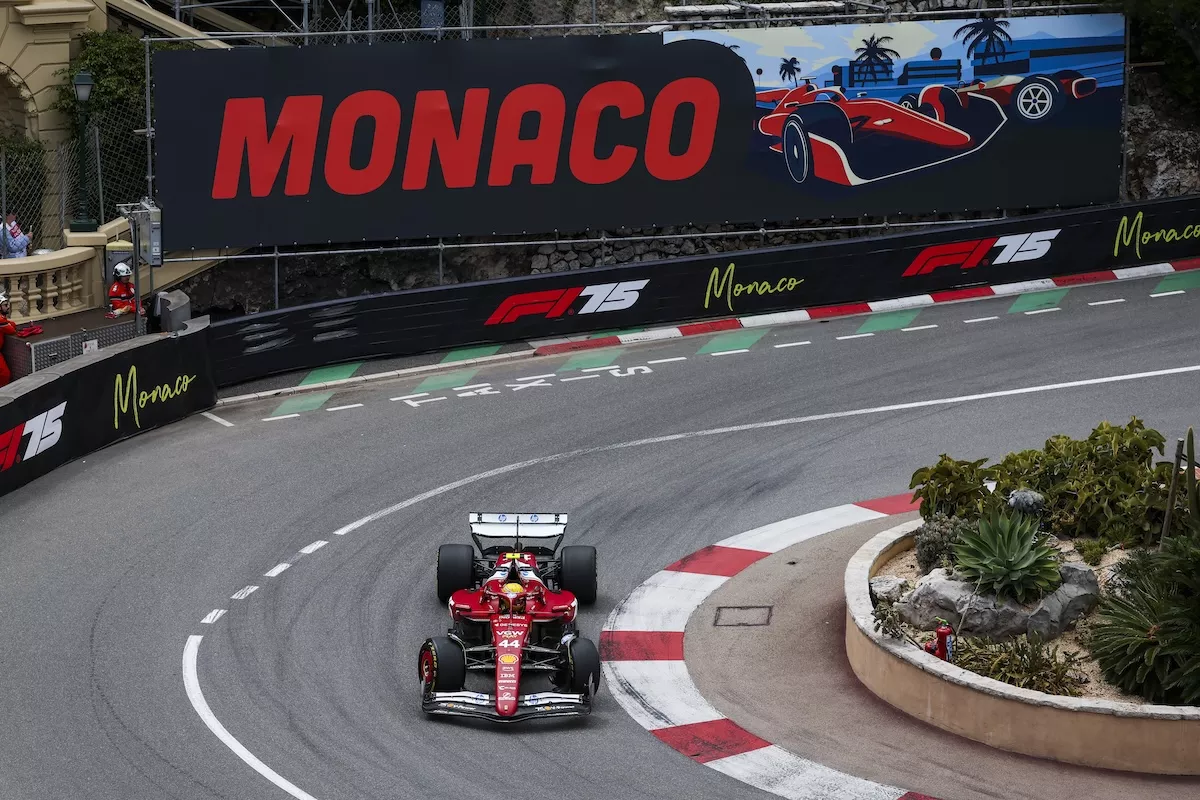
For the first time this season, Mercedes may not be the dominant force on the grid — and a single regulatory decision is largely responsible. The FIA has confirmed that active aerodynamics will not be used at this weekend’s Monaco Grand Prix, a ruling that reshapes the competitive picture and places Charles Leclerc’s Ferrari squarely in the conversation for victory on home ground.
The 2026 cars introduced straight mode — a system where both front and rear wings flatten to reduce drag on designated straights, replacing the DRS of previous seasons. At Monaco, however, that system will be entirely absent. The FIA determined that not a single section of the Monte Carlo street circuit meets the criteria required for the system to operate safely, with the tight barriers, minimal run-off and relentless cornering demands making activation zones impossible to define. The risk of instability at the tunnel exit, in particular, was considered too significant.
The result is a Monaco Grand Prix unlike anything the 2026 season has produced so far — one run on fixed aerodynamic surfaces, without straight mode, and without even the DRS option that was available in previous years.
Ferrari’s moment
Mercedes has won all five races so far in 2026, with Kimi Antonelli claiming four victories and George Russell one. That dominance has been built partly on the power and efficiency of the W17’s power unit — a factor that counts for considerably less around Monaco’s slow, twisting streets than it does anywhere else on the calendar.
The SF-26 suffers from a lack of power at high engine speeds, but is widely regarded as the best car in terms of chassis and aerodynamic performance through medium- and low-speed corners — precisely the conditions Monaco demands from the first corner to the last. Ferrari’s prospects have received an additional boost from Leclerc’s presence on home soil. After a disappointing performance in Montreal, many expect the Monégasque driver to return immediately to the front of the field in an environment where he has traditionally excelled.
Leclerc himself has been characteristically direct about what the weekend represents for Ferrari. “That’s the one track that power is not king. I think that’s definitely car performance. I think our car could be really strong,” he said ahead of the race.
The wider picture
McLaren, which runs the shortest wheelbase on the grid, will also carry legitimate ambitions, with the compact dimensions of the MCL40 well-suited to Monaco’s tighter sections. Mercedes, meanwhile, cannot be discounted — the latest upgrade package introduced on the W17 in Montreal was specifically aimed at increasing downforce, which remains the defining currency of a Monaco weekend regardless of which aerodynamic system is in play.
One thing is unlikely to change. Audi’s Gabriel Bortoleto has suggested overtaking will remain difficult despite the new tools available to drivers in 2026, noting that the removal of straight mode means the aerodynamic effect of the wings will also be absent — leaving qualifying, as ever, as the session that will most likely determine the race result.
Stay updated with Monaco Life: sign up for our free newsletter, listen to our podcasts on Spotify, and follow us across Facebook, Instagram, LinkedIn, and Tik Tok.
Photo source: Scuderia Ferrari Media Centre