

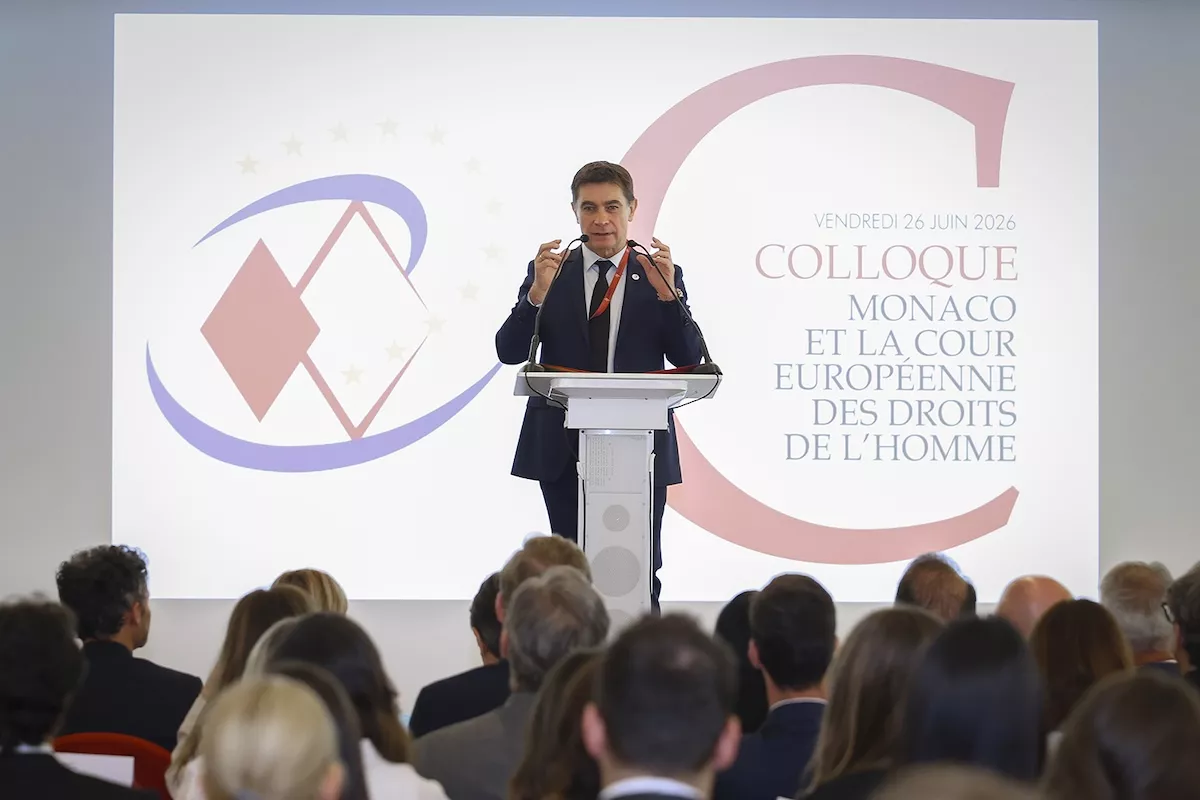
Monaco hosted a high-level symposium on Friday bringing together judges, legal experts and government officials to discuss the future role of the European Court of Human Rights (ECHR) as Europe faces growing challenges including climate change, artificial intelligence and armed conflict.The Symposium ‘Monaco and the European Court of Human Rights’, which was hosted at the Monte-Carlo Bay on Friday 26th June, was organised by the Monaco Institute for the Training of Judicial Professions, in collaboration with the Department of Foreign Affairs and Cooperation.
The event was held as part of Monaco’s presidency of the Committee of Ministers of the Council of Europe.
A shared commitment to fundamental rights
“Protecting human rights is not merely a legal exercise, but a collective duty,” said Isabelle Berro-Amadeï, Minister of Foreign Affairs and Cooperation of Monaco, in her opening speech.
Since joining the Council of Europe in 2004, Monaco has played an active part in the continuous dialogue that allows the Court to deliver balanced, reasoned decisions on complex modern issues.
Samuel Vuelta, Secretary General of the Department of Justice Services, said: “The European Convention is a foundational text that has helped drive judicial reforms and strengthen the independence of the courts in Monaco.”
The Court as a last resort
At the heart of the discussions was the principle of subsidiarity, which affirms that the primary responsibility for upholding human rights rests with national authorities.
Belgian legal expert, Frédéric Krenc, said: “The Court is intended to provide a common foundation of rights while allowing member states flexibility in how those rights are applied domestically.”
This delicate balance allows the system to remain flexible while holding states accountable when domestic protections fail.
Navigating contemporary challenges
Discussions also focused on climate change, artificial intelligence and the war in Ukraine.
Mattias Guyomar, President of the European Court of Human Rights, argued that these issues have reinforced the importance of the Court.
“Lasting peace,” he said, “relies on the genuine protection of human rights—the very foundation of democracy and global stability.'”
A living, accessible system
For those navigating the legal system, the message from the symposium was one of accessibility and rigour. Marialena Tsirli, the first-ever woman to be elected to the post of Registrar by the Judges of the European Court of Human Rights, shared the ongoing efforts to streamline the application process—moving towards electronic forms and implementing smarter case-filtering—to ensure that anyone within the jurisdiction of a member state can seek justice.
“These electronic applications represent a significant digital modernisation of the Court’s ‘front door,’” Tsirli said, adding: “By transitioning away from traditional, slow-moving paper correspondence to a secure digital portal, the Court is reducing administrative errors and speeding up the intake of cases. This is coupled with ‘smarter case-filtering,’ a data-driven approach that allows the Registry to quickly categorise incoming files and identify those that are inadmissible, ensuring that judicial resources remain focused on significant human rights issues.”
Whether through the work of mediators, the advocacy of lawyers, or the rulings of the judges themselves, the system is evolving to meet the needs of the 21st century. As the experts in Monaco made clear, the European Convention on Human Rights is not a static relic of the past; it is a vital, living instrument that continues to evolve, protect, and defend the rights of all.
A second conference focusing on corruption will be held this autumn, organisers announced.
Stay updated with Monaco Life: sign up for our free newsletter, listen to our podcasts on Spotify, and follow us across Facebook, Instagram, LinkedIn, and Tik Tok.
Photo credit: Stephane Danna, Government Communications Department