

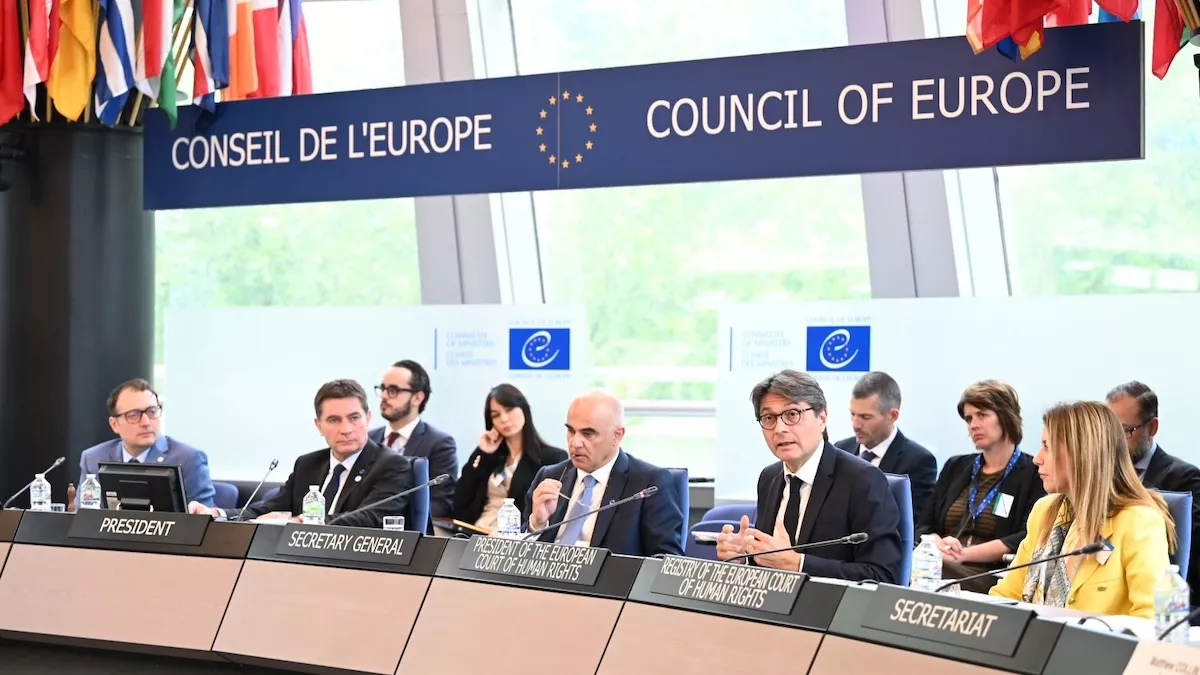
Justice ministers from all 46 member states of the Council of Europe adopted a declaration on Tuesday calling for stronger criminal justice action against money laundering and terrorist financing, with Monaco’s presidency of the Committee of Ministers taking a leading role in shaping the outcome.
The declaration, presented at a conference in Strasbourg under the Monegasque Presidency, sets out concrete measures to improve how financial crimes are investigated and prosecuted, how criminal assets — including crypto-assets — are identified, frozen and recovered, and how legal frameworks across member states adapt to the realities of digital finance, artificial intelligence and decentralised platforms.
Dirty money and democracy
“The fight against money laundering and terrorist financing is a long-term political commitment, which requires the constant adaptation of systems, the sustained involvement of all relevant stakeholders, and a strong, professional and independent judiciary,” said Samuel Vuelta Simon, Monaco’s Secretary of State for Justice.
Council of Europe Secretary General Alain Berset went further. “Tracking down dirty money, recovering it and preventing it from infiltrating our institutions is not just about fighting crime: it is about defending democracy,” he said.
What the declaration calls for
The declaration identifies asset confiscation as one of the most effective tools available to criminal justice systems and calls on member states to strengthen their capacity to identify, freeze, seize and recover the proceeds of crime — specifically including digital and crypto-assets. Financial intelligence units are singled out for a stronger role in the early detection and analysis of suspicious transactions, with the declaration calling for improvements to the quality and operational use of suspicious transaction reports.
On international cooperation, the text calls for earlier exchange of information between prosecutors and judges across borders, more joint investigation teams, coordinated multi-state operations and formal frameworks for sharing confiscated assets. Member states are also called on to adopt national strategies that bring together public authorities and private-sector entities subject to anti-money laundering obligations.
The declaration notes that all measures must remain consistent with the requirements of the European Convention on Human Rights.
Monaco holds the rotating presidency of the Council of Europe’s Committee of Ministers until November 2026.
Stay updated with Monaco Life: sign up for our free newsletter, listen to our podcasts on Spotify, and follow us across Facebook, Instagram, LinkedIn, and Tik Tok.
Photo: Samuel Vuelta-Simon (second from left), Monaco’s Secretary of State for Justice with Mattias Guyomar (second right), President of the ECHR, addressing justice ministers alongside Secretary General Berset (centre). Source: Council of Europe