

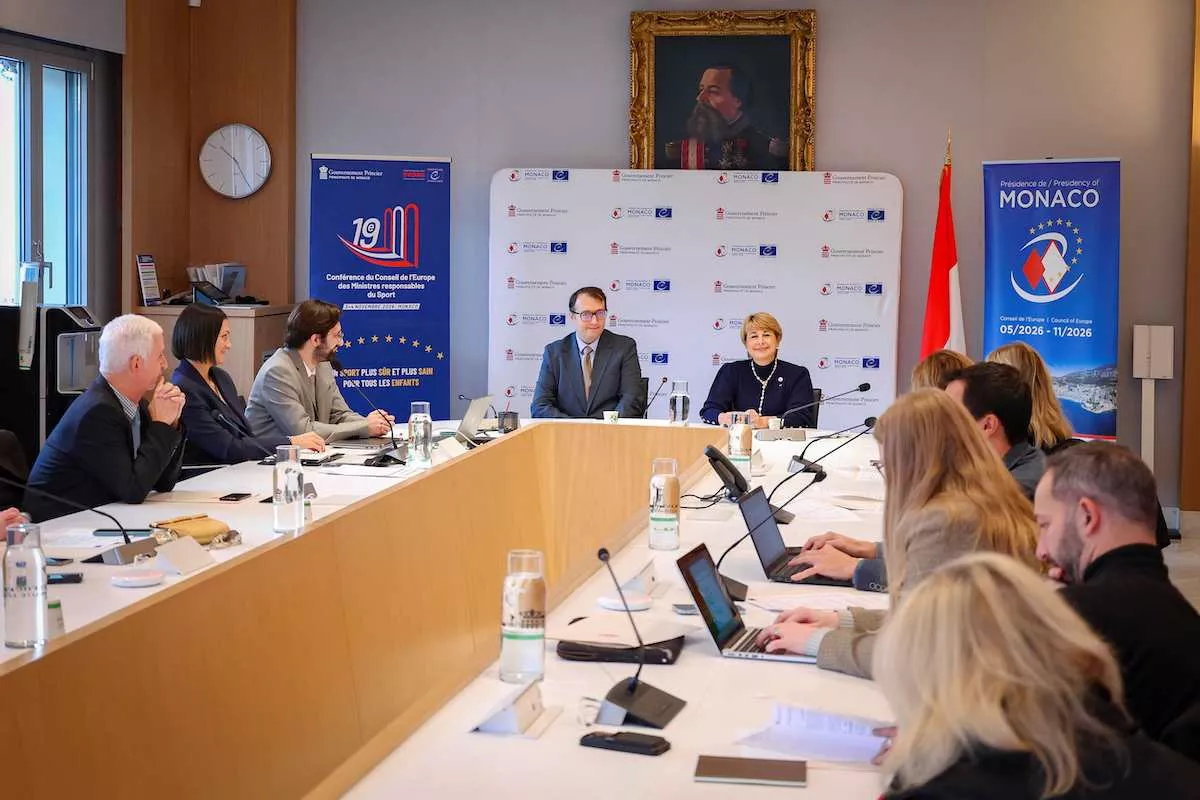
Monaco has shown that a small state can carry the full weight of chairing the Council of Europe, its foreign minister said this week, as the Principality reviewed a six-month presidency that took in new treaties on terrorism and money laundering, a solidarity visit to Kyiv and a ministerial conference on keeping children safe in sport.
Minister for External Relations and Cooperation Isabelle Berro-Amadeï and Ambassador Gabriel Revel, Monaco’s Permanent Representative to the Council of Europe, presented their review of the mandate at a press conference on Monday 23rd November, two weeks after the presidency of the Committee of Ministers passed to Montenegro on 10th November.
What it meant for Monaco
Twenty-two years after joining the Council of Europe in 2004, the Principality took the chair for the first time against a tense backdrop of Russia’s war in Ukraine, shifting global balances and mounting pressure on democratic norms.
“Above all, it showed that a state, whatever its size, can fully shoulder the responsibilities of a presidency and contribute actively to the work of an organisation bringing together 46 member states,” said Berro-Amadeï.
The presidency also drew on Monaco’s own institutions, with the Prince’s Government, the Judicial Services Directorate, the National Council and the Town Hall all involved, alongside steering committees that turned early plans into a full calendar. In Strasbourg, a cultural programme running from 20th May to 28th October brought Les Ballets de Monte-Carlo, pianist Stella Almondo, the Printemps des Arts de Monte-Carlo, the Petits Chanteurs de Monaco, the Monte-Carlo Philharmonic Orchestra and an exhibition from the Prince Albert II Foundation’s Prix de la Photographie Environnementale to a wider audience.
Protecting people, law and Ukraine
Monaco built its agenda around putting people first, especially the most vulnerable, from protecting women and children and encouraging young people to take part in public life to strengthening human rights, fighting organised crime and promoting unity across the Council of Europe.
On 3rd and 4th November, Interior Minister Lionel Beffre chaired the 19th Council of Europe Conference of Ministers Responsible for Sport in Monaco, on the theme ‘Safer and Healthier Sport for All Children’, as reported by Monaco Life. The conference drew some 300 participants, including young people, with Prince Albert II opening proceedings in the presence of Princess Charlene. Sessions focused on violence and abuse in sport as well as physical and mental health, including overtraining and performance pressure, and ended with a resolution setting common guidelines on prevention, response and cooperation between authorities and sports bodies.
Financial crime and legal cooperation were also high on the agenda. Justice ministers met in Strasbourg on 16th June, with Monaco’s Secretary of State for Justice Samuel Vuelta Simon leading the push to strengthen the fight against money laundering and cross-border judicial cooperation. Monaco signed a protocol on 26th May that sets a clear legal definition of a terrorist offence, and an additional protocol opened for signature on 14th October that boosts cooperation against money laundering and terrorist financing, including the confiscation of crypto-assets. According to the government, Monaco also signed the Macolin Convention on the manipulation of sports competitions.
Support for the European Court of Human Rights was underlined by Court President Mattias Guyomar’s official visit to Monaco on 25th June and, according to the government, a judicial symposium on fundamental rights.
Ukraine remained central throughout. On 15th September, Berro-Amadeï travelled to Kyiv with Revel and Florian Botto to show solidarity and to back the Register of Damage and the Special Tribunal, as well as initiatives on returning Ukrainian children and protecting endangered cultural heritage. The Ukrainian Special Tribunal was established by foreign ministers as Monaco took over the presidency in May, as reported by Monaco Life.
“Defending international law cannot stop at statements of principle; it also means backing the mechanisms that establish accountability and address the consequences of this war,” said Berro-Amadeï.
The presidency also linked the environmental crisis with human rights, through a debate held in Monaco on 2nd September that fed into Joint Committee talks on 30th September and Prince Albert II’s address to the Parliamentary Assembly in October.
The human side of the mandate
For Berro-Amadeï, the six months meant preparation on weekdays and weekends alike, frequent travel between Monaco and Strasbourg, and a sense of shared momentum across teams.
“What seemed like a mountain back in May ultimately proved relatively smooth to climb and leaves a genuine feeling of a duty fulfilled,” she said.
For Revel, the presidency chair offered an inside view of how the Council of Europe works at a hectic pace. His role involved keeping dialogue moving on sensitive issues such as migration and foreign interference, following up on decisions taken in Chișinău, overseeing the supervision of European Court of Human Rights judgments and pressing states with pending cases to meet their obligations.
“Returning to a more normal pace is a bit tricky,” joked Revel.
With the chair now in Montenegro’s hands, Monaco ends its first presidency having turned months of preparation into a lasting role in European affairs.
Stay updated with Monaco Life: sign up for our free newsletter, listen to our podcasts on Spotify, and follow us across Facebook, Instagram, LinkedIn, and Tik Tok.
Press conference reviewing Monaco’s Council of Europe presidency with Isabelle Berro-Amadeï and Gabriel Revel. Photo credit: Direction de la Communication / Stéphane Danna