

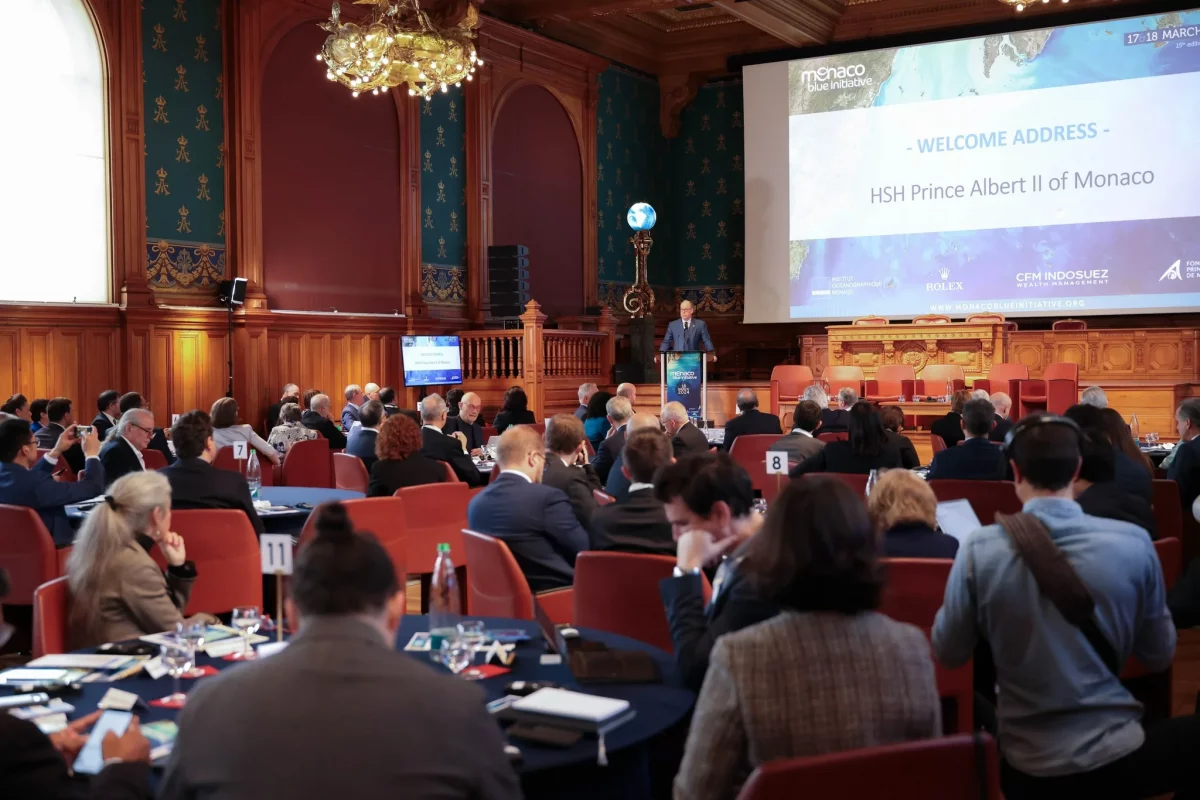
Two major ocean-focused events will take place in Monaco in late May, — the Monaco Blue Initiative on 27th May at the Musée océanographique, followed by the Blue Economy and Finance Forum at the Grimaldi Forum on 28th and 29th May.
Romain Ciarlet of the Fondation Prince Albert II de Monaco and Cyril Gomez of the Institut océanographique de Monaco presented both events at a virtual press conference on Tuesday 7th April as a deliberate sequence: moving from high-level governance dialogue to financial mobilisation, timed to land just weeks before World Oceans Day.
From recognition to action
Romain Ciarlet set the tone by identifying what he sees as the central challenge facing ocean policy. “The main issue today is not knowledge or science — it is the transition to action,” he said.
Despite a growing stack of international agreements and political commitments, implementation continues to lag. “States spend around 22 billion dollars a year on harmful fishing subsidies, compared to just over one billion for conservation. We continue to finance what destroys rather than what regenerates.”
Monaco Blue Initiative: talking candidly at the top
The Monaco Blue Initiative is a restricted-format gathering designed for senior policymakers, scientists and stakeholders to speak without constraint. “We are not here to make announcements,” Ciarlet said. “It is a format where participants can speak freely and align on key priorities.”
This year’s edition will focus on the post-2025 ocean agenda, implementation of the high seas biodiversity treaty — known as the BBNJ agreement — and the way geopolitical tensions are complicating environmental cooperation. “Without clear rules and reduced uncertainty, it is extremely difficult for the private sector to move in the right direction,” he added.
Blue Economy and Finance Forum: putting capital to work
Where the MBI focuses on strategy, the Blue Economy and Finance Forum — drawing around 400 participants including investors, corporations and entrepreneurs — is oriented toward execution. For Cyril Gomez, mobilising private capital is essential to any meaningful progress. “We will never be able to protect the ocean effectively without strong engagement from the private sector,” he said.
He pointed to the scale of activity already under way. “There are more than 3,000 companies working across the blue economy today. It is now possible to align business performance with ocean protection.” Through panels, investor sessions and an innovation showcase, the forum will cover maritime decarbonisation, sustainable food systems and ocean data technologies.
The message from both organisers was the same: the tools and solutions exist, but capital has yet to follow. “An underfunded ocean is an ocean in poor health,” Gomez said.
Ciarlet was equally direct: “The challenge now is to make solutions known to those who hold the capital and can truly drive change.”
See also:
Stay updated with Monaco Life: sign up for our free newsletter, catch our podcast on Spotify, and follow us across Facebook, Instagram, LinkedIn, and Tik Tok.
Photo source: FPA2