

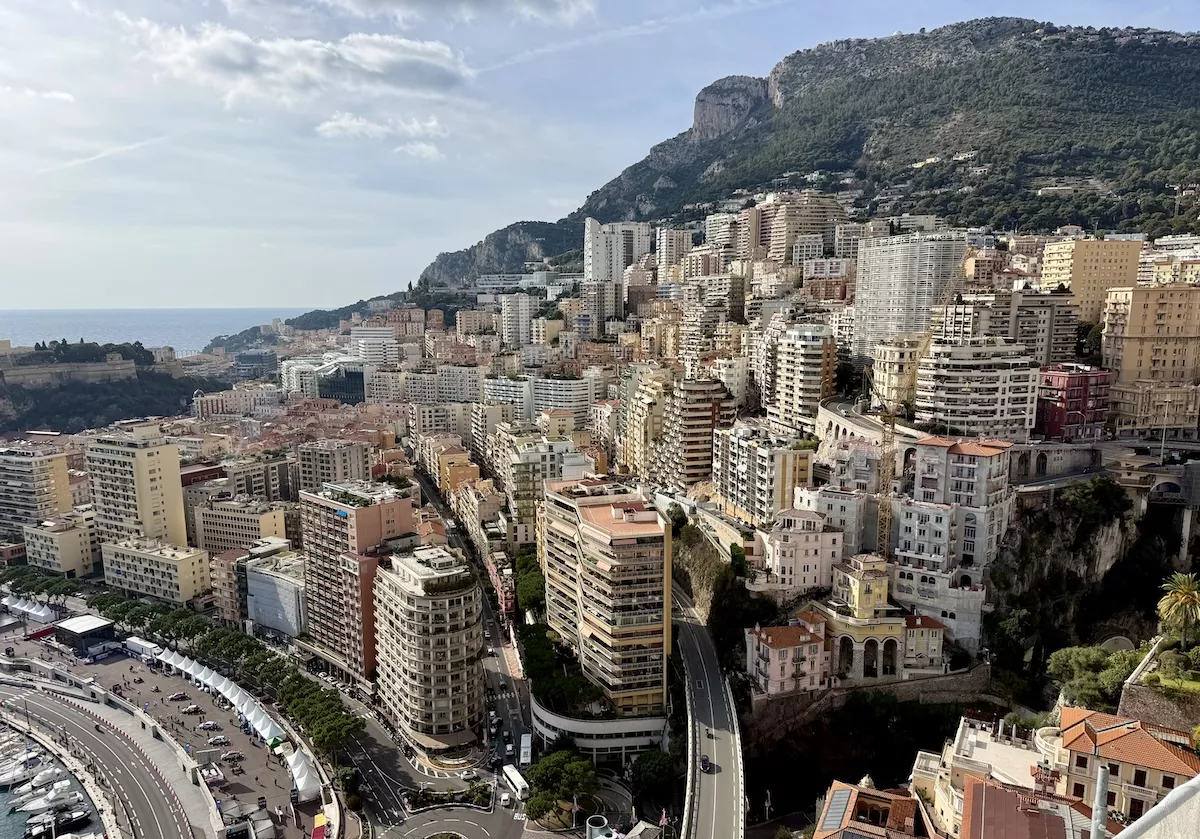
Monaco is, by almost any measure, an exercise in the extreme. At 2.08 square kilometres, it is the second smallest sovereign state in the world, after Vatican City, and the most densely populated. Yet within that sliver of Mediterranean coastline, the Principality has managed to construct a built environment of remarkable density — and the latest data from Monaco’s statistics office IMSEE puts precise numbers on just how much space has been carved out of so little land.
As of 31st December 2025, Monaco’s 1,473 buildings — including those under construction or authorised — contain a combined usable floor area of 3.4 million square metres. To put that in perspective: the total land area of the Principality is 2.08 million square metres. The built floor space already exceeds the entire surface of the country by more than 60%, a figure that speaks to Monaco’s extraordinary vertical density and its relentless upward ambition.
Of that 3.4 million square metres, housing accounts for 2.03 million — or just over 60% — the remainder occupied by commercial, office and other uses. More than 40% of the residential floor area is concentrated in just two districts: Monte-Carlo, with 453,500 m² of housing, and La Rousse, with 389,300 m².
Where people actually live
The district breakdown reveals the stark contrasts within Monaco’s eight neighbourhoods. Monte-Carlo dominates with 314 buildings and the largest housing footprint. Fontvieille, primarily an industrial and commercial district, has the greatest cumulative floor area of any district at 605,000 m² — but a comparatively modest residential share of 228,700 m², reflecting its mixed-use character.
At the other end of the scale, Monaco-Ville — the historic Rock, home to the Prince’s Palace — accounts for just 56,700 m² of residential space across 220 buildings, the smallest housing footprint in the Principality by some distance. Larvotto, despite its seafront cachet and some of the highest per-square-metre prices recorded anywhere in Monaco, has only 57 buildings and 197,900 m² of housing — though that is set to shift as recently completed developments including Jardins d’Eau and Le Renzo begin to register fully in IMSEE’s data.
The price of scarcity
The physical constraints of the Principality have a direct and well-documented effect on prices. The 2025 Real Estate Observatory, published by IMSEE in February 2026, records an overall price per square metre of €57,569 — historically elevated even by Monaco’s own standards, though marginally below the 2024 peak of €58,402. In the Larvotto district, prices have crossed €70,000 per square metre for the first time, driven by the arrival of new luxury developments on the resale market.
For properties built since 2020 — the decade that includes Mareterra, L’Exotique and Bay House (Testimonio 2) — the average price per square metre reaches €65,602, the highest of any construction era in the dataset. Even the oldest stock, buildings dating from before 1940, commands more than €42,000 per square metre. In Monaco, age is not much of a discount.
See also:
Monaco real estate 2025: high-value flips, limited new supply and a revamped price index
Stay updated with Monaco Life: sign up for our free newsletter, catch our podcast on Spotify, and follow us across Facebook, Instagram, LinkedIn, and Tik Tok.
Main photo credit: Cassandra Tanti