

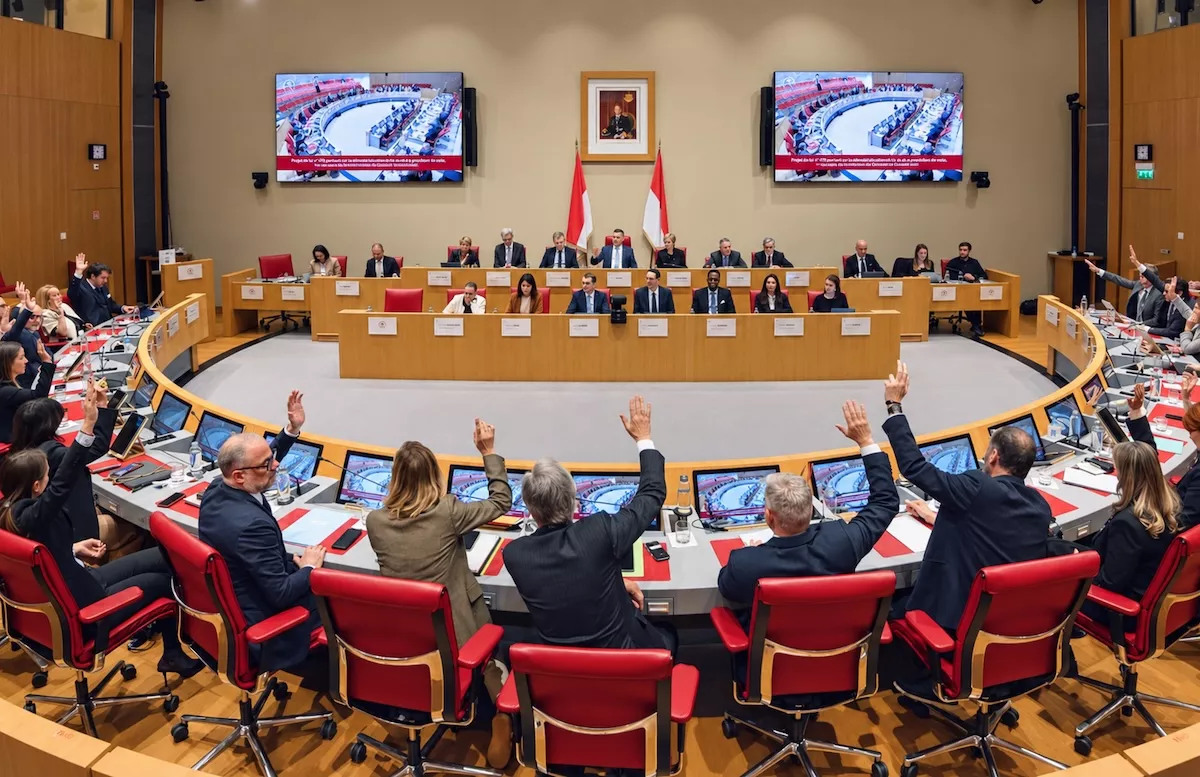
Monaco’s National Council has approved the Principality’s 2026 amended budget, a week after its president suspended the debate in protest, having secured commitments from the Government on the two issues at the top of its agenda: priority access to public sector jobs and the supply of state-owned housing.
The budget passed on Thursday 15th October with 13 votes in favour, two against and five abstentions. Council President Thomas Brezzo insisted that neither side had backed down. “The Assembly did not win against the Government, and the Government did not give way to the Assembly. It is Monaco that is moving forward,” he said.
A suspended session
The vote brought to a close a tense week between the elected Assembly and the Government. At the first public session on the amended budget on 7th October, Minister of State Christophe Mirmand opened his response by reminding councillors that the Government takes its strategic priorities, and the confidence to carry them out, from the Sovereign Prince alone, and that it is not constitutionally answerable to the National Council.
Councillors said the remarks did serious damage, “in substance as in tone”, to relations between the two institutions. Brezzo suspended the session, a rare step, to give the Minister of State time to reflect, arguing that elected representatives could not be expected to give up their parliamentary prerogatives, and warning that continuing without genuine dialogue risked “a total impasse”.
At the heart of the stand-off were two long-running demands from the Assembly. The first was stronger enforcement of the National Priority, the principle that gives Monegasque nationals precedence in employment. Brezzo had claimed in September that more than 50 qualified Monegasque candidates were turned away from public sector jobs each year, describing the situation as “unacceptable”. The Government disputed the figure, saying the applications from 2025 concerned 31 people, 16 of whom were subsequently recruited.
What the Council secured
When the debate resumed this week, the Government had shifted its position. A joint commission will be created to support Monegasque nationals facing difficulties in their careers, something the Minister of State had initially rejected on the grounds of the separation of powers. Senior posts in the civil service will now be advertised systematically, so that Monegasques can apply, and a dedicated contact within the Minister of State’s office will report to the National Council each year on how the National Priority is being applied.
On housing, the Government recommitted to building new state-owned apartments on a regular basis, with the aim of housing 75% of Monegasques in the state sector. The Council had pressed for around 100 new homes a year, while the Government had argued that 40 a year would be sufficient, based on population figures from the IMSEE, the Principality’s statistics institute.
The issue is pressing. No new state-owned apartments are due to be delivered in 2026 or 2027, with the first tower at Bel Air not expected until January 2028, after geotechnical problems delayed several projects. The Government has promised around 90 homes at the next allocation round through accelerated renovations.
A budget squeezed by falling revenue
Beyond the political confrontation, the amended budget reflects a tighter financial picture. Revenue has been revised down by €67.9 million, or 3.1%, to €2.149 billion, driven by lower receipts from VAT and corporate tax as the exceptional income generated by the Mareterra land extension dries up. Ordinary spending, meanwhile, is up 3% on the initial budget, due in part to civil service pay rises and the cost of organising the Pope’s visit.
To balance the books, €107 million of investment spending was removed, though the Government says €104 million of that is simply a delay to project timelines. Franck Julien, who chairs the Council’s Finance and National Economy Committee, was unconvinced. “Postponing is not saving: these expenses will come back in 2027,” he said.
The Minister of State defended the forecasts, pointing out that last year the Government was criticised for underestimating revenue by €400 million. He described a 3% gap on a budget of more than €2 billion as “an honest forecast, not a miscalculation”, and noted that the budget still ends with a surplus of €5.9 million, with no borrowing and no income tax.
The real test in December
For the National Council, the promises made this week are only a first step. Councillors say the commitments must now translate into concrete measures, including new housing projects beyond those already under way, when the Assembly examines the 2027 initial budget in December.
Monaco Life is written by qualified journalists, writing original content. Sign up for our free newsletter, listen to our podcasts on Spotify, and follow us across Facebook, Instagram, LinkedIn, and Tik Tok.
Photo source: National Council of Monaco