

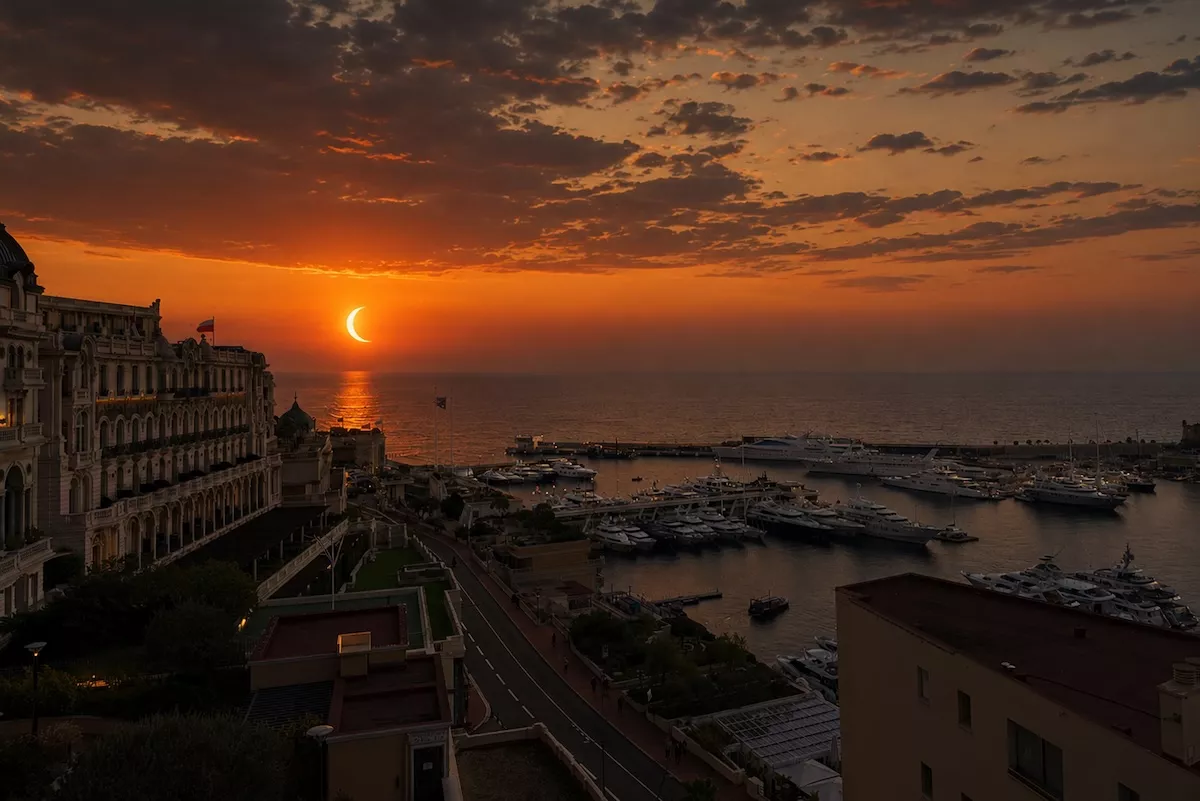
Around 95 per cent of the Sun will disappear behind the Moon in the skies over Monaco on the evening of Wednesday 12 August, when a rare total solar eclipse sweeps across the far north of the planet and cuts across the Iberian Peninsula. The Principality sits well outside the narrow band where the Sun is blotted out entirely, but it will still see one of the deepest partial eclipses observed from the Riviera in years, unfolding low over the horizon as the Sun begins to set.
It will be the first total solar eclipse visible from mainland Europe since August 1999, though only a handful of European regions fall directly beneath the Moon’s shadow. Everywhere else on the continent, including Monaco, the event will register as a partial eclipse of varying depth.
What Monaco will see
From Monaco, the Moon will begin to bite into the Sun’s disc at around 7.30pm, with the eclipse reaching its maximum at roughly 8.24pm. At that point close to 95 per cent of the Sun will be covered, leaving only a thin crescent of light. Crucially, the Sun will be very low in the sky at maximum, sitting little more than two degrees above the horizon towards the west-north-west.
Because the Sun is so low, it will slip below the horizon while still substantially eclipsed, rather than the eclipse being seen to run its full course in a clear sky. This makes an unobstructed western horizon essential for anyone hoping to follow the event to its conclusion, and the hills and buildings rising to the west of the Principality may cut the view short. A vantage point looking out over the sea towards the west offers the best chance of catching the crescent Sun as it descends.
The depth of the eclipse is broadly similar along this stretch of coast. Neighbouring Nice will see about 95 per cent of the Sun covered, Marseille around 96 per cent, while further north Paris will reach roughly 92 per cent.
A total eclipse for Iceland and Spain
The path of totality, the narrow strip where the Moon completely covers the Sun and day briefly turns to twilight, begins in the Russian Arctic and travels south across Greenland and the Atlantic before crossing western Iceland, northern Spain, the Balearic Islands and the north-eastern tip of Portugal. The longest period of totality, lasting 2 minutes and 18 seconds, falls over the ocean just off Iceland’s western coast.
The eclipse takes place close to the point at which the Moon is nearest to Earth in its orbit, meaning the Moon appears slightly larger than usual and the total phase lasts a little longer as a result. In Spain, totality arrives shortly before sunset, with the darkened Sun hanging low in the evening sky.
Watching safely
There is no moment during the eclipse in Monaco when it is safe to look at the Sun with the naked eye. Unlike observers within the path of totality, who can briefly remove their protection during the total phase, viewers in the Principality will see only a partial eclipse and must keep certified eye protection in place from start to finish.
Eclipse glasses and handheld solar viewers are safe only if they meet the international ISO 12312-2 standard, which should be printed on the product. They should be inspected before use and discarded if scratched, torn or coming away from the frame. Ordinary sunglasses offer no protection whatsoever, even very dark ones, and stacking several pairs together does not make them safe.
Eclipse glasses must never be used in combination with binoculars, a telescope or a camera. The concentrated light gathered by such instruments will burn straight through the filter and cause serious eye injury. Any optical instrument used to view the Sun needs a purpose-made solar filter fitted securely over the front, never at the eyepiece. Children should be supervised throughout.
Viewing without eclipse glasses
Those without certified glasses can still follow the eclipse safely using indirect projection, which involves looking at an image of the Sun rather than the Sun itself. A small hole punched in a piece of card, held up with the Sun behind the viewer, will project a crescent image onto a surface below. A kitchen colander works in the same way, casting dozens of crescents at once, as do the small gaps created by crossing the slightly open fingers of both hands. The dappled light beneath a leafy tree produces the same effect, scattering tiny crescent Suns across the ground.
Looking ahead
For those left wanting more, the Côte d’Azur will not have to wait long for a second chance. On 2 August 2027, another total solar eclipse will cross southern Spain, the Strait of Gibraltar and North Africa, with totality lasting well over four minutes along the Andalusian coast and more than six minutes in Egypt. It too will be seen as a deep partial eclipse from Monaco. A further eclipse, annular rather than total, will pass over Spain and Portugal on 26 January 2028.
Monaco Life is produced by real multi-media journalists writing original content. See more in our free newsletter, follow our Podcasts on Spotify, and check us out on Facebook, Instagram, LinkedIn and Tik Tok.
Photo of Monaco by Cassandra Tanti, with AI generated eclipse overlay