

A private collector has spent a quarter of a century quietly building what Sotheby’s is now describing as the largest and most comprehensive collection of vintage Cartier watches ever brought to market. This year, it goes under the hammer across three continents.
The Shapes of Cartier: The Finest Vintage Grouping Ever Assembled spans more than 300 timepieces and traces a century of Cartier’s watchmaking history, with pieces drawn from all three of the maison’s historic branches — Paris, London and New York. The collection is expected to achieve in excess of $15 million in total, distributed across Sotheby’s Important Watches auctions in Hong Kong on 24 April, Geneva on 10 May and New York on 15 June.
Why Cartier London is the star
While Cartier Paris produced the Tank and Santos that most collectors recognise instantly, it is the London branch — and specifically its extraordinary experimental period between 1967 and 1974 — that gives this collection its most significant pieces and its genuine depth.
Operating independently from Paris and New York, Cartier’s Bond Street workshop under Jean-Jacques Cartier pushed the boundaries of watch design further than anywhere else in the maison’s history. The results were watches that challenged every convention of the form: asymmetrical, geometric, distorted, sculptural — objects that had more in common with wearable art than conventional horology.
The centrepiece of the Hong Kong sale is a rare yellow-gold Cartier London Crash from 1987, estimated at $400,000 to $800,000. The Crash, originally conceived in 1967, remains one of the most radical watch designs ever produced. Its entire form — case and dial — was deliberately deformed into a surreal, melted silhouette. For years, stories circulated that the design was inspired either by Salvador Dalí’s melting watches in The Persistence of Memory or by a Baignoire Allongée destroyed in a car accident. As Francesca Cartier Brickell revealed in her book The Cartiers, neither is true: Jean-Jacques Cartier and his chief designer Rupert Emmerson simply took the existing Maxi Oval, pinched and bent it, and created something entirely new. Fewer than a dozen original London Crash watches are believed to have been produced between 1967 and 1970. This 1987 example is thought to be one of only three made that year.
The other highlights
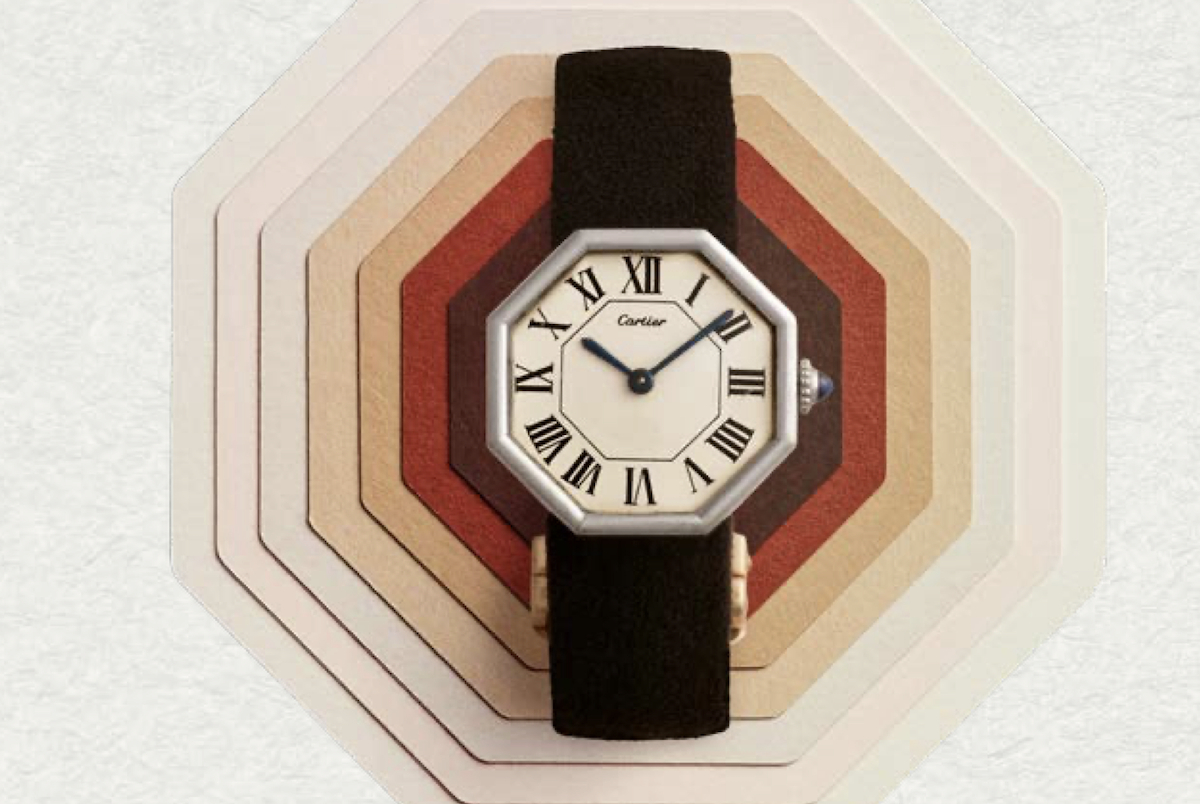
Alongside the Crash, the collection includes a remarkable assembly of Cartier London pieces that rarely appear on the open market. A Decagonal — a ten-sided 18ct yellow gold watch hallmarked 1970–71 — is one of only five known examples, all in men’s sizes, estimated at $60,000 to $80,000. A Tank Asymétrique in 18ct white gold with blue numerals, hallmarked 1992, carries the same estimate range. An Asymétrique with blue enamel from 1973–74, produced in the final phase of Cartier London’s experimental years, is one of only five known London enamel watches from the era, estimated at $50,000 to $80,000.
A gentleman’s Baignoire London from circa 1973–74, in yellow gold with the case ends stretched outward rather than pinched — inverting the standard Baignoire form entirely — is estimated at $50,000 to $68,000. A Driver’s watch from 1966–67, deeply curved to allow the time to be read from the steering wheel, estimates at $50,000 to $80,000. A Tank Allongée in white gold with a stark black dial from 1992 is estimated at $40,000 to $60,000.
What makes this collection unusual
Sam Hines, Global Chairman of Sotheby’s Watches, described the collection as remarkable not merely for the number of pieces but for the quality and rarity of individual examples, particularly in the London category. “The appeal of vintage Cartier lies in its ability to capture a moment in design history while remaining entirely timeless,” he said. “This collection is remarkable not only for its breadth, but for its depth — particularly in its unprecedented assembly of Cartier London pieces, many of which are among the most important examples ever to appear on the market.”
The auction schedule begins in Hong Kong on 24 April, with further sales in Geneva on 10 May and New York on 15 June. Additional highlights from the collection will be announced throughout the year.
Stay updated with Monaco Life: sign up for our free newsletter, catch our podcast on Spotify, and follow us across Facebook, Instagram, LinkedIn, and Tik Tok.
Photo source: Sotheby’s