

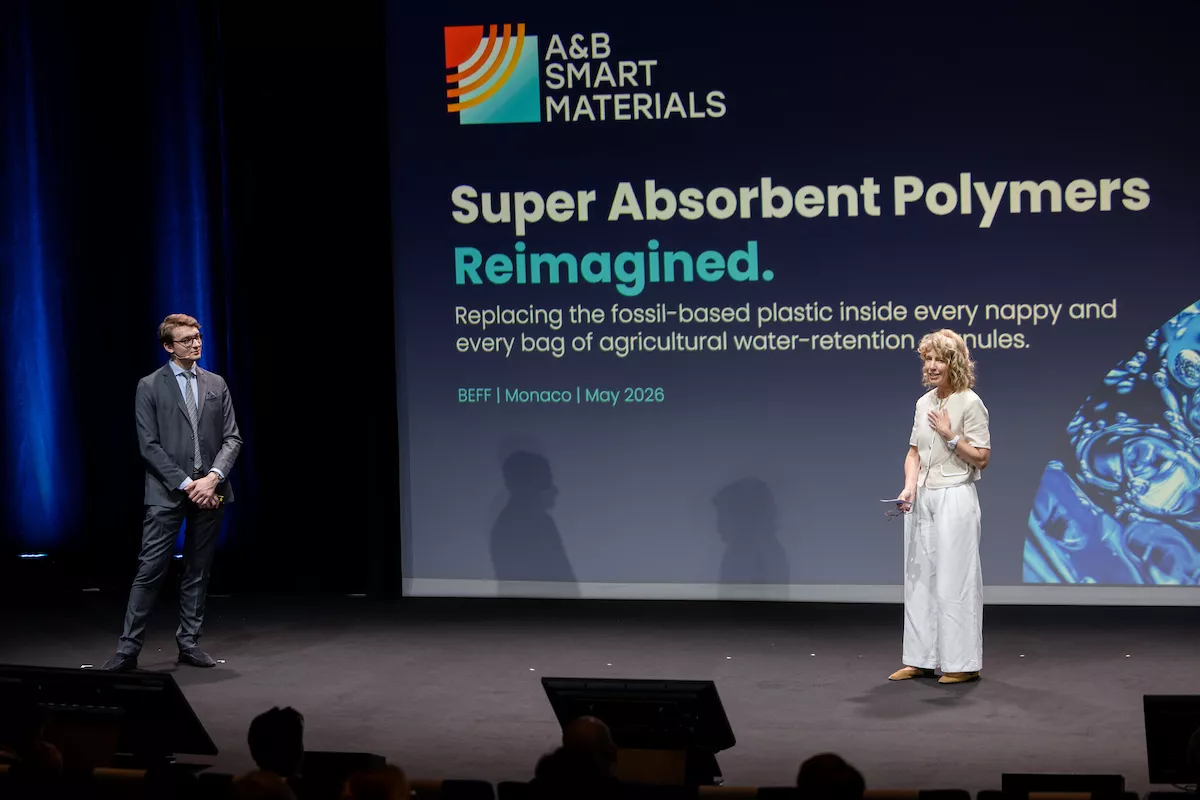
At the Blue Economy & Finance Forum (BEFF) 2026 held in Monaco in May, A&B Smart Materials took centre stage to introduce a disruptive solution to the nappy waste crisis. With 300,000 disposable nappies entering the environment every minute, the start-up is replacing persistent fossil-fuel plastics with bio-based alternatives that promise to reshape the future of the hygiene industry.
Modern hygiene products—nappies and menstrual pads—rely on synthetic SAPs to function. These polymers are engineering marvels, capable of absorbing hundreds of times their own weight in liquid. However, they come at a heavy environmental cost.
Currently, the industry consumes 200 million barrels of oil annually to produce these fossil-fuel-derived plastics. Designed for extreme durability, they are not biodegradable; they can persist in the environment for up to 500 years, eventually breaking down into the microplastics that permeate our ecosystems, from our soils to our own bloodstreams.
With the market for these materials projected to balloon from $9 billion today to $17 billion by 2035, the environmental ticking clock is accelerating.
A bio-based solution
Enter Amaury Van Trappen and his team at A&B Smart Materials. An Oxford-based startup, the company has developed a groundbreaking, fully bio-based, and biodegradable alternative to synthetic SAPs.
“What we are looking for is a way to solve the global plastics crisis, and we can’t do that without identifying a solution for nappies,” said Lucy Mortimer, a founding partner at Archipelago Ventures, during the BEFF 2026 pitch session. “A&B Smart Materials offers that solution. Their polymers can be programmed to decay within days, not decades.”
By utilising abundant, low-cost natural feedstocks, the team has created a ‘drop-in’ solution. This means hygiene manufacturers—the P&Gs and Kimberly-Clarks of the world—could theoretically swap out their synthetic polymers for A&B’s greener alternative without needing to overhaul their entire industrial machinery.
Why investors are paying attention
The impact potential has already drawn significant attention. A&B Smart Materials recently closed an oversubscribed $2 million pre-seed round, backed by a consortium of strategic investors including Archipelago Ventures and others.
The urgency is bolstered by a tightening regulatory landscape. The EU has already signalled a move to ban non-biodegradable synthetic SAPs in soil-related applications by 2028, effectively forcing the industry to innovate or face obsolescence.
For Van Trappen, who was recently named to the Forbes 30 Under 30 list, the goal is clear: to prove that environmental impact and high-scale investment returns are not mutually exclusive.
What’s next
With the pre-seed round successfully closed, the team is now turning its attention to the challenge of industrial-scale production. As the company eyes its next major funding round by early 2027, they are actively seeking strategic partnerships within the chemical and hygiene industries to move their innovation from the laboratory to the supermarket shelf.
As Van Trappen noted during the BEFF 2026, the goal is not just to improve a product—it is to unlock circularity for a massive, global industry. “The only thing blocking nappies from being truly biodegradable is the super absorbent,” he says. “We are unlocking that.”
Stay updated with Monaco Life: sign up for our free newsletter, listen to our podcasts on Spotify, and follow us across Facebook, Instagram, LinkedIn, and Tik Tok.
Photo: Amaury Van Trappen and Lucy Mortimer during the BEFF 2026 pitch session. Credit: Philippe Fitte.