Twins send love to Princess Charlene on National Day

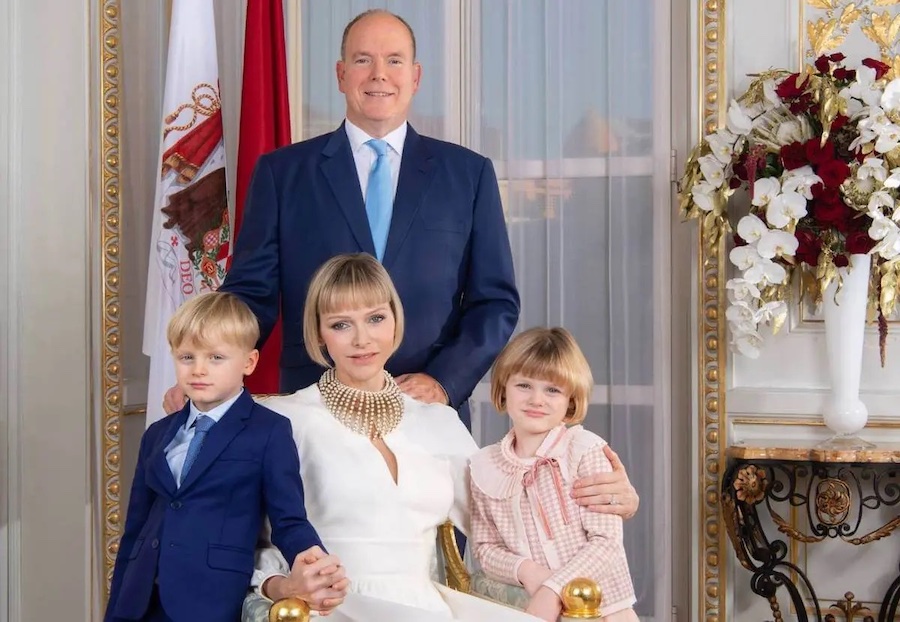
It was the tear-jerker moment of National Day celebrations, when twins Prince Jacques and Princess Gabriella held up signs from the Palace window saying “We miss you mommy” and “We love you mommy”, as Prince Albert put his hand to his heart.
It was always going to be a day of mixed emotions – a solemn mass at the Cathedral, the awarding of medals to service men and women, a celebration of 724 years of the House of Grimaldi.
But most poignantly, for the first time since their marriage 10 years ago, Princess Charlene was absent from National Day festivities this year in Monaco.
However, she was certainly not forgotten. About an hour after appearing in the Palace window alongside their father Prince Albert for the official military parade, six-year-old twins Prince Jacques and Princess Gabriella held up hand-drawn signs saying “We miss you mommy” and “We love you mommy”, complete with red love hearts. A smiling Prince Albert looked to the crowd for their reaction, then affectionately put his hand to his heart and signaled a kiss as the crowd cheered on in support of the family.
The Princess was due to appear alongside her husband and two children to mark the special day, but the Palace revealed earlier in the week that she needed more time to recover from her state of “deep general fatigue”, in a location outside of the Principality.
In an interview with People published on Friday, Prince Albert further revealed that Princess Charlene’s current state is the result “of several factors which are private matters.” He added, “she was clearly exhausted, physically and emotionally. She was overwhelmed and couldn’t face official duties, life in general or even family life.”
The Prince said that his wife had agreed that the best thing for her was to “have a rest and have a real medically framed treatment,” in a facility outside of Monaco for privacy reasons.

Photo by Michael Alesi / Stéphane Danna, Government Communication Department

Earlier on National Day, Princess Gabriella and Prince Jacques, decked out in full military attire, embraced their public duties and stood alongside their aunts Caroline, Princess of Hanover, and Princess Stephanie as Prince Albert completed the traditional awarding of medals in the Palace courtyard.
Also present for National Day celebrations was the extended Princely family, including Pierre Casiraghi and his wife Beatrice, Louis Ducruet and his wife Marie, Pauline Ducruet and Camille Gottlieb.
 
 
Top photo Michael Alesi / Stéphane Danna, Government Communication Department


Soriano Giaguaro: the future of electric motorbikes

Monaco Life was in Milan for the recent unveiling of the Soriano Giaguaro V1R electric motorbike, “one of the most advanced, stylish, environmentally friendly Italian machines on the planet.”
There are many things that Italy is famous for: the food, the wine, the fashion and the very fast cars. Something Italy is not decidedly famous for is superbikes, but that hasn’t stopped Marco Antonio Soriano from relocating the family’s motorcycle company, founded in Madrid in 1939, to Bel Paese and entrusting the Soriano legacy to a team of local experts.
On 10th November that team joined Marco, Founder of Soriano Motori Corp, for the fervent unveiling of the Giaguaro V1R electric motorbike in Milan – a profound revamp of the 1944  Tigre created by his grandfather, the impressively named Ricardo Soriano Hermensdorff von Scholtz, Marquis of Ivanrey. That 96cc beauty was also on display in Milan, a stark reminder of how far technology has come in 80 years.

Ricardo Soriano Hermensdorff von Scholtz

The original 1944 96cc Tigre, photo credit Simona Bruno

“It is an emotional moment today because it is my family legacy,” Soriano tells Monaco Life. “Not everyone has this history, this nostalgia and emotion. I think the human factor is driven by emotion, and this is where my creativity comes from.”
What began as a design on a napkin has become a game-changing vehicle that oozes Italian sophistication and style; a powerful sports bike designed to satisfy a generation of younger riders who want to position themselves in a sustainable future.
“The owners of Soriano EV motorcycles are promised to be piloting one of the most advanced, stylish, and environmentally friendly Italian machines on the planet,” says Soriano.
The motorbike features two electric motors which consist of liquid-cooled brushless units developed in collaboration with Moog. It weighs in at 100 kilograms, can charge from empty in 15 minutes, has a range of 320 kilometres, a max of 180kms/h and measures 80hp (60kw) thanks to a powerful 15-20kw battery comprised of high-capacity Lithium Polymer. With an acceleration of zero to 100kms (60mph) in 3.5 seconds, the Soriano Giaguaro (Jaguar) V1 measures up to many hypercars today.
Production takes place at two state-of-the-art facilities in Oggiono and Lecco, towns surrounding Lake Como, Italy.
Photo credit Simona Bruno

The V1R and V1S are leading the charge, but the diverse range will also include a sports model – and all three are set to showcase at the Milan Motorcycle Show (EICMA) from 25th to 28th November.
“The most important features that we had to keep in mind were the range, the performance, the weight, and we had to develop the right components in order to deliver the whole package,” says Designer Lykos Ornerakis.
It means that the major elements – the chassis, engine and management software – are completely “Made by Soriano”. So too are the unique gearbox and clutch systems, intended to really coax people away from petrol power.
“The problem with EVs, especially in the two-wheel sector, is the noise, or lack of it,” says Marco Soriano. “So, we created a technical sound system that allows you to hear the bike in three different sounds: the ‘vroom’ of the past, the EV ‘whistle’ of today, and the ‘enterprise’ sound of the future.”
Photo credit Simona Bruno

“The second problem was a lack of gear shifting,” adds the motorbike enthusiast. “EVs are automated, so we added that component and, in doing so, we invented a brand new type of engine that connects to a gear box of five gears plus one that goes backwards, allowing you to go in reverse.”
While contributing to that motorbike thrill, sound also increases safety, something very few electric two wheelers can boast today.
With delayed progress on electric motorcycles from the other big manufacturers, including Honda, Yamaha and Suzuki, the time is ripe for Soriano to begin rolling out its SV two-wheel series.
But the market is gearing up, with Kawasaki expected to unveil its first electric motorcycle that same week at EICMA, and Ducati, Italy’s most famous motorcycle brand, announcing that it will supply e-motorcycles for MotoE races from 2023, even though it hasn’t made an e-bike yet.
Still, there’s luxury in buying from boutique manufacturers like Soriano Motori, which allows people to customise their electric motorbikes for a total fee of between 25,000€ and 35,000€.
So far, 80% of the first 100 motorbikes sold are headed to the United States where Marco Soriano is resident with his wife and three children. He’s now turning his attention to Europe, including Monaco.
The Soriano Motori team and models wearing Soriano fashion, photo by Monaco Life

There’s a saying among motorcyclists that driving a car is like watching a movie, whereas riding a motorbike is like being in one. Well, there are few landscapes as epic as the winding coastal roads between Italy and France, not to mention Monaco’s commitment to trimming CO2 emissions and reducing traffic congestion.
“I am already looking to collaborate with various groups in Monaco to open up one of our very first retail stores there in the Principality,” reveals Soriano. “It is great for the brand and for sustainability. My appreciation is that Monaco embraces sustainability at a different level and we have a very strong ESG framework that I would like to share with the people of Monaco.”
That ESG commitment also includes the recycling of their electric batteries, which allows clients to recondition the component for a lifespan of 10 years.
Overall, Soriano’s complex modular system, with patented technologies, can be transferred to any other type of electric vehicle, so we plan on seeing more global electric vehicle development from this innovative company in the years ahead.
 
SEE ALSO:

Marco Soriano: “Electric motorcycles and high tech wearables – this is lifestyle” 

 
Top photo of Marco Antonio Soriano, photo credit Simona Bruno


Guitarist Steve Hackett coming to town

Former Genesis guitarist Steve Hackett will be playing live at the Opera Garnier this month, performing all the hits from his time with the band as well as from his solo career. 

Guitarist, singer, songwriter, and producer… these are the many hats Steve Hackett has worn in his long and distinguished career in the music business. Now he is bringing his magic to Monaco where he will perform on stage at the Opera Garnier on Thursday 25th November.

Hackett came to fame as the lead guitarist for the progressive rock band Genesis from 1971 to 1977, contributing to six of the band’s studio albums, three live ones, seven singles and an EP before leaving to try his hand at a solo career.

As a soloist, he released several acclaimed albums, including a favourite of slain rock legend John Lennon, Selling England by the Pound.

He was inducted into the Rock and Roll Hall of fame in 2010 as a member of Genesis and hit the road again in 2013 after a long absence from touring, where he found a new set of fans and a renewed interest in his music.

By 2019, Hackett’s live performances were at their zenith, and he was playing sold out shows worldwide. The pandemic forced some cancellations, but he resumed touring as soon as was possible, allowing for the Monaco date.

During this same period, he also released his autobiography, A Genesis in my Bed, and announced an upcoming collaboration with Roger King for an acoustic album to be called Under a Mediterranean Sky.

Hackett will be playing at the Salle Garnier at the Opera de Monte Carlo on 25th November at 8:30pm.


Photo by Lee Millward


“Plastic is not the problem, humans are the problem”

Through the use of blockchain technology, Zak Johnson and his sustainable clothing company Naeco are putting traceability into the world of sustainability, allowing people to track plastic from the moment it is deposited for recycling to the time it is turned into high-end clothing.
Six years ago, Zak Johnson was an avid kite surfer and scuba diver who began to develop techniques to recycle the plastic rubbish that he saw washing up on the Bournemouth coast in England.
“I managed to create a machine in my spare bedroom that turned plastic bottles into pellets, which I then sent off to a fabric miller who milled it into a synthetic polyester. Eventually, we were able to produce a very water repellent fabric, so I decided to make it into a pair of swim shorts,” Zak tells Monaco Life from his office in London.
The niche business took off, and swimwear soon turned into fashion and corporate wear. Today, Zak Johnson is the multi-award-winning founder of sustainable brands Reborn and Naeco (ocean spelt backwards), with clients that include the Arsenal football club, Moët Hennessy, Poker Stars, Harrods and Magners. His mission: “to change the world, one bottle at a time”.
It’s an ambitious goal considering there are 812 billion plastic bottles currently on the planet, a number that is set to increase by 10 billion within the decade.
Still, Zak doesn’t see plastic as the problem.
“I love plastic, and I am happy to say it,” the young entrepreneur says enthusiastically. “Plastic is cheap, efficient and durable. Humans are the problem. We treat plastic as if it’s rubbish, we use it once and throw it away. Let’s just multi-use the plastic as many times as we physically can so we don’t need to produce as much.”
But success in re-using plastics is reliant on successful recycling, so how do you convince a sceptical western society in the recycling process? How do you guarantee that all that plastic doesn’t just end up in landfill in Indonesia?

Photo by Tanvi Sharma

The answer: blockchain. Naeco, with its patent-pending technology, is the first in the world to use fully traceable blockchain technology for its plastic recovery and recycling process, and manufacturing of sustainable clothing.
Through each of the company’s own Reverse Vending Machines (RVMs), Naeco is able to collect and store 1,000 plastic bottles at a time. Each bottle is scanned and its composition is recorded, determining if, for example, it is a 16g Evian water bottle. The item is crushed and stored in the machine before being transported to Naeco’s own recycling plant where it is turned into pellets. The pellets are milled into synthetic materials, and the materials are sewn into garments. Every stage of the process is marked on a public ledger: the blockchain.
So, what began as a sustainable swimwear business to clean up the coastline of Bournemouth has morphed into a complete vertical supply chain that includes mobile recycling machines, the recycling plant itself, fabric milling and garment manufacturing.
And thanks to blockchain technology, Naeco is able to guarantee the recycling process from the moment a plastic item is deposited to the time it hits the shelf as a piece of clothing.
“We did it by accident, to be completely honest,” laughs the entrepreneur. “I never set out to build a recycling company, I was into fashion, it was glamorous. Now I’m into dirty recycling. But we’re taking something that is not considered a commodity and turning it into a commodity, and that’s amazing.”
People are able to track and trace the plastic bottles that they deposit through an app, which also rewards them with cash and token incentives that can be redeemed at leading retailers.
The garments produced from this plastic can also be purchased from Naeco, a multi-award-winning British fashion label that allows consumers to buy sustainable garments that protect our planet and oceans.
Zak Johnson wearing Naeco merchandise

Currently, 80% of the company’s revenue is generated through its sustainable corporate clothing, aptly named Reborn.
“F1 now has a head of sustainability, so do shipping companies, oil and gas companies … businesses that are seen as non-sustainable brands are now thinking about sustainability,” says Zak. “We say to a business who is already buying uniforms, or already producing plastics, that we can take that plastic and turn it into a positive story and it is not going to cost them anymore to do so. It is a really easy win for them, they just need to take their CSR budget on uniform or buy a reverse vending machine for their stores.”
Within the next few years, demand for recycled plastics will increase as governments introduce penalties to help meet carbon targets. In the EU, a plastic packaging levy introduced in January 2021 mandates member states to pay a tax of €0.80 per kilogram on non-recycled plastic packaging. Similarly, in the UK, a plastic packaging tax will be introduced in April 2022 taxing plastic packaging that contains less than 30% recycled material at £0.20 per kilogram.
But in order for measures like this to be successful, monitoring systems must be in place, and blockchain technology provides the easiest solution.
As demand for recycled plastics and traceability grows, so too does Zak Johnson’s business.
“We have seen an 8X growth this year,” says Zak. “We are doing a series A fundraising now that we are closing in December which is helping us to grow the business more quickly because we have too much opportunity. It is a five-star problem but it is still a problem.”
So, what does the future look like for Naeco and Reborn?
“My vision, my utopian view, is that we will create a world where we are recycling our own plastic waste in-territory, so each country doesn’t need to produce anymore plastic because it recycles exactly what it has,” says the company founder.
More immediately, he would like to see an entire city adopt the system within the next six months, a city that is keen to trial reverse vending machines and full traceability on their plastics. “Because if we can do a city, we can show how it is done, what the benefits are, etc. If we can do a city, we can keep rolling it out on a larger scale.”
Could Monaco be that trial city?


Ocean anchored in Glasgow Climate Pact

After six years of effort spearheaded by the Prince Albert Foundation, the oceans have now been firmly added to the list of ecosystems to protect in the Glasgow Climate Pact, signed during the COP26 summit.
A solid victory has been won for the seas in the aftermath of the COP26 summit in Glasgow. The work done by the association ‘Because the Ocean’, of which the Prince Albert II of Monaco Foundation is a founding partner, has paid off in spades with the inclusion of the seas into the Glasgow Climate Pact, which was adopted on 13th November.
The pact confirms “the importance of ensuring the integrity of all ecosystems, including forests, the ocean and the cryosphere, and the protection of biodiversity”.  This small concession is a major step forward in the fight to preserve the seas.
In Paragraph 60 of the agreement, the relevant work programmes and constituted bodies under the United Nations Framework Convention on Climate Change (UNFCCC) were asked “to consider how to integrate and strengthen ocean-based action in their existing mandates and work plans and to report on these activities within the existing reporting processes.” It goes on to say in Paragraph 61 that the Chair of the Subsidiary Body for Scientific and Technological Advice is also invited “to hold an annual dialogue, starting in June 2022, to strengthen ocean-based action and to prepare an informal summary report thereon and make it available to the COP”.
On 31st October, the first day of the COP26 conference, Prince Albert II launched the third ‘Because the Ocean’ declaration alongside several world leaders at a special event held at Edinburgh University. The declaration called for more acknowledgement of the links between the seas, climate and biodiversity, as well as appeals for ambitious measures to be put in place to combat global warming and protect the oceans.
Some of the highlights were calls to phase out greenhouse gas emissions from international shipping, promoting further development of clean offshore renewable energy sources, and the strengthening of both private and public support for climate adaptation and mitigation in the oceans. The final note declared that those who sign up must commit to working with the Intergovernmental Panel on Climate Change (IPCC) to achieve these lofty goals.

Photo by Gaetan Luci, Prince’s Palace

A plurilateral initiative in favour was signed by the governments of Australia, Belgium, Canada, Chile, Columbia, Costa Rica, Dominican Republic, Fiji, Guatemala, Honduras, France, Indonesia, Ireland, Norway, Panama, Spain, Seychelles, Sweden, the UK, and Monaco.
This was a follow up on the COP25 mandated Ocean and Climate Dialogue held in December 2020, where it was universally recognised that this event should not be a “one-off”, but a first step in cementing ocean protection linked to climate into the general overall rhetoric. The direct result is that the Glasgow Climate Pact decided to hold annual ocean and climate meetings as a matter of course from 2022.
Ongoing ocean climate discussions give the opportunity to share lessons learned, challenges faced, and offers a direct forum to talk about direct financing options, as well as technical assistance in support of sustainable solutions.
Talks also allow more concentrated ways to combine process and practice for a better understanding of how the ocean, climate change and biodiversity are inextricably linked and therefore must be considered not as separate parts, but as a whole. Collaboration is essential to make this work, say the advocates, and ocean-based solutions must be integrated into the Nationally Determined Contributions (NDCs), National Adaptation Plans (NAPs) and other UNFCCC processes.
This has been seen as a big leap forward by some ocean activists, but it still falls short of solid plans toward the 1.5ºC target agreed to in the Paris Agreement. Prince Albert II expressed regret at this delay, but remains hopeful, declaring that “solutions exist that protect nature and enable advances for mankind.”
 
SEE ALSO: 

“The COP has turned blue”

 
Photo by Naja Bertolt Jensen on Unsplash


Drone show to replace fireworks on 18th November

The Mairie on Tuesday announced that 196 drones will take to the sky above Monaco on Thursday night for a light show in celebration of National Day on the 19th.
The Mairie traditionally organises a host of festivities to celebrate Monaco’s National Day, including a fireworks show on the 18th.
But this year, the City Hall is putting on a more environmentally-friendly display, a drone light and music show, created and choreographed by local company MC-Clic.
At around 8pm, 196 light drones will fly in the sky above the Prince’s Palace for 12 minutes for a display that can also be enjoyed by people as far away as the Fun Fair in Port Hercule.
A secure area with sound will be reserved for the public on the north side of the port. Access is free and mask wearing is mandatory.
 
 
Photo by William Daigneault on Unsplash