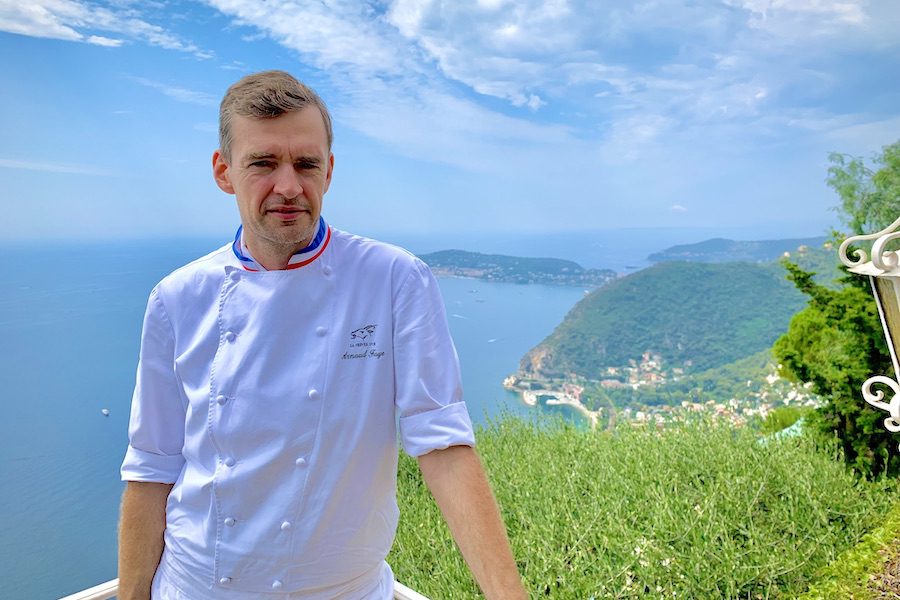
La Chèvre d’Or: Fine dining with soul and authenticity

It’s what legends are made of, a mystical medieval village perched high on a rocky cliff face, mythical beasts and a golden goat, food that allows you to travel through the centuries, and a panorama that takes you to the heavens.
But La Chèvre d’Or is no fairytale. It is a very real oasis hidden in a sweltering, tourist-filled Riviera, and it’s just 20 minutes-drive from Monaco.
In 1953, investor Robert Wolf fell in love with Château de La Chèvre d’Or and turned it into a restaurant. According to local historians, Walt Disney convinced Wolf to acquire a cluster of private houses in the village and transform them into hotel rooms. The hotel later became associated with the prestigious Relais & Châteaux, and today La Chèvre d’Or has 45 rooms and suites, surrounded by beautiful, manicured layered gardens.
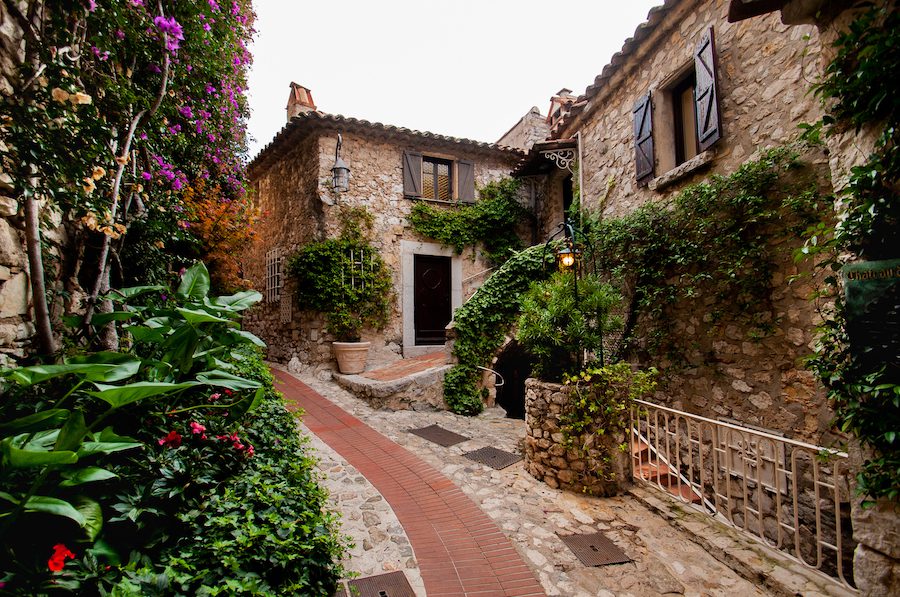
La Chèvre d’Or in Eze Village, photo provided

At its heart remains the restaurant of the same name, which obtained its first Michelin star in 1975 and its second in 2000. Since 2016, that distinction has been maintained by Executive Chef Arnaud Faye, who was awarded the prestigious Meilleur Ouvrier de France in 2019.
Each year from April to October, 42-year-old Arnaud creates intricate dishes that are deeply researched and considered interpretations of the Riviera’s regional and historic cuisine.
“When I arrived here from the Domaine de Chantilly, my vision was the same as a tourist,” Arnaud tells Monaco Life. “I toured Eze, Nice, Vence, Saint Paul de Vence… to see what guests here expect. For me, it is important to have on each plate a different touch of Riviera cuisine, but with a more modern vision.”
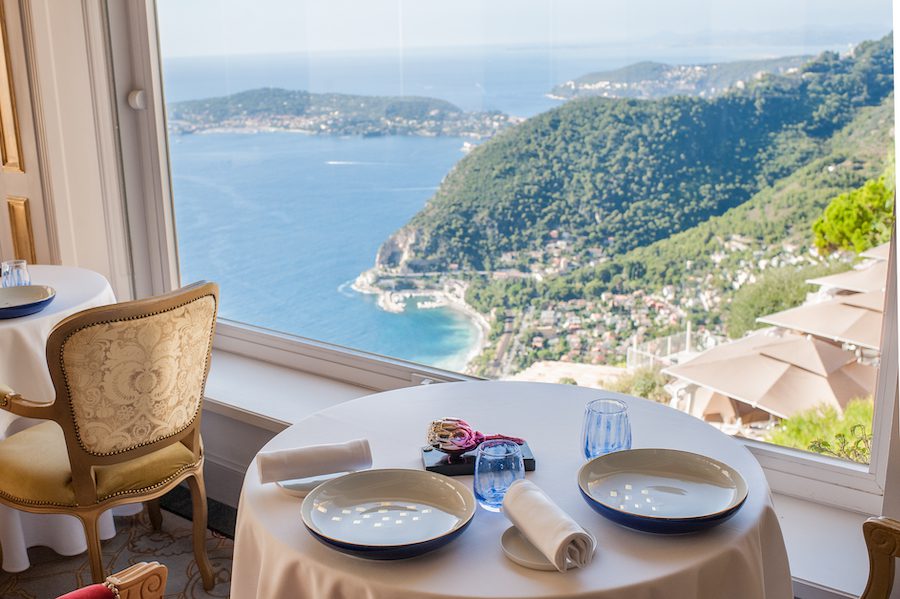
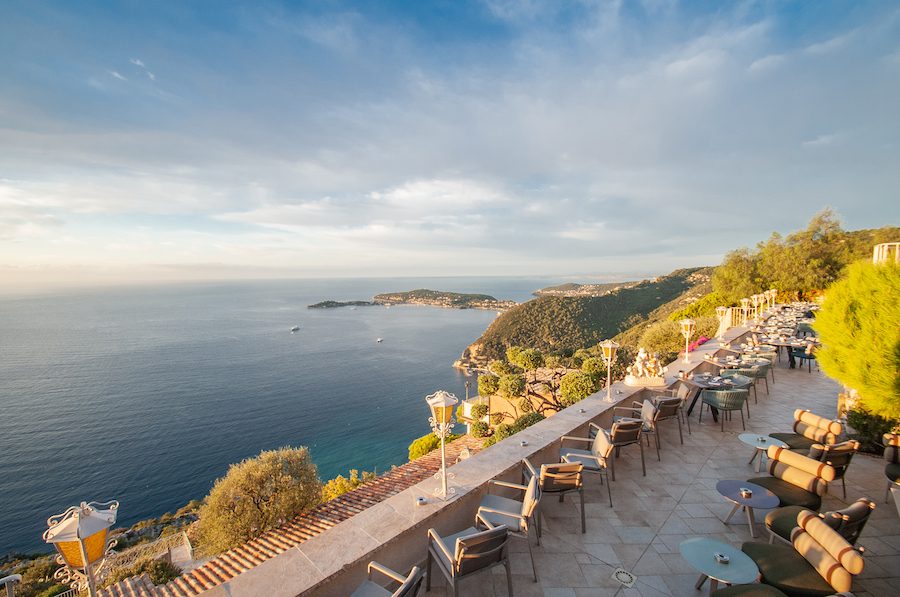
Views of the Eze coastline and St. Jean Cap Ferrat from La Chèvre d’Or, photo provided

That vision manifests itself in the classic Mediterranean entrée of tomatoes and mozzarella. With this, his signature dish, Chef Arnaud Faye fills sweet cherry tomatoes with rich, creamy burrata. It is finished with a tomato infused water, fennel sorbet and fig leaves for a summer dish that is laden with history, flavour and texture.
The same theory is played out with another peasant ingredient, rabbit, a notoriously dry protein which the chef cleverly manages to turn sumptuous through a technique of sous vide and roasting on a bed of wild herbs. This is served with smoked octopus, eggplant prepared two ways, and jus with girolles, lending depth, richness and fragrance.
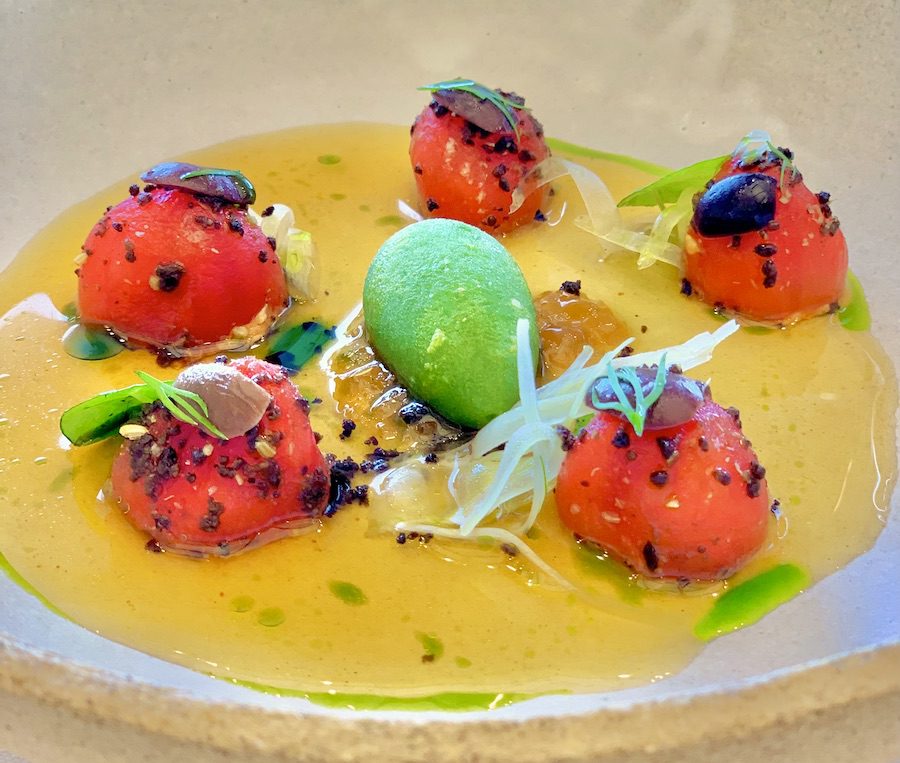
Chef Arnaud Faye’s signature cherry tomato and burrata dish, photo by Monaco Life

In magnifying the produce of the Riviera, Arnaud pays particular attention to the vegetables, something he developed a passion for while working the gardens of his grandparents in Auvergne, central France, as a child.
“For me, this is very important, because it is always possible to cook beef or veal, but what I find really interesting is the vegetables,” says Arnaud. “I work the vegetables to create different textures, tastes and aromas. I only use seasonal produce from local producers, so I have a farmer near Villefranche who grows my cherry tomatoes, for example, and I get my courgettes from Nice.”
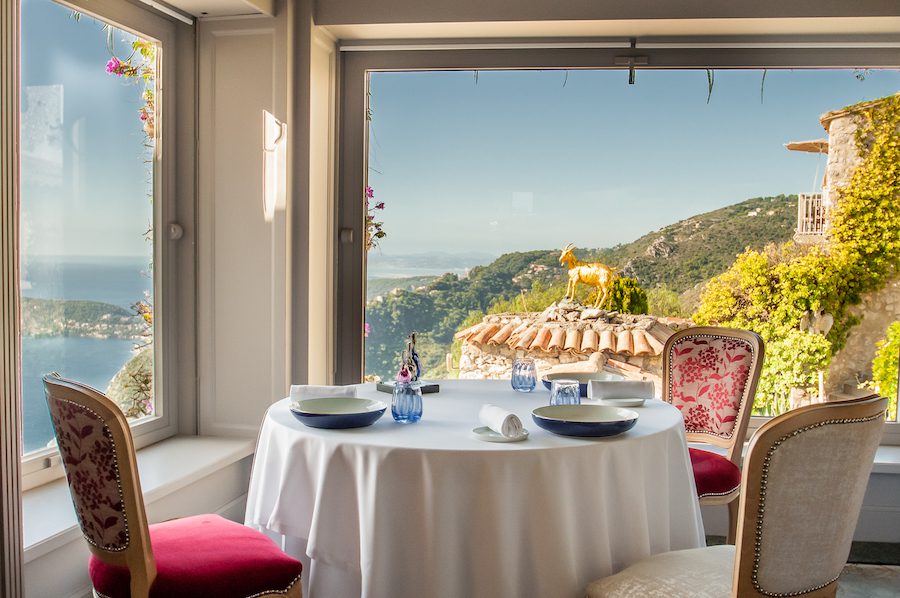
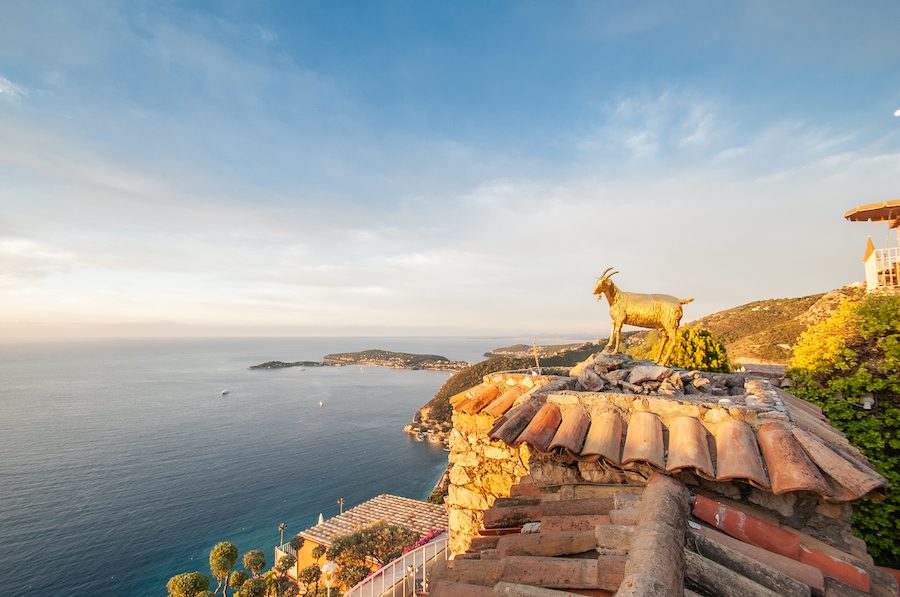
La Chèvre d’Or and the golden goat, photo by James Pouliot

Arnaud’s cuisine is an obvious celebration of the terroir that stretches from the rocky foothills of the Mercantour to the intense blue waters of the Mediterranean Sea.
Lamb, he adds, is sourced from the local countryside, while the ‘catch of the day’ depends on what the fisherman have brought in on their boats that morning.
Each dish shines with technique, soul and authenticity.
The play on textures is also embraced by Pastry Chef Julien Dugourd, whose dessert of white and yellow peaches with verbena is a sophisticated masterpiece. A wide variety of Chef Julien’s exquisite desserts can also be enjoyed in Les Remparts, a terrace restaurant where guests can choose from an extensive Mediterranean menu prepared by Chef Benjamin Zannier, in collaboration with Executive Chef Arnaud Faye, surrounded by arcades of jasmine, ivy and bougainvillea, and immersed in that extraordinary view.
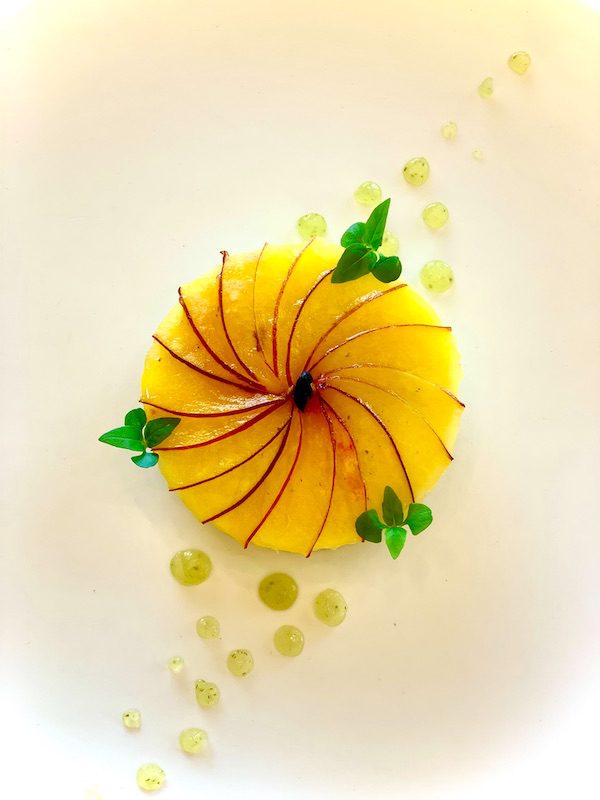
Textures of white and yellow peaches by Pastry Chef Julien Dugourd, photo by Monaco Life

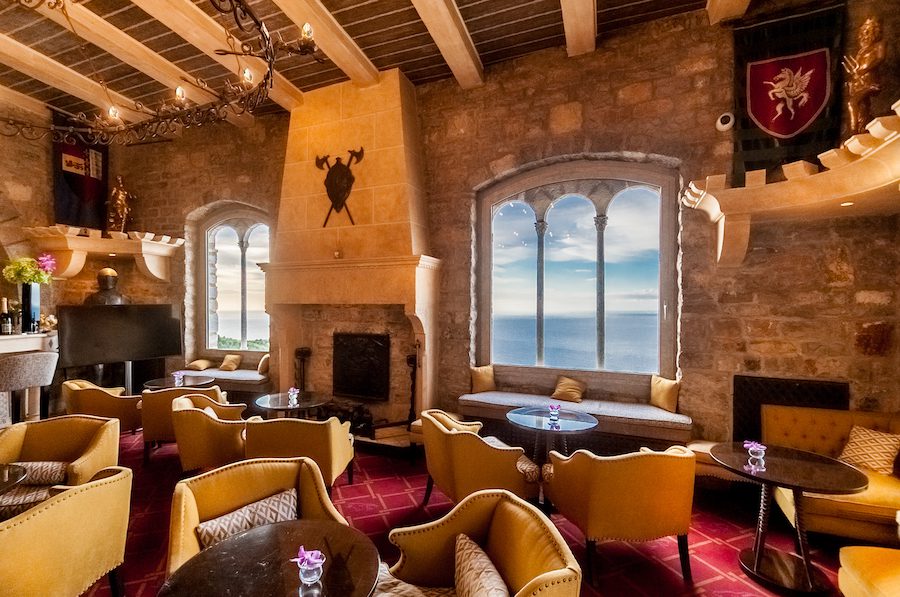
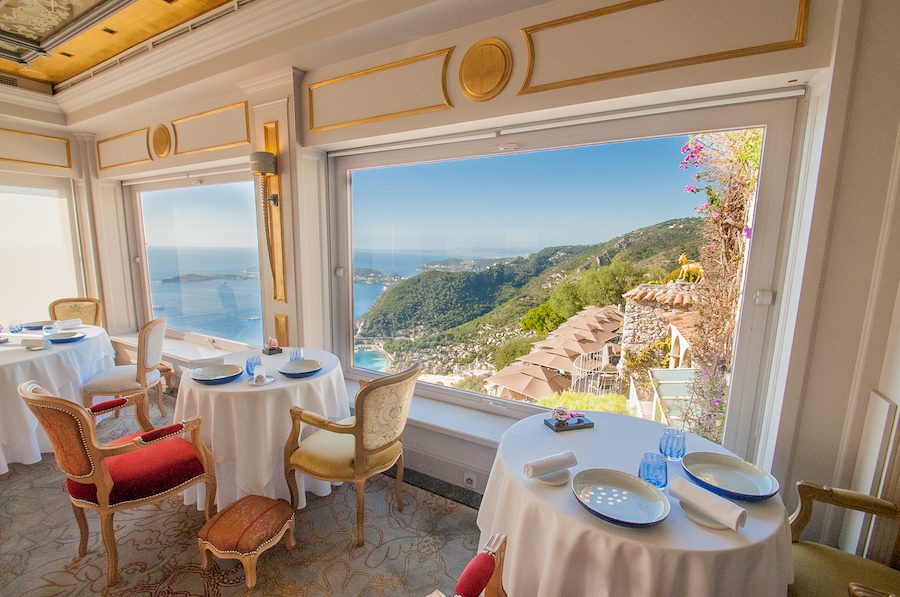
There is no outdoor terrace at the two Michelin starred restaurant La Chèvre d’Or. Instead, large floor to ceiling windows frame the azure waters that is dotted with luxury superyachts, capturing an image of the Riviera as if it were frozen in time. It also adds to the intimate, elegant ambiance of the restaurant, which seats a maximum of only 48.
As anyone who frequents La Chèvre d’Or will tell you – especially habitual guest U2 frontman Bono – visiting this restaurant is like being welcomed in to a home, despite the perfection that comes with being a two-starred establishment.
Restaurant Director Marc Piquet is a seasoned professional, whose warmth and knowledge sets the tone for a truly memorable experience. Maître d’Hôtel Pauline Gachet won the prestigious Georges Baptiste Cup in 2019, and Chief Sommelier Phillipe Magne has been perfecting his craft at La Chèvre d’Or for 32 years. His charm is matched only by his extensive knowledge of champagne and wine. When the restaurant closes in October for six months, Phillipe tours the country in search of fine labels to serve his guests, accumulating a reserve that now remarkably boasts 26,000 bottles.
“I always propose different houses, the large and famous ones like Moët & Chandon and Taittinger, but also smaller producers who are sometimes better than the big houses,” Phillipe Magne tells me from behind his intriguing display of chilled champagnes.
Guests can choose from an extensive wine list that extraordinarily includes 45 wines by the glass, or they can, like myself, put their trust in Phillipe to make the perfect pairing.
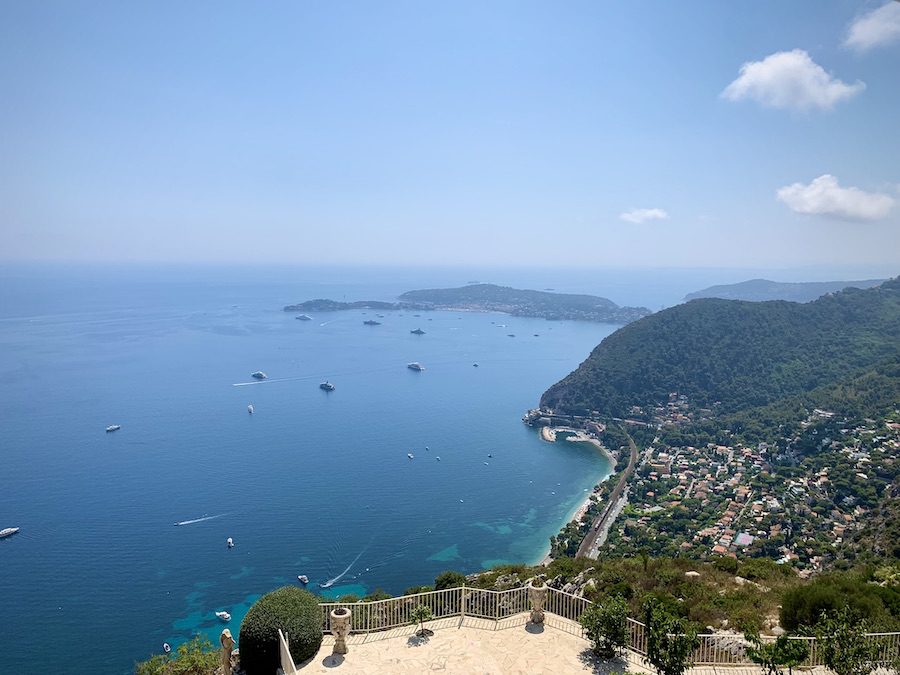
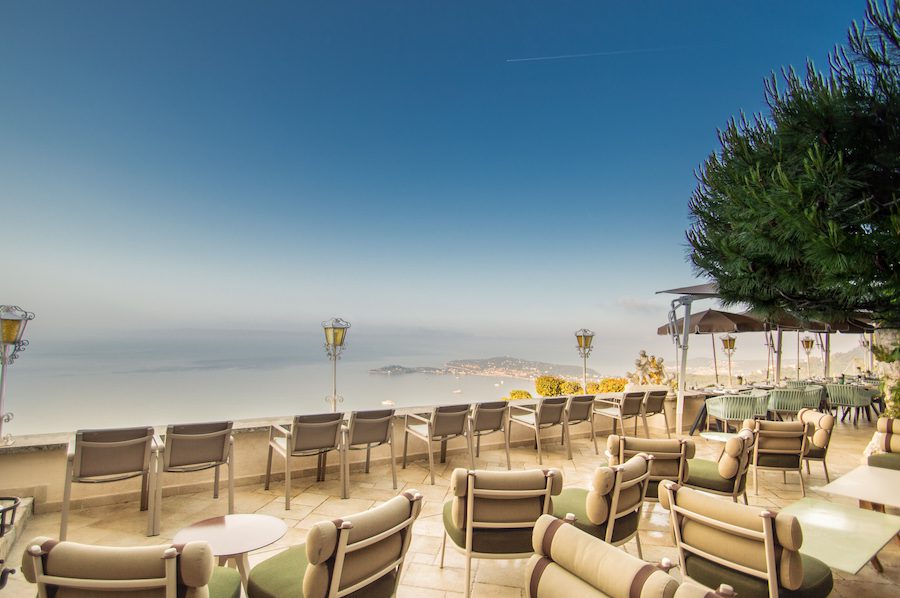
The view from La Chèvre d’Or is just like looking down from the heavens, photo by Monaco Life

In the end, it is easy to understand why La Chèvre d’Or is honoured among celebrities, politicians, royalty and the elite.
But it is a destination for all who wish to experience the true flavours, heart and hospitality of the French Riviera, a vibrant reminder of how powerful time, place and story is when it comes to food.

The ‘From rocks and waves’ lunch menu is a five-course gastronomic experience for 160€ per person, or 90€ for three courses. The eight-course ‘From rocks and waves’ dinner menu includes langoustine, crab and pigeon, and is priced at 260€, paired down to five courses for 220€ (prices exclude wine).

Top photo of Executive Chef Arnaud Faye by Cassandra Tanti for Monaco Life, all rights reserved. 
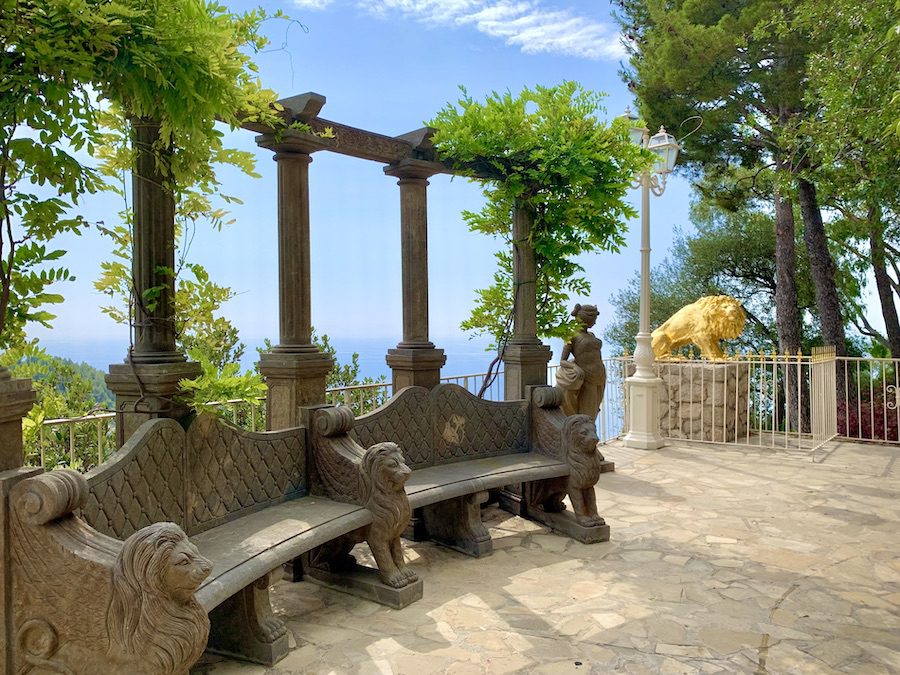
See our gallery below for more pictures:
 

“Life is Beautiful” with artist Houda Bakkali

Monaco’s Le Pinocchio restaurant will be featuring private viewings of the works of artist Houda Bakkali this month, inviting guests to experiment with augmented reality as they admire her special brand of visual art.
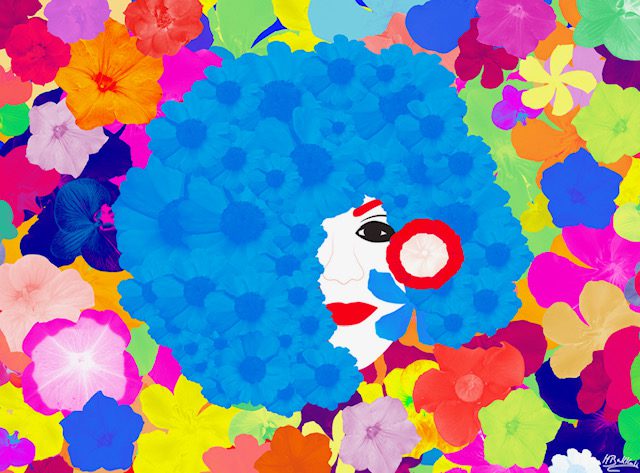
Barcelona-based Houda Bakkali wants us all to look at the world the way she does: in a positive light. After a year and a half of bad news, the artist is asking people to remember, through her latest exhibition at Le Pinocchio restaurant, that “Life is Beautiful” and to be grateful despite all the difficulties life presents.
“With the new graphic series ‘Life is Beautiful’, the international visual artist Houda Bakkali launches a universal message of optimism and hope, more necessary than ever in these strange dark times that humankind is experiencing due to the global pandemic and the unpredictability of its evolution,” Juliet Art Magazine said of her exhibition. “While the whole world is sick, disoriented and frightened by the future, the Spanish artist concentrates on the digital canvas, all the most vibrant and incredible colours that nature and pixels are able to offer to create a real explosion of joy of against which it is impossible to remain neutral.”
It would, indeed, be hard to stay neutral upon seeing the works on offer by the vibrant Bakkali, which will be on display from 9th to 22nd August. Loaded with imagery depicting strong females and representing iconic feminine themes such as flowers, curves and colour, her work is much like the artist herself.

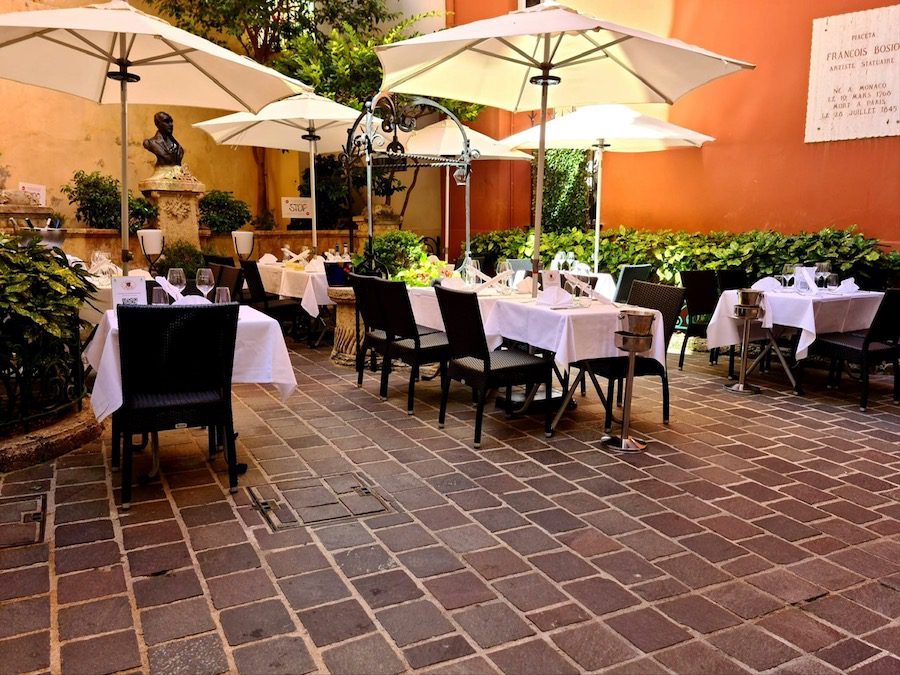
Le Pinocchio restaurant is located in the old town of Monaco, photo provided

Le Pinocchio has hosted the artist in the past. She had a show in the midst of the pandemic back in October of 2020 where she displayed her Africa series as well as debuting a new piece at the time called Crazy Heart.
“At this very particular time that we live because of the pandemic, we must find new ways to continue sharing our creativity with the public,” said Bakkali at the time. “My art is essentially digital, so this virtual presentation is a perfect option to bring the public closer to my creative process. In Monaco, I feel at home. It is a country that I love and being able to show my work in such an emblematic place as Le Pinocchio is a great honour. I am very grateful and happy for this opportunity.”
Bakkali is an international visual artist and has exhibited around the globe, including in Paris, Madrid, Cannes, San Remo, New York, Barcelona, Córdoba, Biarritz and Lorc, as well as in the Principality.


Marc Scarpa: “We're breaking the entry barrier to the DeFi world”

Monaco Life speaks to the entrepreneur behind DeFiance Media, a new 24-hour streaming broadcast network that delivers news and information on today’s decentralised economy and digital lifestyle, with an innovative twist.
Marc Scarpa is a streaming media veteran who is combining his decades-long experience with the world’s hottest obsession: decentralisation.
He is the co-founder of DeFiance Media, a video-news startup that reaches 65 million US households and another 15 million globally through various networks and distributors such as Local Now, NetRange, Select TV and Glewed TV.
Now, DeFiance Media has launched a new website and mobile experience providing enhanced coverage of the DeFi sector to digitally-focussed people who are looking for news that aligns with their alternative thinking.
Monaco Life: What is DeFiance Media and where does it fit in today’s media industry?
Marc Scarpa: DeFiance Media is a 24-hour linear broadcast channel dedicated to decentralised culture, finance and technology. We reach 80 million homes globally now on OTT, OTA, streaming platforms and connected devices. Our primary mission is to promote the adoption of the decentralised evolution. Everything has existed in the centralised world for so many years, but decentralisation and distributed lifestyle is where we are at right now.
What kind of content do you carry and create?
Our programming algorithm is very specific, we are covering what we feel are the top 10 topics that are part of this new evolution of cultural creatives: blockchain, digital currencies, artificial intelligence (AI), robotics, cyber security – a very under reported market that affects almost everybody – alternative energy, connected living, biotech, social impact projects, and regenerative culture.
What we aim to do at DeFiance Media is offer an alternative voice and to really target that new group of cultural creatives, of which there are about a quarter of a billion of them on the planet. That group has not really been given a single broadcast media outlet that represents them and covers the topics that they are interested in, the way that they want it to be covered.
Currently, there is a barrier of entry to get into this DeFi world, knowing who to follow and where to find them. We want to make it a frictionless experience for people to come in and see what this world is about, to engage and participate in it, and to ultimately be a contributor to it.

DeFiance Media’s original programming includes interviews with people at the forefront of the decentralised world

There are many individuals who do cover these topics in their various platforms, but they are scattered all over the internet. Is the aim of DeFiance Media then to bring all of this content together in a one-stop-shop kind of arrangement?
Exactly. YouTube, for example, is an amazing platform but it is fragmented and there is a lot of noise there because it has no real curation process. What we are doing is very much what Arianna Huffington did in curating media and news. We are taking the best of the best content creators that already have a voice in our 10 topics, and inviting them to be a part of our media network. We are getting them out to a new, larger, linear audience, while at the same time still creating our own original programming.
We offer the television experience with a 24-hour live linear feed with curated programming from our contributors and original programming that we make. We also have the news where we reference other news outlets that have the best stories of that day, from Science Daily and MIT Press, to Blocworks and Bitcoin Magazine, which is clickable directly to the sources.
And we have a curated social media, featuring the greatest minds of our era who are writing about everything from AI to biotech.
This is all real-time.
So yes, we provide curation because there is a lot of noise out there. We are building our offering both in television and on the desktop and mobile experiences.
Can you tell us more about your original content?
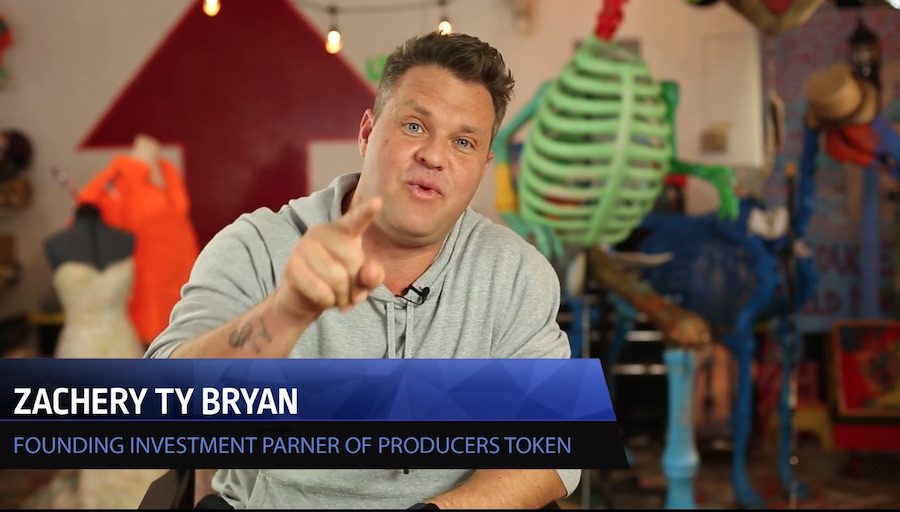
One of our favourite shows is ‘Anything is Possible’ with Patrick Tsang, an entrepreneur and investor who is promoting positivity with the life ethos that anything is possible. He is interviewing everyone from Anthony Scaramucci and Tim Draper to Baroness Michelle Mone and AI entrepreneurs. The way he approaches that half hour interview show is less about business and more of a one-on-one conversation with the individual. He wants to understand why these people are motivated to create what they’re creating.
We also have a programme called ‘Cashless with Sarah Austin’, who has been listed as one of Forbes’ 30 under 30 and who interviews men and women at the forefront of the new digital economy.
So, while all of the news articles from third party sources serve as someone’s daily reading, the original broadcasting programming is taking it to the next level with more focussed feature stories on individuals.
We also do specials, like ‘Culture Conversation’, which was shot at the Bitcoin 2021 conference in Miami, where we interviewed Blond:ish, Tony Hawk, Shark Tank’s Kevin O’Reilly, and a variety of entrepreneurs who were there talking about what they were doing in the space, the type of companies they are funding, and what this new decentralised cultural movement means to them – the key that we really try to focus on more than anything else.
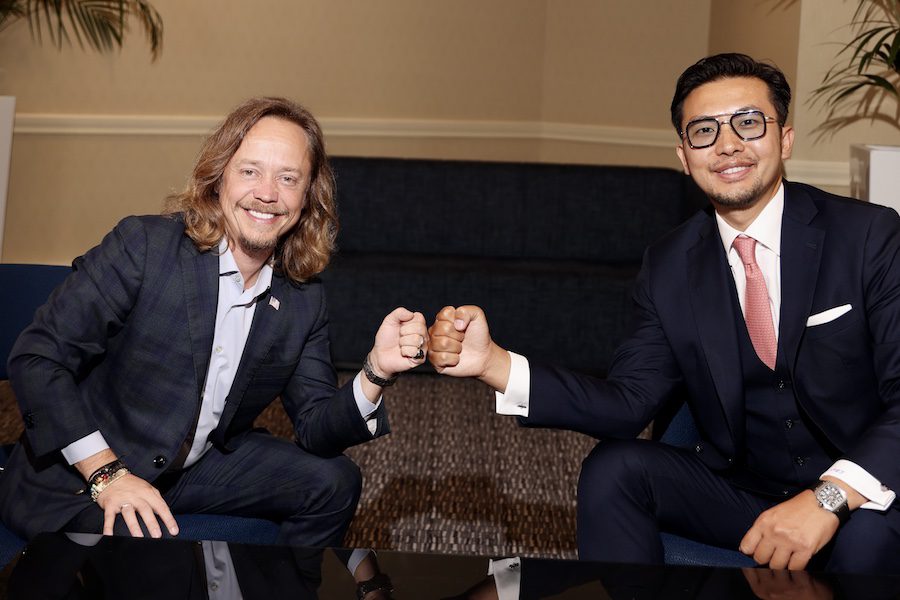
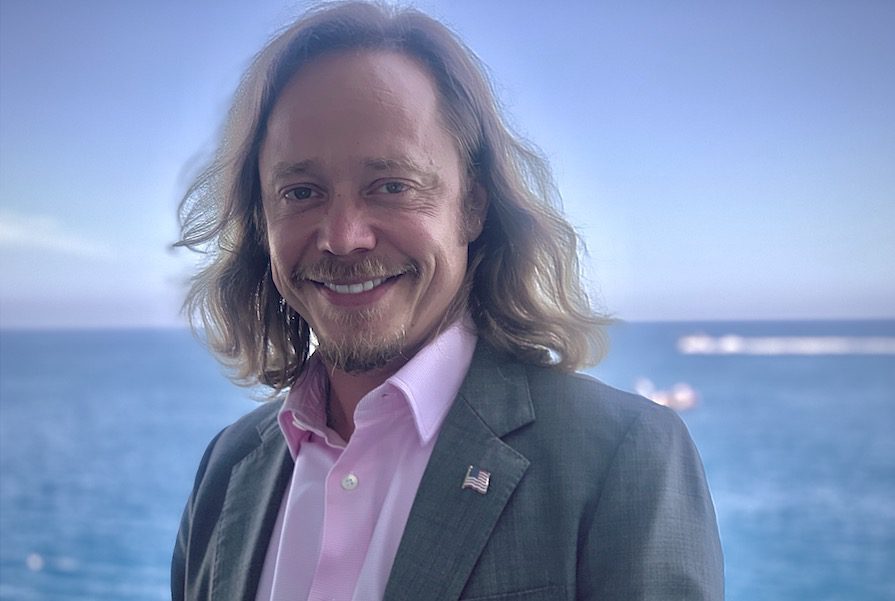
Crypto titan and DeFiance Media investor Brock Pierce with ‘Anything is Possible’ host Patrick Tsang

Who is backing this project with you?
Among the many investors and partners in this venture are Co-Inventor of NFTs and Co-Founder of Tether Craig Sellars, Tsangs Group Global Family Office, who are Investors in Fubo TV and Live Company Group, Head of the Bitcoin Foundation and philanthropist Brock Pierce, Award-Winning Author and Futurist Daniel Pinchbeck, blockchain veterans Michael Cao and Winnie Liu, and powerhouse Hollywood producer Lauren Selig.
What other market-related features does the DeFiance Media platform have?
Money makes the world move forward, so we have the world’s first ever broadcast crypto ticker, allowing people to stay glued to their set and trade at the same time.
Then, and this is where it gets interesting, we allow for our viewers to make transactions. In the market section, people can get market data on, say, Ethereum with links to websites, technical documentation and news, but they can also buy and trade through the platform. People can watch someone on our channel, do research on their company, see where that token is trading at that moment in time, and make transactions.
We have a third-party provider that facilitates all of the transactions for us through a variety of exchanges. You can use your credit or debit card, or get it straight from your bank account.
What is your vision for DeFiance Media?
Our vision is to promote a positive narrative for the decentralised evolution to as many people as possible and ultimately, we would like to reach a billion households. If fashion TV can reach a billion households, there’s no reason why we can’t. We aspire along the lines of MTV News meets CNET meets Bloomberg TV, but with a very different type of programming, approach and subject matter. Right now, we are independent, and we want to continue to grow as much as possible so we can have that independent voice.
 
RELATED ARTICLES:
Brock Pierce: “We’re looking for evolution, not revolution”

Understanding bitcoin and the great crypto boom


Award encourages Prince to "stick to my convictions"

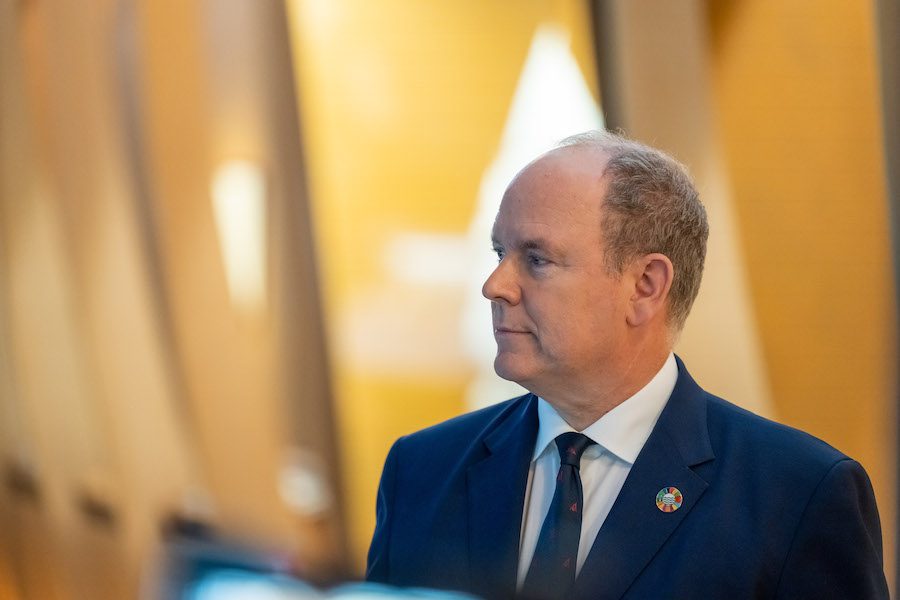
Prince Albert II has been awarded the 2021 Jane Alexander Global Wildlife Ambassador Award for his continuing dedication to and support of environmental causes, namely the protection and study of seahorses in the Mediterranean.
Prince Albert II has a long history of championing environmental causes, a passion which led him to launch the Prince Albert II of Monaco Foundation in 2006. Since then, he has been involved heavily in wildlife conservation and this year, his contribution to seahorse protection, led by the efforts of the 2021 Indianapolis Prize winner Dr Amanda Vincent, has earned him the Jane Alexander Global Wildlife Ambassador Award.
“Prince Albert II is an inspirational leader at the forefront of protecting the health of earth’s lands and waters, the variety of its plants and animals, and the development of renewable energies,” said Jane Alexander. “It is a great honour to welcome him as the recipient of the Global Wildlife Ambassador Award for 2021.”

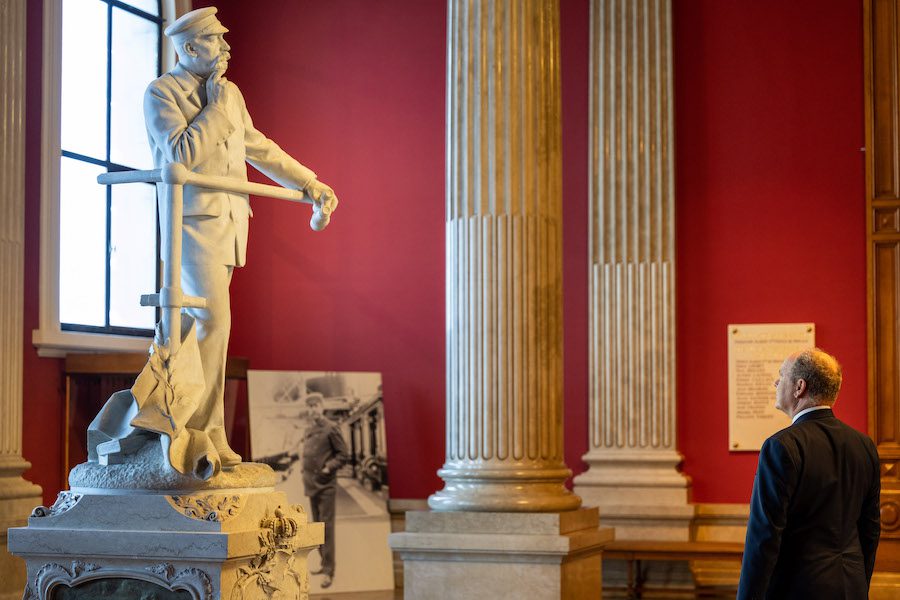
Prince Albert II at the Oceanographic Museum established by Prince Albert I

Prince Albert II has led the charge for the Convention on International Trade in Endangered Species of Wild Fauna and Flora (CITES) in Monaco on behalf of seahorses, which are native to the waters off Monaco and are good indicators of general sea health. Since 1978, Monaco has been involved with CITES, providing funding to support the preservation and protection of wild seahorse populations in the region.
In November 2020, Monaco also became the official proponent of a new International Union for Conservation of Nature’s Resolution focused on conservation of seahorses, pipefish and sea dragons, which directs 1,450 organisations to take action.
The Prince’s commitment to nature has led him, through his foundation, to open 10 foreign branches funding nearly 700 projects totalling €84 million.
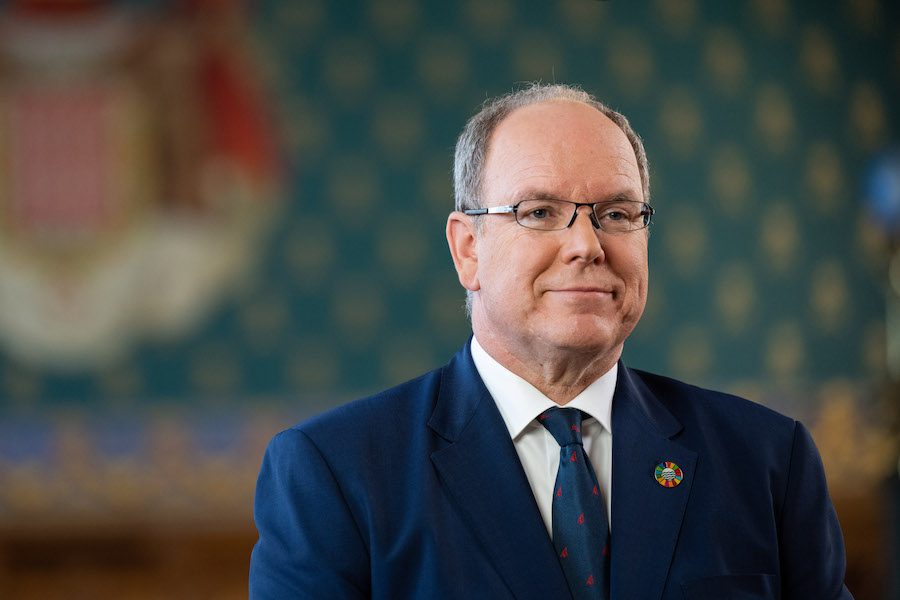
Prince Albert II of Monaco has welcomed the award as encouragement to continue on his environmental path

Recipients of the Global Wildlife Ambassador Award have been deemed crucial in helping raise awareness about threatened and endangered species and habitats by using their positions and skills to alert policymakers, businesspeople and the public of the situations. Former winners include Sigourney Weaver for her work with gorillas and Harrison Ford for his nature protection efforts.
“I am extremely honoured to be receiving such an important award, a truly significant one in the field of animal conservation,” said Prince Albert. “Please allow me to take this award as an additional encouragement to pursue my action and to stick to my convictions. It will help me keep on my commitments and my contributions to the preservation of the oceans, the conservation of coral reefs and marine protected areas, and strive to protect endangered marine species.”
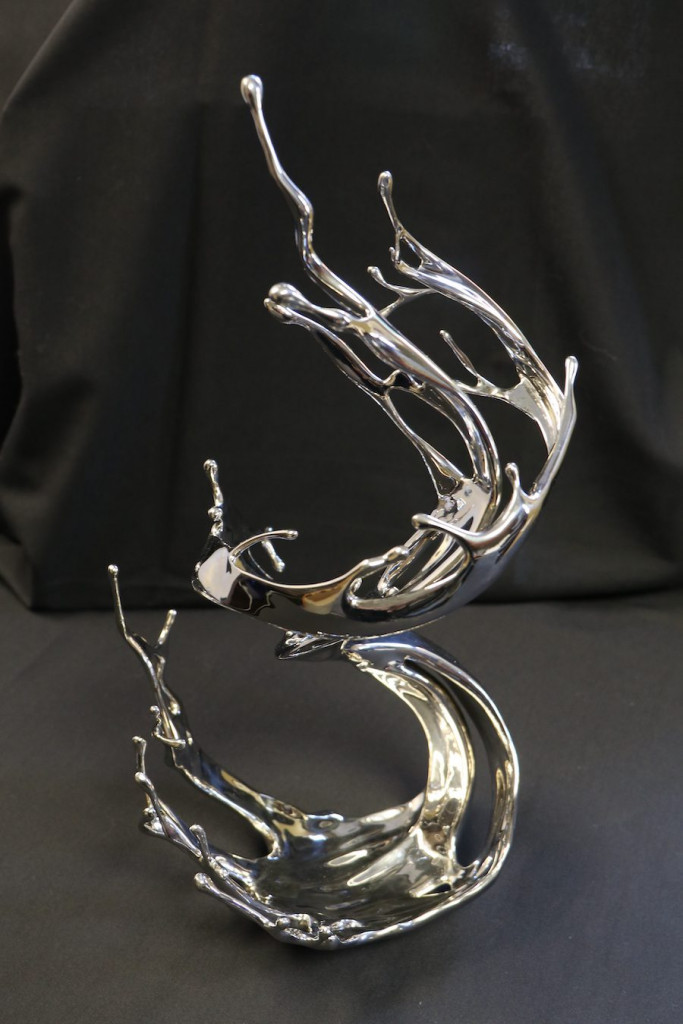
Award by Artist Zheng Lu

The Prince will be honoured at a black-tie event on 25th September at the Indianapolis Prize Gala presented by Cummins, held in the American city which gives the prize its name. The award was created by Beijing-based artist Zheng Lu and is part of his ‘Water in Dripping’ series, which highlight water’s importance in the natural world as a source of life.
The Prince has also received $250,000 for his Foundation.


Photos provided by the Indianapolis Prize


UNESCO adds Nice to World Heritage List

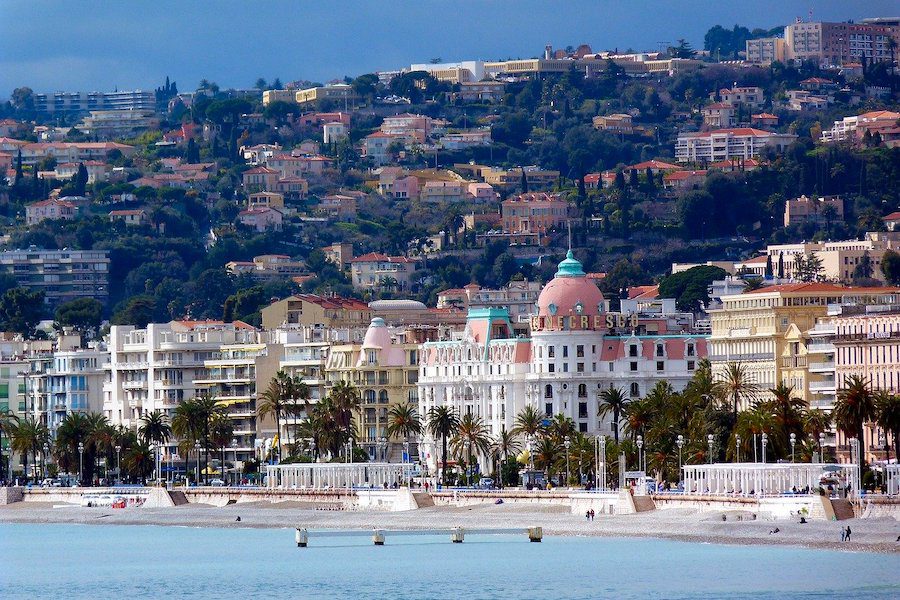
The City of Nice has been added to the UN’s prestigious World Heritage List under the label of ‘Winter Resort Town of the Riviera’.
Meeting online in this year’s host city of Fuzhou, China, the UNESCO World Heritage Committee chose Nice on Tuesday 27th July together with a number of new sites for their cultural, historical or scientific significance.
The news came as a huge relief to Mayor of Nice Christian Estrosi, who says he has worked for more than a decade to restore the French Riviera’s largest city to its former glory and obtain World Heritage status.
“Since 2008, we have worked tirelessly to bring to life everything we had forgotten: the beauty of our facades, our buildings, our diverse places of worship, our gardens, our landscapes, our public spaces,” he told Nice Matin. “We have worked to give back to our city what had enabled it to seduce the most prestigious politicians, the most inventive business leaders, the most daring artists from all over for nearly two centuries.”


A World Heritage Site is a place that is listed by the United Nations Educational, Scientific and Cultural Organisation (UNESCO) as having special cultural or physical significance.
The city of Nice has a long history of tourism, both in summer and winter.
The natural environment and its mild Mediterranean climate came to the attention of the English upper classes in the second half of the 18th century, when an increasing number of aristocratic families took to spending their winters there. In 1931, the city’s main seaside promenade, the Promenade des Anglais, was inaugurated by Prince Arthur, Duke of Connaught, and was visited by the likes of Queen Victoria and her son Edward VII, who spent winters there, and Nice-born Henry Cavendish, who discovered hydrogen.
The city has also been a drawcard for notable painters including Marc Chagall, Henri Matisse, and Niki de Saint Phalle. Their work is commemorated in many of the city’s museums, including Musée Marc Chagall, Musée Matisse and Musée des Beaux-Arts.
Nice also has a rich architectural heritage. During the Savoyard period, several palaces and mansions were built, as well as churches in the Baroque style. During the Belle Époque, the city was enriched with numerous villas and hotels, including the famous Negresco Hotel.
Mayor Estrosi says the World Heritage classification has given him more confidence to push forward with having Nice chosen as the European Capital of Culture 2028.


“We’re looking for evolution, not revolution”

During his recent trip to Monaco, we caught up with crypto titan Brock Pierce who gave us his expert insight into the future of Bitcoin, why it is great for clean energy, and how cryptocurrencies are changing the world, for the better.
While we were all trying to figure out dial-up internet in the early 2000s, Brock Pierce was building one of the world’s largest virtual-asset trading companies, Internet Gaming Entertainment, and employing hundreds of thousands of people to play videogames like World of Warcraft to win virtual prizes that he could sell for real money.
The American entrepreneur, philanthropist, and former actor went on to fund dozens of crypto companies, including Mastercoin, Blockchain Capital and Tether, and was listed in Forbes’ first ever list of the richest people in cryptocurrency in 2018.
Monaco Life: It has been a crazy few months in the crypto world. How are you feeling about it all?
Brock Pierce: I am just generally grateful, I enjoy the ride – the highs, the lows, it’s all part of the adventure.
You are considered the Ambassador of Bitcoin. Why is that?
In 2013, 2014, and 2015 I spent a lot of time educating government on digital assets, then I stopped because I thought there were many others doing it. When I ran for president of the United States of America last year I was talking to a lot of legislators on a state and federal basis, and I learned in almost every one of those meetings that no one has talked to them about what is going on here. No one had bothered to meet them and explain anything. So, I have gotten back into the education of government and that’s not just been on a state and federal basis, but also international.
You recently led the first official delegation to El Salvador, which approved the adoption of Bitcoin as its legal currency. What does that mean for the country and others?
The main drivers for El Salvador are financial inclusion, because 70% of the population doesn’t have access to banking or financial tools. Around 4.5 billion people on the planet aren’t or are under-banked – that’s two-thirds of planet, particularly in the developing world. So, this open banking system can address that quickly.
The government in El Salvador is giving 30 dollars worth of Bitcoin to every citizen, so you are going to see the entire nation have a Bitcoin wallet in a matter of months. This is a very big deal. There is an enormous amount of interest amongst developing nations to potentially follow suit. What El Salvador is doing might create a chain reaction, and everyone is looking at what happens in El Salvador. If it all goes well, the dominos will fall. But it is already creating direct foreign investment in the country.
What other opportunities does this create?
There are a few of us that are looking to fund the building of the next power plants in El Salvador, geothermals, where we take a volcano and basically build a very advanced energy infrastructure to produce highly abundant, low-cost clean energy. That’s going to come from foreign investment, and our intention is to finance that.
These developing nations are starting to see the benefits of opening up to innovation; they’re saying “We want to be part of the future”, in the same way that Dubai and Singapore did 50 years ago. When you have visionary leadership and a government that wants to be part of the future, you attract intellectual capital and social capital, because the best and the brightest are looking to do things.
Generally, most governments are in the way of their own progress, and our hands are tied. But if we actually see a visionary leader who says “Build a future here”, there are a lot of us who know how to do it and want to do it.
It all sounds quite revolutionary…
We are not looking for revolution, we’re looking for evolution. It’s about creating a world where the old and the new win together. That’s where the public and private sectors start to work together harmoniously. The El Salvador government is not going away, it’s just figuring out how to serve the people more effectively. In the 21st century, we have a lot of challenges, but we have a lot of solutions as well, and innovation is the answer to most of our problems. 
But what about the fact that Bitcoin mining uses an enormous amount of energy?
Thank god for the energy problem. Seriously, Satoshi’s second gift is that we are going to create the world’s clean energy. (Editor’s note: Satoshi Nakamoto is the name used by the presumed person or persons who developed Bitcoin.) We are the reason it is going to happen; we are the primary driver. We used to light our lamps with whale blubber, so why did we upgrade our energy grid? Because we needed a lot of energy. It is the consumption that forces change. And it’s not just Bitcoin, it is all computing, all AI (artificial intelligence) – all advanced computing consumes a lot of energy.
So how do you feel about China pulling the plug on Bitcoin mining and trading in the country?
It is the best thing for the rest of the world. China had a leading advantage, now everyone’s got a shot. Because of China, everything has sped up. China is driving tens of billions of dollars into energy infrastructure immediately. Which is great.
Right now, Bitcoin miners are the primary drivers of upgrading America’s energy grid. That’s what we are doing in El Salvador, and the same thing is happening in the US. We are also going to be financing a lot of the fabs (semi-conductor fabrication plants), we’re the main driver of this and we move faster than anyone else.
And all this is happening right now.
What about the massive 55% correction that Bitcoin saw after it hit the all-time high of 64k in April?
What an incredible event that was – the fact that we had a 50% drop and the system didn’t break. Any other system that this has ever happened to has had to be bailed out by a government. It shows that this system can take that kind of plunge, and it won’t break. Sure, you saw a temporary loss in value on a balance sheet, but the system didn’t skip a beat.
But it showed how volatile Bitcoin is, and that’s why governments are now stepping in to warn investors…
Yes, and we want informed people. I will never give a speech encouraging anyone to invest in anything, I only encourage you to invest in yourself. If you haven’t brought Bitcoin, go buy $20 or $100 worth – something inconsequential. Assume that you are going to lose your first Bitcoin, so it is better to start small, and the earlier you start, in many ways the better off you are.
Think of it not as an investment, but that you are paying for your un-education. Then, through your own understanding and knowledge, you can make informed decisions for yourself. There is a learning curve, you learn through the process of doing.
Once you get comfortable and you understand what’s going on, take a look at your own portfolio and decide what’s right for you, taking into account how old you are and your income versus investable assets. You also have to consider what your level of conviction is. How much do you believe?
So, would your advice be to simply hodl? (Editors note: ‘hodl’ is ‘hold’ in the crypto world)
I do, I don’t trade. Markets go up and down, and unless you are a professional trader, I generally advise against it. I know so many people who sold Bitcoin when it was at $200 to buy in lower, and when Bitcoin went to $10,000, they sold wanting to buy back in at $5,000, but it just kept going up. So, unless you’re a trader, I would say in general “hold”. You can always take some portion if you want to learn how to trade, but don’t take the whole principal. Trading is a practice, and I don’t like the emotional rollercoaster. I am a builder, not a trader, and I support people building things.
Are we in a bear market, or are Bitcoin and alt coins going to skyrocket this year?
I am not sure whether we are in a bear market or not, there are so many compelling data sets right now that I think we can see a fairly rapid recovery. This may be a short-term down market, just look at the rate of institutional adoption, government adoption, what’s going on in China… it is probably just a really good buying opportunity, and I think there is a very good chance we will see a rapid recovery.
Where do you see the year 2021 ending out?
Higher than we are now.
Reaching 3X?
$100,000 Bitcoin next year? It is certainly possible. And when we get to $100,000 Bitcoin, about half or maybe a majority of all the world’s billionaires will have made their money from Bitcoin and cryptocurrency. Think about that for a minute.
Well it is clear that crypto is making millionaires in an entirely new way…
Yes, it is democratised opportunity – opportunity that is available to everyone. The wealth is spread out all over the world, and because people didn’t make it over the course of generations or decades, a lot of them are more willing to invest in things that are needed in the world, to give it to charity. This is the greatest wealth transfer in the history of the world – we are putting money into the hands of younger people who are ready to do the work, at a time when god knows we need.
Will there be mass adoption of crypto assets in the years to come?
It is already happening. There are as many as 300 million people now – this is very real and we are currently in the full phase of adoption.
What about banks creating their own digital currencies? What role will they play in the future?
Government-issued currencies are not going away, it’s like what is happening in El Salvador. Think of it like this. You have your checking account, which is your government issued money that you pay bills with, etc, and you have your savings account – Bitcoin, an asset that is deflationary or appreciates in value over time. We are already used to this, except banks don’t pay you anything in your savings account, so we probably shouldn’t use banks for saving. They’re not very good at that.
Tell us something we don’t know that is going to useful in the future?
Stablecoin-based lending (Editors note: a stablecoin is a digital currency that is pegged to a “stable” reserve asset like the U.S. dollar) is paying out three to 10% interest. Now that is a proper savings account. Is it sustainable? Absolutely. Because as a lender, you are lending directly to a borrower; you are not paying for the retail bank space, the employees, the profit margins, the compliance, etc. The banks generate the same rates, they just keep the majority of it. Instead, you can have access to the full yield, the full potential of your money. It is a pretty amazing thing. Bitcoin aside, your digital dollar accounts are paying out three to 10%, and this is relevant to everyone. Again, go out and learn, because whether the Bitcoin thing appeals to you, whether you get it or not, this should appeal to anyone who has savings of any sort.
Do you think Monaco should capitalise on the crypto “evolution”?
I would hope that Prince Albert does what El Salvador did and makes Bitcoin legal tender in Monaco. If they did that, the Principality would be booming. You would have the biggest Chinese gamblers coming to the Casino. Monaco used to be a place that attracted tremendous wealth – it still does – but not like it used to because the world has changed. Monaco is so well situated, there is the brand of Monaco, banking licenses… there are so many things that Monaco could be doing to benefit greatly from all that’s happening.