

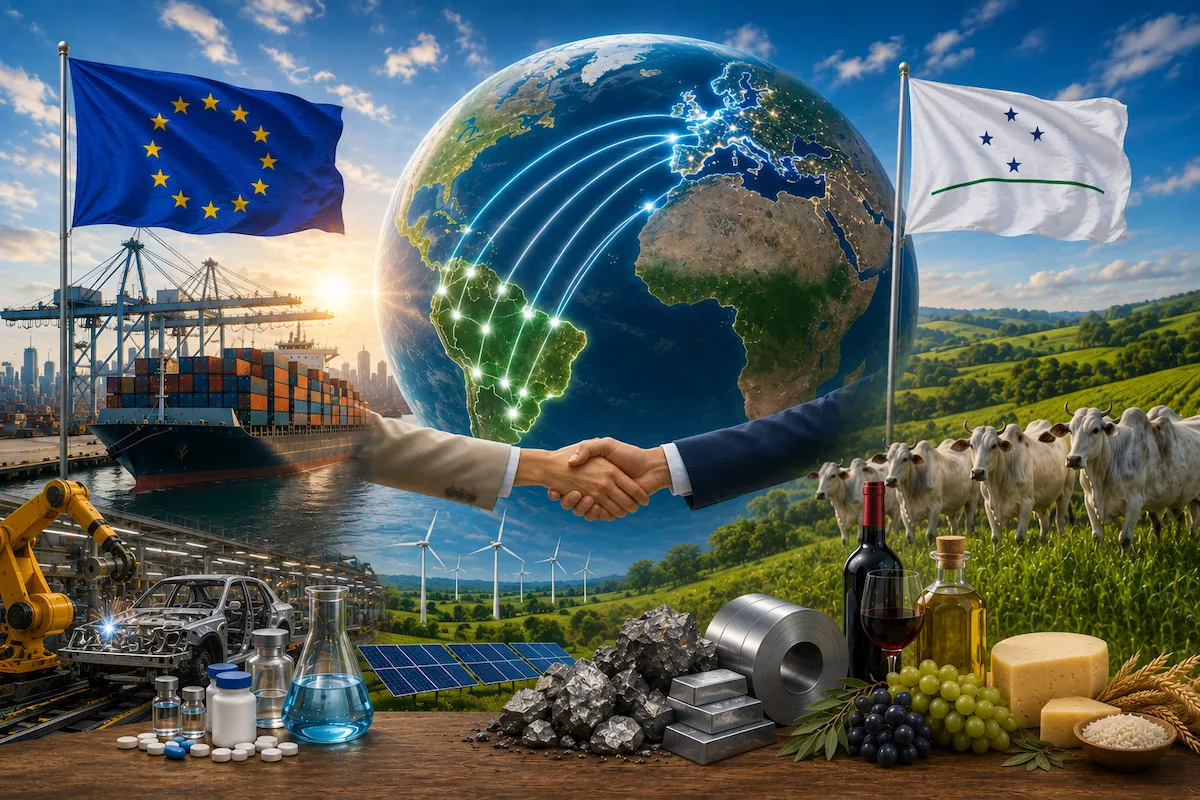
A trading zone of 700 million people came into force on Friday 1st May as one of the world’s largest trade agreements began its provisional application.
The EU-Mercosur deal — 25 years in the making — links the European Union with the four founding Mercosur nations of Argentina, Brazil, Paraguay and Uruguay. Negotiations began in 2000 and ran through multiple phases before a political agreement was reached on 6th December 2024, with EU member states formally endorsing it on 9th January 2026.
By 2040, the European Commission projects it will deliver more than €77.6 billion in increased EU GDP, boost annual EU exports by up to €50 billion — a rise of 39% — and support up to 600,000 jobs across Europe.
What changes for businesses
The most immediate practical effect for European businesses is the reduction of tariffs on industrial goods. Duties on cars, which currently run as high as 35% in Mercosur countries, will come down significantly, as will those on machinery, currently between 14% and 20%, and pharmaceuticals, currently up to 14%. The Commission estimates EU firms will save more than €4 billion per year as a result.
European companies will also gain the right to bid on Mercosur government procurement contracts for the first time. Brazil’s federal procurement market alone exceeds €8 billion per year.
The agreement also secures more reliable access to critical raw materials. The EU currently imports 82% of its niobium — used in superconducting magnets for MRI scanners and cancer treatment — from Mercosur countries. Formalising that supply relationship is considered strategically important given the EU’s broader green and digital transition ambitions.
What it means for food and farming
For EU agricultural producers, the deal reduces tariffs on key exports into Mercosur markets, with wine and spirits facing duties of up to 35% in those countries, chocolate 20% and olive oil 10%. EU agricultural exports are projected to increase by almost 50% overall, with dairy exports expected to rise by more than 100% by 2040 and beverages by 54%.
The agreement also protects European geographical indications — products such as Champagne, Parmigiano Reggiano or Prosciutto di Parma — from imitation in South American markets, ending what Brussels describes as unfair competition.
The more contentious question has been the direction of agricultural trade flowing the other way. Beef and poultry imports from Mercosur into the EU are capped at 1.5% and 1.3% respectively of total EU annual production. Rice, honey and ethanol carry additional protections. A €6.3 billion safety net has been established to protect EU farmers in the event of market disturbances, and the European Commission has committed to monitoring agricultural markets closely as the agreement beds in, with safeguard provisions that can be triggered if sensitive sectors come under pressure.
Standards and sustainability
The EU has been explicit that the deal does not lower European food safety or environmental standards. Only imports that meet EU food safety rules will be permitted, border inspections are being reinforced, and audits in exporting countries will increase over the next two years. Meat produced using substances banned in the EU — including certain hormones and antibiotics — remains prohibited.
Beyond trade, the agreement includes binding commitments to implement the Paris Climate Agreement, preserve biodiversity and tackle deforestation in Mercosur countries, strengthen workers’ rights and enforce intellectual property protections. Whether those commitments prove enforceable in practice has been a central concern of critics, particularly given deforestation pressures in Brazil.
The Commission will continue working towards the agreement’s full ratification in line with EU treaty requirements, with provisional application covering the trade elements while the broader partnership agreement works through national parliaments.
Stay updated with Monaco Life: sign up for our free newsletter, catch our podcast on Spotify, and follow us across Facebook, Instagram, LinkedIn, and Tik Tok.
Image has been created by Monaco Life using AI