

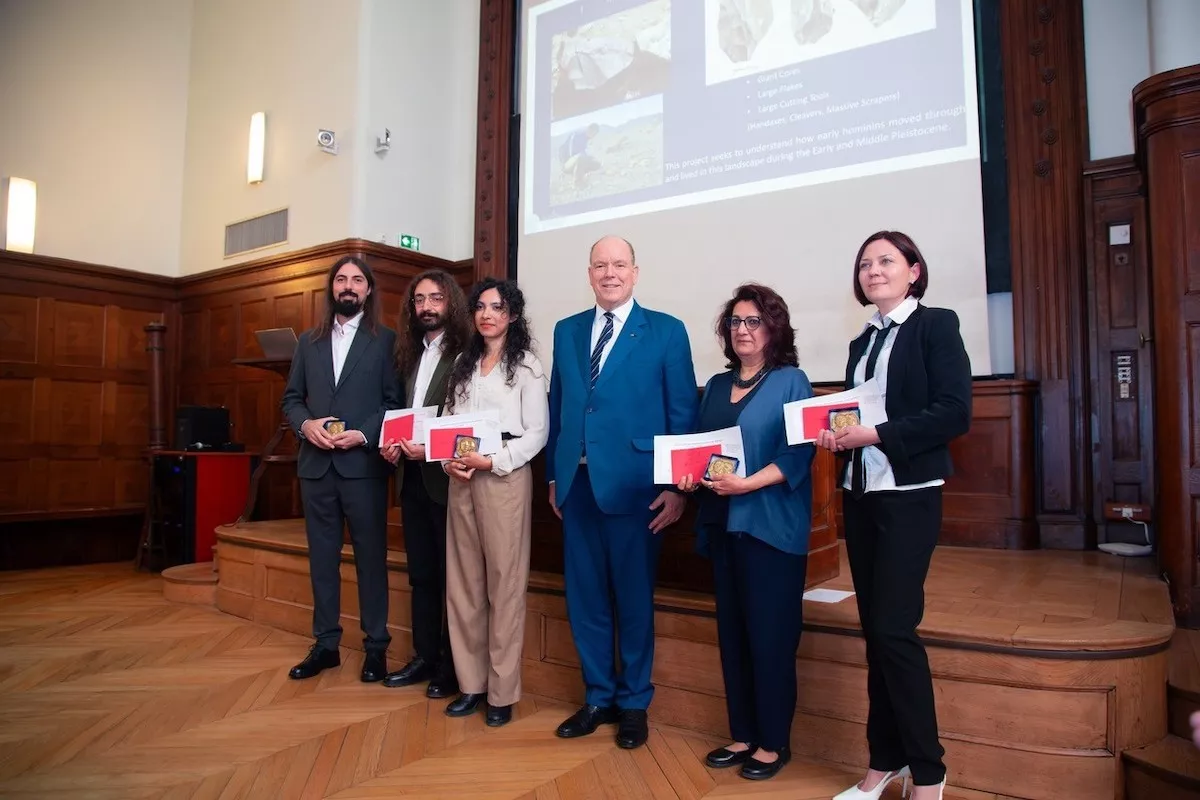
Centuries of human history collided with cutting-edge science in Paris on Thursday 8th October, as Prince Albert II awarded the prestigious Rainier III Research Grants to four pioneering prehistorians.
The young researchers gathered at the historic Institute of Human Palaeontology (IPH), founded in 1910 by Prince Albert I, to share discoveries ranging from Iberian glacial caves to ancient settlements in Central Asia. Selected from 67 applications spanning 17 nationalities, the recipients received their awards directly from the Prince during a high-level scientific symposium.
Global research focuses on human origins
The four winning projects span regions from the Mediterranean to Central Asia, focusing on key moments in early human history.
Spanish researchers Diego Lombao and José Rabunal secured funding to dig inside limestone caves in Galicia, studying how early humans adapted to harsh Ice Age conditions. French researcher Leïla Hoareau received support to examine prehistoric beads and jewellery, shedding light on ancient trading networks and social identities around the Mediterranean.
In Central Asia, Evgenyia Osipova was awarded for her excavation work in southwest Kazakhstan, uncovering some of the earliest human traces near the Aral Sea. Meanwhile, Iranian researcher Sepehr Zarei was recognised for his study of ancient stone tools in the Persian Gulf hinterland, tracing how early human species migrated across the region.
A century of discovery meets modern science
Running alongside the award ceremony, the scientific symposium, entitled ‘Our Origins in Question: Latest Advances in Human Palaeontology’, brought together four leading international scientists to evaluate how modern technology is reshaping the discipline. The speakers detailed how artificial intelligence, big data, and non-invasive imaging are transforming classical prehistory, allowing researchers to extract new insights from fossil records and genetic data.
University of Toulouse Professor José Braga addressed humanity’s earliest ancestors, focusing on australopithecines and paranthropes, while Professor Lluis Quintana-Murci of the Collège de France detailed the role of genetics in environmental adaptation. CNRS research director Dr. Marie-Hélène Moncel presented findings on the Eurasian dispersal of Palaeolithic cultures, and Complutense University of Madrid Professor Juan Luis Arsuaga illustrated how Neanderthal morphology adapted to extreme climate shifts.
As the world’s first foundation exclusively dedicated to prehistory and human palaeontology, the IPH continues to draw international scientists to study its fossil collections, bridging traditional field archaeology with cutting-edge analytical tools.
Stay updated with Monaco Life: sign up for our free newsletter, listen to our podcasts on Spotify, and follow us across Facebook, Instagram, LinkedIn, and Tik Tok.
Prince Albert II with the Global Palaeontology Grants winners in Paris. Photo Credit: Hugo Lopez CDG, Institut de Paléontologie Humaine