

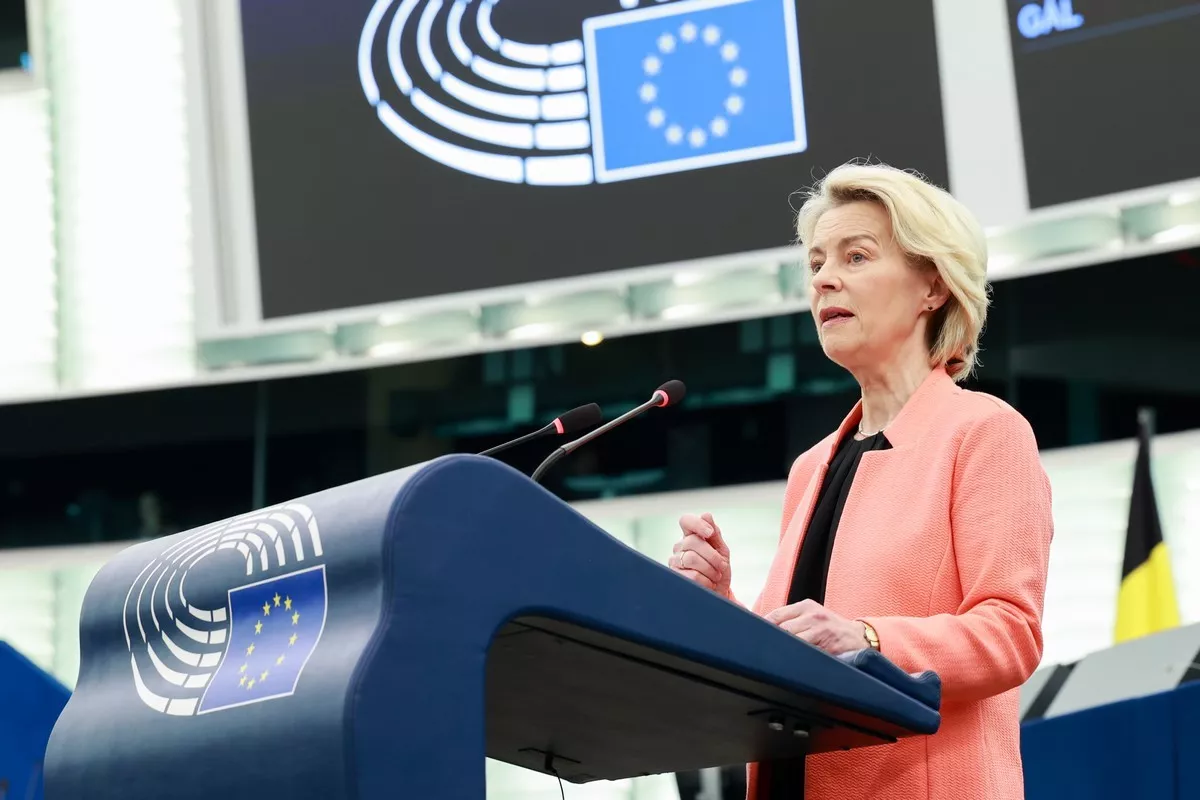
European Commission President Ursula von der Leyen will deliver her annual State of the Union address to the European Parliament in Strasbourg this Wednesday 16th September.
The speech will set out the executive’s legislative priorities and strategic vision for the year ahead, building on a busy 12-month period focused on economic competitiveness, industrial autonomy, and defence readiness, guided by the theme of turning past promises into concrete progress.
Stepping up defence and security
Defence has dominated the agenda over the past 12 months. Following the October 2025 Defence Readiness Roadmap, the Commission proposed five major joint security projects in July 2026—including the Eastern Flank Watch, the European Air Shield, and the European Space Shield. To back them up, the EU is pushing a ‘military Schengen’ plan to make it faster and simpler for troops and military equipment to cross national borders when needed.
Boosting the economy and industry
The EU has launched major changes to boost business and trade. In December 2025, the Commission introduced an affordable housing plan alongside an energy infrastructure package to speed up cross-border power grids. January 2026 saw the signing of a historic trade agreement with Mercosur—the South American trade bloc—wrapping up a year of completed deals with Australia, India, Indonesia, Mexico, and Switzerland.
Spring brought a wave of industrial tranformation, starting with the Industrial Accelerator Act in March to boost low-carbon manufacturing, followed by EU Inc.—simpler online rules designed to make starting and running a business easier across the bloc.
In April, the Commission launched the ‘One Europe, One Market’ roadmap to complete the single market by 2027, followed in June by a new tech package featuring Chips Act 2.0 and cloud and AI development acts.
Protecting democracy, society, and digital spaces
Domestic and social initiatives have shaped the wider portfolio. In November 2025, the EU introduced the European Democracy Shield and a new strategy for civil society groups, alongside the Pact for the Mediterranean to build closer ties with southern partner countries.
Early 2026 saw an action plan against cyberbullying launched in February—backed by technical readiness trials for a pan-European age-verification app in April and a child safety report in July.
In May, the Commission adopted its first-ever anti-poverty strategy alongside updated LGBTIQ+, anti-racism, and gender equality frameworks, as well as a transport package to make cross-border train travel and single-ticket bookings easier.
Backing Ukraine and managing emergency crises
The EU also increased its support abroad. In June 2026, official talks began on the first set of steps for Ukraine to eventually join the EU, backed by an agreement among member states to provide an extra €90 billion in budget and military support for 2026 and 2027.
Closer to home, when severe wildfires tore through several member states in July and August 2026, the EU put its crisis response into practice by coordinating an emergency cross-border deployment of 777 firefighters and 41 aircraft.
As European Commission President Ursula von der Leyen takes the floor on Wednesday morning, her message will echo a simple truth from the past year: “When we are tested, Europe responds together.”
Stay updated with Monaco Life: sign up for our free newsletter, listen to our podcasts on Spotify, and follow us across Facebook, Instagram, LinkedIn, and Tik Tok.
On 16th September, European Commission President Ursula von der Leyen will deliver her sixth State of the Union address in Strasbourg. Photo Credit: Alain Rolland / European Parliament