

The youngest victim of gender-based violence in Monaco last year was just six years old. The oldest 80.
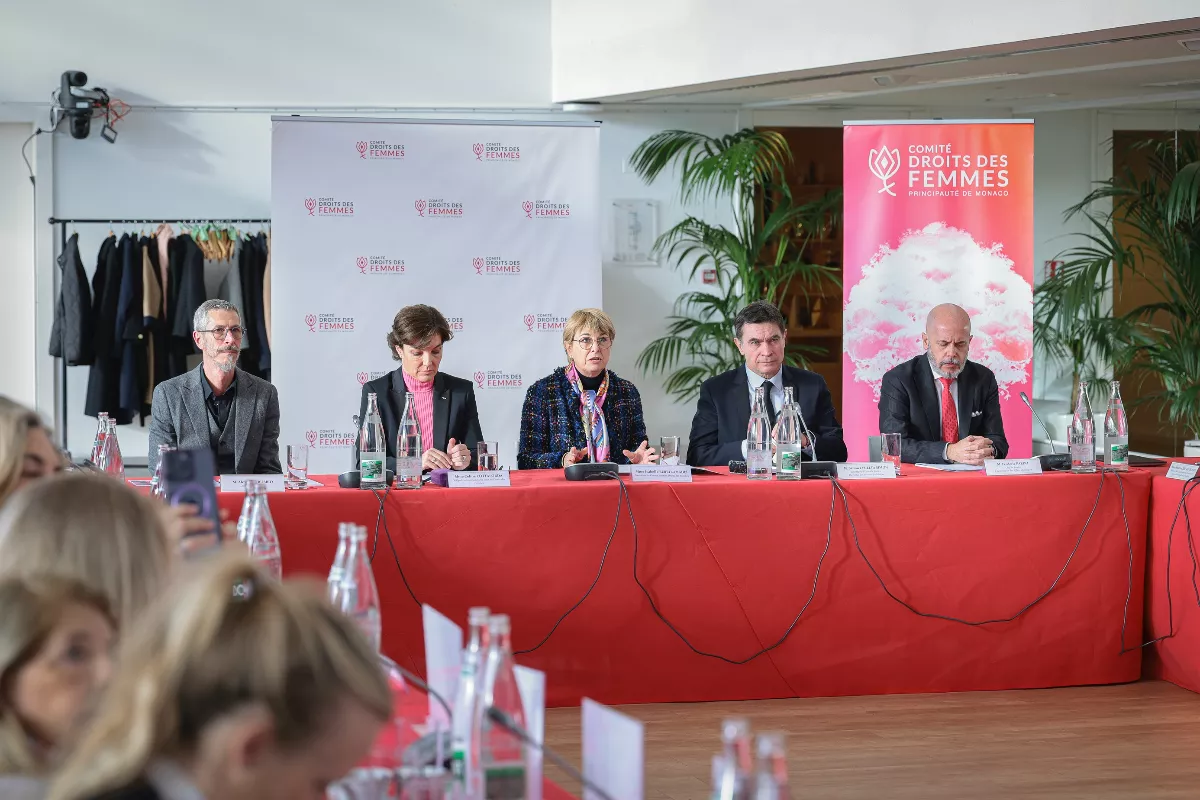
These shocking figures emerged on Tuesday as the Committee for the Promotion and Protection of Women’s Rights held its seventh annual meeting, revealing that reported cases of violence against women increased from 35 in 2024 to 40 in 2025.
Speaking to the press at the Yacht Club de Monaco following the morning’s plenary session on January 20th, Céline Cottalorda, interministerial delegate for women’s rights, was straightforward about the gravity of the challenge. “We always say that one victim is one too many,” she said. “And indeed, as long as there are victims of violence, we must continue working on this subject.”
The committee’s newly published study, produced by IMSEE, shows that more than 90% of victims of sexual violence and intimate partner violence are women. In 85% of police cases, victims reported physical violence. Moreover, and quite disturbingly, in 66% of cases recorded by the victim support association AVIP, violence occurred in the presence of children.
‘Boîte Noire’ goes viral
One of 2025’s unexpected successes was a short film about coercive control, a form of psychological abuse that still remains little understood, sometimes even by the victims.
‘Boîte Noire’ took an unusual but interesting approach by presenting the story from the perpetrator’s perspective, a gamble that proved successful, as the film was viewed more than 820,000 times on social media without any paid promotion.
“We’ve never had numbers like that,” Cottalorda said. “It went viral, and it really touched people. We have loads of comments that prove what was shown in the film is accurate and really concerns people.”
The film was part of the committee’s campaign for the International Day for the Elimination of Violence against women on November 25th, which also included a video contest for young people.
The committee is now exploring how to incorporate coercive control into Monegasque law. “We want to raise awareness about this concept that isn’t yet very well known, and above all, enable victims, those around them, and even perpetrators to become aware,” she explained.
Training the frontline
Behind the statistics lies extensive effort to train those who encounter victims daily. Last year, 115 professionals – police officers, social workers, magistrates, and hospital staff, among others – received specialised training. Since 2019, 600 people have competed the programme.
A separate workplace sexism prevention course has trained 567 civil servants since 2022, with 119 competing it in 2025. The sessions are voluntary and open to everyone.
The committee continues to expand these training sessions. In fact, recently they added modules on perpetrator behaviour for police and magistrates, and specific sessions for teachers. “Teachers are on the front line, particularly with children,” Cottalorda said. “It’s important to give them the keys to understanding, and above all to action, so they can direct potential victims who might be identified.”
Pay gaps and compensation
A new study on the gender pay gap, using 2024 data, showed improvements since the last survey based on 2019 figures. “The trend is towards a reduction in gaps, but there’s still wage inequality, especially in the private sector,” Cottalorda said. The public sector fares better, with many women in senior positions.
However, she aims for deeper analysis in the future. “It would be interesting to have even more precise data to really be able to compare equal work, equal pay. Today we have an overall picture, but it would be interesting to go further and to work with companies.”
For now, though, among concrete measures is a victim compensation scheme. If someone convicted of violence fails to pay court-ordered damages, the state steps in. In 2025, two victims received €10,000 and €20,000 respectively. “We can see it’s a mechanism that works, that’s effective,” Cottalorda said.
The abortion question
The government’s decision not to proceed with the legalisation of abortion doesn’t mean ignoring women’s needs, says Isabelle Berro-Amadeï, Minister of Foreign Affairs and Cooperation. “What concerns the princely government is obviously the concrete situation of women and the need for us to adapt our support,” she said.
A sexual health roadmap will be unveiled in the coming weeks, including free and anonymous gynaecological consultations for women under 21, better sex education, and improved contraception information. “We want to respond in a pragmatic and concrete way to the expectations that have been expressed within society by stepping up these support measures,” she said.
What’s next
International Women’s Day will be marked on March 6th at the Espace Léo Ferré, with another public speaking competition. In June, Monaco takes on the presidency of the Committee of Ministers of the Council of Europe and will host the Congress of Local and Regional Authorities on June 19th.
“It will be an opportunity for us, with all the stakeholders mobilised around women’s rights, to showcase what we’re doing in the principality,” Cottalorda said.
Wrapping-up the conference, she said: “The transformation of society happens through knowledge, training and collective mobilisation. It’s 100% emancipation. And it’s not because we’re talking about women’s rights that it’s 50% – it’s 100%. We really hold on to that.”
Stay updated with Monaco Life: sign up for our free newsletter, catch our podcast on Spotify, and follow us across Facebook, Instagram, LinkedIn, and Tik Tok.
Main photo credit: Stéphane Danna, Government Communications Department