

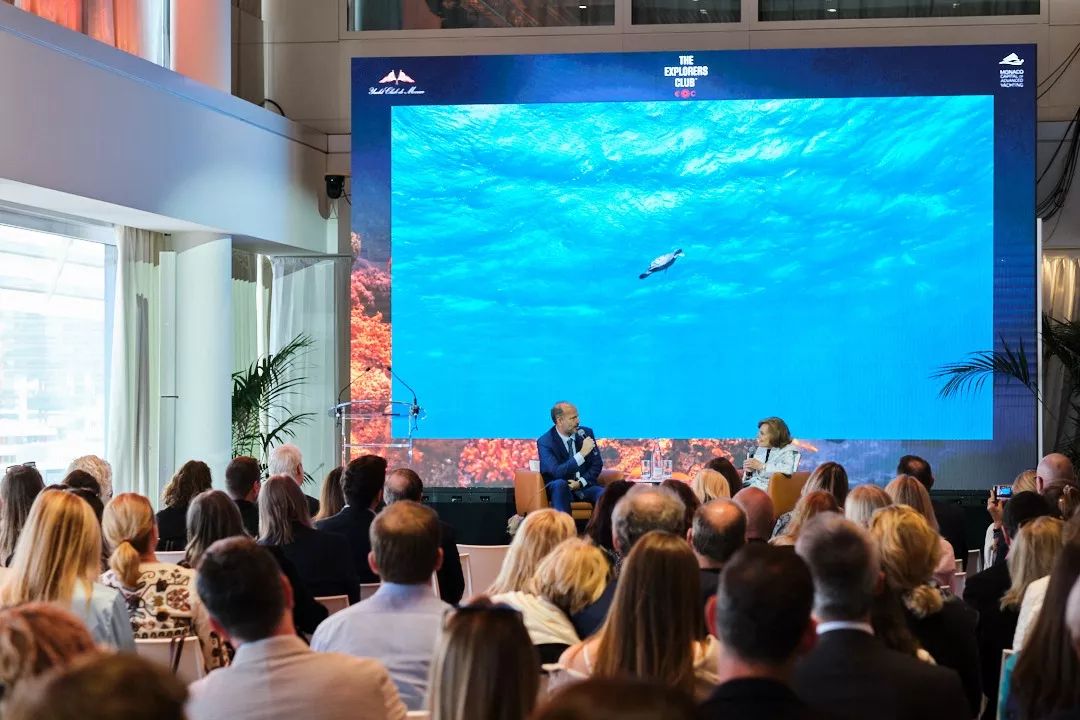
The Yacht Club de Monaco hosted the 30th edition of the Captains’ Forum as part of the inaugural Monaco, Capital of Advanced Yachting Rendezvous, bringing together captains, owners, engineers, scientists and industry figures for a day of discussion under the theme ‘How to follow heroes: The intersection of science, yachting and exploration’.
Organised in collaboration with Oceanco, MB92 Group, Jutheau Husson and ICON Yachts, the forum has grown over three decades into one of the most significant annual gatherings in the international yachting community. This edition set out to move beyond aspiration and focus on concrete solutions — asking not whether yachts can play a role in ocean science, but how.
A moment of reckoning for the industry
The day opened with Micca Ferrero, head of ICON Yachts, who set the tone with a clear-eyed assessment of where the sector stands. “We are living a historic moment where modern yachts are finally meeting exploration and ocean protection in a concrete way,” he said, before adding: “The ocean doesn’t need our admiration, it needs our commitment.”
Polar waters and the weight of responsibility
Captain Maiwenn Beadle, known for her expeditions in polar regions, spoke about the particular demands of navigating in some of the world’s most remote and fragile environments. “Today I navigate in the most difficult places in the world — in ice, in the Arctic, in Antarctica,” she said. “I navigate in preserved environments, very far from any help or support. It is an immense responsibility, both towards the environments in which I sail and the people I take there.” She drew a line from the great explorers to the present day: “They left with questions, and they wanted to come back with answers.”
Whale excrement and the oxygen we breathe
Scientist and entrepreneur Matthew Zimmerman, a specialist in sonar technology and cetacean research, made the case for whale conservation in terms that were hard to ignore. “Phytoplankton is responsible for approximately 50% of the oxygen we breathe. If we lose the whales, we lose the phytoplankton, and we lose half the oxygen we breathe.” His presentation, titled “Floating Gold: the power of whale excrement,” argued that the maritime community has a direct role to play in protection through data collection and detection technologies. “Observations from citizen science are really important, because without broad and complete data, we don’t know where to concentrate our conservation efforts.” He closed with a challenge: “What will you do to help? Think about it before it’s too late.”
Finding wrecks, mapping the unknown
Maritime explorer David Mearns, a world specialist in deep-water wreck location, described several missions conducted aboard yachts and exploration vessels, including the discovery of the Japanese battleship Musashi. He highlighted the unique capabilities large yachts bring to scientific missions through underwater imaging and mapping technologies. “When you find a wreck so lost that even the great Bob Ballard said it couldn’t be found, people pay attention,” he said, describing underwater sonar work as “remote telepresence in its purest form.”
Commander G. Mark Miller, a former NOAA oceanographic vessel commander, argued that the biggest barrier to research is simply access to ocean areas — and that yachts are perfectly placed to fill that gap. His presentation proposed integrating passive data collection systems that operate without disrupting a yacht’s normal operation. “What if every voyage quietly collected data?” he asked, addressing captains and owners directly. “The technology exists. The need exists. The choice is yours. Let’s make every mile count.”
Designing for exploration
Yacht designer and engineer Dominique Geysen presented SailXplorer, a concept vessel designed as a platform for researchers, submersibles and scientific equipment while minimising environmental impact. “I simply could no longer look away from the omnipresence of tourism, environmental degradation and the distress of certain species,” he said of the project’s origins. On the question of sail propulsion: “Isn’t it logical to add sail to the equation if we want to reduce carbon emissions and navigate globally?”
Science made tangible
Ocean mapping professional Taigh MacManus pointed to the progress already made: “When I joined this programme in 2013, we had only mapped 15% of the world’s oceans. Today we are at 26%.” He emphasised the potential of involving crews and guests directly in data collection. “You can make science both tangible and concrete for guests. The opportunities to cooperate with scientists are unparalleled.”
Sailor and citizen science advocate Emily Cunningham described simple protocols that allow crews to contribute to research during normal voyages without specialist equipment. “One of the main difficulties is access to sailing time for researchers,” she said, making the case that yachts in regular operation represent an underused scientific resource.
The forum’s conclusion was clear: the yacht is no longer simply a vessel for navigation, but an increasingly powerful platform for exploration and research — if those who own and operate them choose to make it so.
Stay updated with Monaco Life: sign up for our free newsletter, catch our podcast on Spotify, and follow us across Facebook, Instagram, LinkedIn, and Tik Tok.
Photo source: YCM