Monaco extends health pass rule

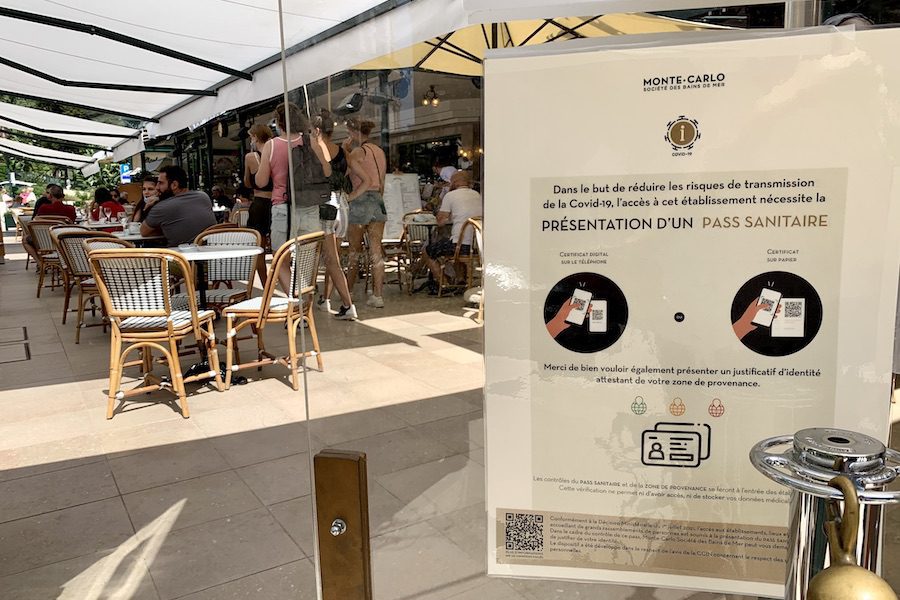
The mandatory health pass has been extended in Monaco until at least 25th February 2022, the government announced on Thursday.

“Given the health situation, HSH Prince Albert II decided to extend and strengthen the use of the sanitary pass until … the end of the February holidays,” said the government in a statement. “These decisions follow the proposals of his government established in consultation with the National Council.”
It means that the use of the health pass, or any equivalent proof to verify someone’s vaccine status, a negative test, or recovery from the virus, is still necessary for anyone wishing to access the terraces of restaurants and bars. As of 1st December, this obligation will be extended to young people aged 16 to 18 years.
Meanwhile, the number of people allowed in public venues has been reduced from 1,000 to 300 people. This concerns, in particular, the Opera, the Princess Grace Theatre and the Grimaldi Forum.
“The strengthening of these sanitary measures follows the general degradation of the health situation in Europe while the winter period is more conducive to the circulation of the virus,” said the government.
In the Principality of Monaco, the number of Covid-19 infections has also been steadily rising. The government is therefore encouraging every member of the population who is eligible for the vaccination to have the shot, for the protection of themselves and others.
“For the pandemic to be defeated and for life to return to normal, the vast majority of residents and people working in Monaco must be vaccinated,” stated the government.
In an effort to keep circulation down, free Covid tests are currently available without prescription at the Auditorium Rainier III until 14th November. Anyone who travelled outside the Principality during the school holidays is encouraged to get tested.
The government has not ruled out further tightening restrictions if the health situation continues to deteriorate.
 
 
Photo by Monaco Life


ASM tactical analysis: profligate or creatively defunct?

The dust hadn’t even settled on Sunday’s disappointing goalless draw at Reims before the inquest into AS Monaco’s barren goal-drought began. Without a goal in three games, Benoît Badiashile had barely regathered his breath when he addressed the issue pitch-side at the Stade Auguste Delaune. 
“We aren’t too predictable, I think it’s just a lack of efficiency because we’ve had opportunities to score.” Volland’s glaring miss late-on against Reims was clearly still fresh in the memory of the France U-21 international defender, yet the late chance could mask a larger, systemic issue in Kovac’s side.
Kovac alluded to this post-match, stating that, “At the minute, we are having problems creating opportunities and converting them. We lacked a bit of determination, and we were a bit too predictable in the build-up.”
In investigating the cause of the goalless run, two diagnoses have therefore emerged. The first, posited by Badiashile, highlights ASM’s profligate form in front of goal, whilst the second, posited by Kovac, identifies their creative deficiency as the source of the problem.
Kovac’s theory of creative deficiency merits further attention and analysis given the abundance of data that highlights AS Monaco as a statistical outlier relative to their closest rivals. The use of the novel xG data metric, which analyses the quality of a goal-scoring opportunity and gives it a rating between 0-1 (1 being a certain goal and 0 being a statistically impossible chance), illustrates this disparity.
Based on the chances created over the course of the season thus far, ASM would have been expected to score 16.4 goals. Given that Kovac’s men have found the net 17 times this season, it indicates that they are scoring about as many goals as would be expected of them considering the quality of chances that they are creating.
This xG figure is, however, low compared to their most direct rivals. Lyon and PSG have xGs of 22.9 and 22.8 respectively, although PSG have significantly outperformed their xG, netting 29 times this season. Local rivals OGC Nice also have a far superior xG of 26.2, they are however, currently underperforming in front of goal this season having only netted 23 times.
Statistically, ASM’s current chance-creation is more closely comparable to a mid-table side, for example Clermont Foot, whose current xG is just below ASM’s at 16.2, or Nantes, who lie just above Kovac’s side, with 15.9. The xG metric therefore emphasises ASM’s weakness in creating high quality goal-scoring opportunities, and, if not for a robust defence, their Ligue 1 ranking would be considerably worse.
ASM’s xG metric results are therefore suggestive of an inability to work the ball into dangerous, goal-scoring areas, and this being the case, it is in the build-up play that issues lie. Specifically, a visual inspection, as well as an analysis of data highlights a lack of variation in the attacking build-up and an over-reliance on one player for creative threat.
Kovac’s attacking tactics revolve around the use of overlapping wingbacks. The wingbacks, able to bomb forward thanks to a defensive back 3, work in combination with the two narrow-sitting wingers, often Diop and Martins, allowing the wingbacks to get to the byline and cut the ball back into the centre of the goal. Over 50% of ASM’s goals in Ligue 1 have come from within the 18-yard box, and many of them have been orchestrated in this way.
Although a perfectly reliable tactic for creating chances, and one masterfully utilised by Chelsea manager Thomas Tuchel in his sides Champions League winning campaign, it is the predictability that is the problem. Kovac himself has realised and subsequently addressed this in the wake of the draw at Reims.
Specifically, it is left wing-back Caio Henrique who provides the vast majority of ASM’s attacking thrust, and it is his left-wing that is the channel for the majority of their attacks. The Brazilian wing-back has an xA (expected assist) rating of 2.6, meaning that, if the chances had been taken, he should have created over 2 goals in Ligue 1 this season. This is an impressive figure, and one that isn’t close to being matched by any teammate; Wissam Ben Yedder has the next best rating on 1.5.
In contrast, ASM’s direct rivals have multiple sources of threat. 5 Lyon players have an xA of over 1.5, Nice have 2 players with an xA of over 2.5, and PSG have 4 players with an xA of over 2. It is this abundance of attacking sources, which brings a level of unpredictability to their play, which subsequently leads to a higher xG, as well as a higher goal tally.
With too few sources of creativity, ASM risks becoming one-dimensional, or, in Kovac’s own words, ‘predictable’. Threat from the central midfield area would be a useful way of offsetting ASM’s reliance on the wide areas; however, the current options in this area are either not suited to playing such a role, or are playing too deep.
Fofana and, in particular, Tchouaméni are elite-level midfielders, yet their attributes aren’t tailored towards providing that elusive killer-ball in the final third to split through the defence. Rather, their strengths lie in shielding the defence, dispossessing, pressing and instigating counter attacks by offloading the ball to the more dynamic wingers and wingbacks. Tchouaméni is also an efficient, line-breaking dribbler; however, most of these runs come from deep and are suited to a counter-attacking game rather than against a team playing a low-block, as is often the case in Ligue 1.
Golovin, in his return from injury, is an obvious candidate to play in a more advanced midfield role. As a more traditional playmaker, he is a serial provider of key passes in the final third and his return could alleviate some of the reliance on Caio Henrique. Another option in the role is Jean Lucas, the summer signing from Lyon has had bright moments thus far, but has not yet found a level of consistency. Currently, he is playing in a deeper midfield role, but his technical ability, which allows him to excel in tight spaces, means that he could be utilised higher up the pitch, especially when playing against a tightly-packed low-block.
The deployment of a more incisive attacking option in the midfield could therefore be a way to ensure variation in ASM’s attacking build-up, and distribute the burden of chance-creation amongst more players in different attacking positions.
In spite of the creative deficiencies that the various data expose, Monaco’s profligacy in recent weeks has similarly contributed to their goal-drought. Profligacy; however, is borne out of circumstance and is itself fostered by a lack of creativity.
The last-gasp Volland miss against Reims is case-in-point; the chance constituted 0.66 of ASM’s entire 0.97 xG in this game, and was therefore the only considerable chance of the entire match. The psychological pressure of having to convert such a chance, in the context of having received so few opportunities, coupled with the fact that the recipient of the chance may not be razor sharp due having so few touches, can unsurprisingly contribute to suboptimal attacking outcomes. Creative deficiency and profligacy therefore go hand-in-hand.
Kovac will undoubtedly be working hard over the course of the international break to remedy ASM’s current creative deficiencies, and he will hope that, should that work bear fruit, his side will quickly find themselves back in European contention.
 
 
Photo by AS Monaco



Stars’n’Bars awarded for clever anti-waste campaign  

Local restaurant Stars’n’Bars was given a National Energy Globe Award prize at COP26 in Glasgow for its 2020 European Waste Reduction Week campaign featuring eye-catching posters that tickled funny bones.

In 2020, the team at Stars’n’Bars created a series of seven original posters using humorous messages to remind people of simple ways to reduce waste in honour of European Waste Reduction Week.

The posters were a hit and on Monday 8th November at the COP26 Summit it was announced that they received a National Energy Globe Award from the Energy Globe Foundation, a global forum for environmental change and to foster awareness about the need for sustainable action.

The posters touched on several topics and featured “ugly” vegetables with snarling faces telling people not to waste food, asked people to “shower with a friend” to save water, to recycle old clothes, and to not horde items such as toilet paper.

The posters were displayed on the restaurant’s internal television system and on its digital menu. They were also posted on social media and shared on the official Monaco Facebook page for Waste Reduction Week, which generated thousands of views.

“2019 was the first year in which Monaco participated in the European Waste Reduction Week and we hosted dozens of zero waste workshops and conferences,” says Didier Rubiolo, co-founder of Stars’n’Bars. “Our Family Fun Day was a great success, and we were one of the 16 finalists for the SERD Best Action Awards (chosen from nearly 17,000 actions in 33 countries).

“Unfortunately, in 2020 the following year, Covid-19 hit and the pandemic took away any possibility of public participation. We decided to communicate our message in a more creative way. So, we created the digital posters and we are delighted that they have now received an Energy Globe Award.”

For over two decades, the Energy Globe Fund has excelled in recognising and promoting innovative solutions and business models around the world in order to meet the twin objectives of shared prosperity and protection of the environment.


AMF President talks crypto currency

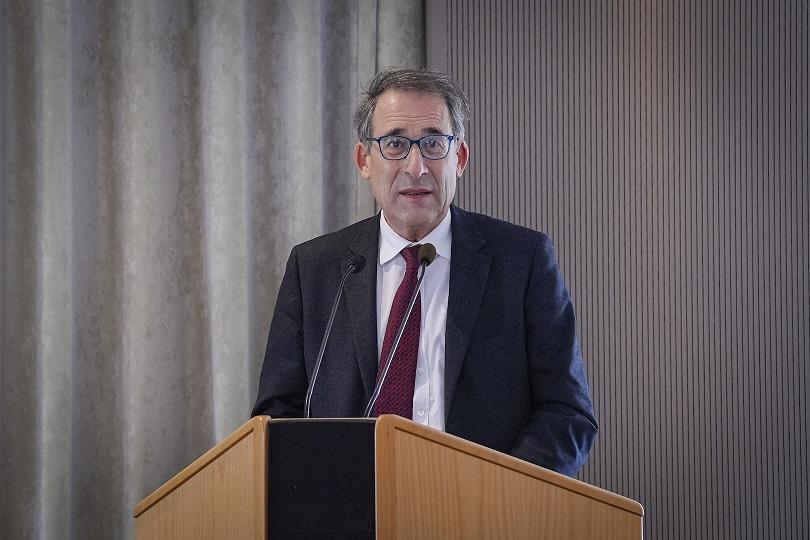
The President of the French Financial Markets Authority has told a luncheon debate in Monaco that crypto currencies and other digital assets should be regulated at the national level.
Robert Ophele, the President of the French Financial Markets Authority (AMF), spoke at a lunch held in the Principality on 5th November as part of the Francophone FIUs Forum, debating on crypto currencies, digitisation of assets and other pertinent subjects relating to the financial market.
According to Ophele, “The digitisation of assets is a major source of innovation” which should nevertheless be regulated at national levels, before moving on to encompassing legislation at European levels.
In 2019, the Plan d’Action pour la Croissance et la Transformation des Entreprises
(PACTE) law provided a framework for fundraising by issuing tokens, called Initial Coin Offerings or ICO, as well as the monitoring of Service Providers on Digital Assets (PSAN). “Today, 25 project leaders are registered, there will be 30 at the end of the year,” Ophele added.
The finance specialist said that analysis of cases of cyber insider breaches or cyber dissemination of false information shows that the entire chain of players in the financial world may be affected: issuer, bank, information distributor, stock market regulator, stock exchange, right on down the line.
He added that cases of cyber price manipulation analysed mainly stem from the intrusion of private trading accounts, therefore reinforced international cooperation from regulators is necessary. It remains difficult and the international legal framework is still poorly adapted. Active participation in the various international working groups dedicated to financial cyber security and the involvement of European institutions therefore appear to be essential in order to curb this stock market cybercrime.
The AMF is the body that regulates the French financial market, its participants and the investment products distributed via the markets as well as being one of the driving forces behind change at both the European and international levels.
The Monegasque Association of Financial Activities (AMAF), the Monaco equivalent of AMF boasting over a hundred members, hosted the event.
 
 
Photo by Stephane Danna, Government Communication Department


AMAO renamed as OACIS

The Monegasque Association on Ocean Acidification is changing its name to better reflect the scope of its work in this important field.
Ocean acidity is the lesser known consequence of our CO2 emissions and it has increased by 30% since the beginning of the industrial revolution, and could increase by 150% by the end of the century if our CO2 emissions continue to increase at the current rate. Ocean acidification threatens many organisms and ecosystems, such as coral reefs, and the communities that depend on them.
Prince Albert II of Monaco and his Foundation have raised attention about this issue, which was virtually unknown 15 years ago, notably with the Monaco Declaration on Ocean Acidification signed by 150 scientists from 26 countries in 2009.
Meanwhile, experts in Monaco were among the early pioneers on ocean acidification, both in terms of research and awareness-raising. In 2013, they launched the Monegasque Association on Ocean Acidification (AMAO), bringing together the Prince Albert II of Monaco Foundation, the Scientific Centre of Monaco, the Monaco Oceanographic Institute, the Government of Monaco, and the Environment laboratories of the International Atomic Energy Agency, as well as two partners outside Monaco: the Villefranche-sur-Mer oceanographic laboratory and the International Union for Conservation of Nature. AMAO works to advance the science and get the message about ocean acidification across in high-level international forums.
The association quickly recognised the need to study ocean acidification in the context of multiple global stressors such as ocean warming and oxygen loss. Marine organisms are subject to a cocktail of these changes happening at the same time, and the study of the impacts of multiple stressors is essential.
AMAO was also a pioneer in researching proposed measures to combat these changes, and the impact that these measures in turn may have on marine life. The association coordinated the Ocean Solutions Initiative, the results of which were included in the IPCC Special Report on the Ocean and Cryosphere.
To better reflect the scope of the association and to multiply its impact, the AMAO General Assembly wished to formally expand its scope to include the study of other climate stressors impacting the ocean, as well as potential solutions to address them, while maintaining a particular focus on ocean acidification. AMAO, created in 2013, is therefore evolving to become Ocean Acidification and other ocean Changes – Impacts and Solutions, or OACIS.
Meanwhile, the association also recently welcomed a new member: the Institute for Sustainable Development and International Relations (IDDRI) in Paris.


Monaco Life with Prince Albert of Monaco Foundation press release.