

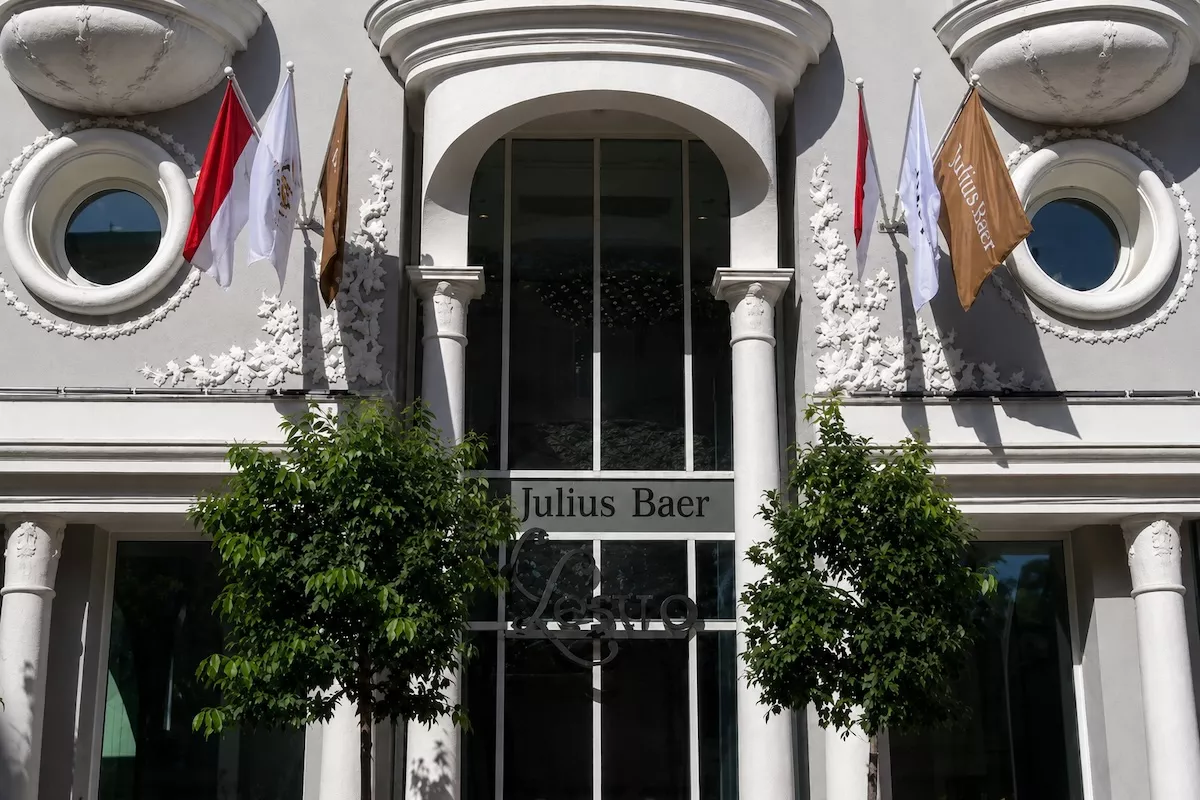
Julius Baer Wealth Management (Monaco) has been fined €1.5 million by the Principality’s financial regulator for serious anti-money-laundering failings, the latest sanction against a portfolio management company as Monaco works to strengthen its defences against dirty money.
The penalty was handed down by the sanctions committee of the Autorité Monégasque de Sécurité Financière (AMSF), whose decision — dated 25th August — was published in the Journal de Monaco on Friday 4th September and on the authority’s website. It followed an on-site inspection of the firm carried out in October 2024.
What the regulator found
The AMSF upheld both grievances against the company in full. A portfolio manager wholly owned by the Zurich-listed Julius Baer group, the firm had 25 staff and 908 client accounts at the time of the inspection, 44.1% of them classed as high or very-high risk, with 91.2% held with Bank Julius Baer Monaco.
The first grievance concerned the way the firm organised its anti-financial-crime controls within the group. Under an intra-group agreement with Bank Julius Baer Monaco, it delegated due diligence on its highest-risk clients to the bank’s compliance department while keeping lower-risk clients itself. The regulator found the arrangement was insufficiently framed: the agreement set out neither clear criteria for classifying client risk nor a documented process allowing the firm to satisfy itself that the checks carried out by the bank were complete, sound and up to date. Information, it found, flowed in one direction, without any mechanism for consolidation or joint decision-making.
The effect, according to the decision, was that the firm had become dependent on the bank’s checks without the contractual means to exercise real control over them — despite remaining ultimately responsible for meeting its legal obligations. The regulator found this had fed through into wider weaknesses, from the application of its risk-based approach and the identification of beneficial owners behind complex structures to establishing clients’ source of wealth, screening against targeted financial sanctions and monitoring transactions.
Suspicion reports filed hundreds of days late
The second grievance concerned the late filing of three suspicious-transaction reports, each submitted to the AMSF’s financial-intelligence unit long after grounds for suspicion had emerged.
In the first case, the beneficial owner of a client — a Russo-British national — was linked, by press reports identified during a 2021 review, to a corruption scheme, yet the firm did not file its report until June 2022, some 393 days later. The second concerned a €5 million payment credited in May 2019 to a Monaco company owned by a politically exposed person, which came from a counterparty the firm had not identified and could not properly document; the report was not filed until July 2023 — 1,202 days, or more than three years, after the transaction. In the third, two outbound transfers in mid-2023 triggered internal alerts, one of them to a payee whose bank details appeared on an altered invoice with no apparent link to the company that had issued it; that report followed 239 days later.
The decision tied these delays back to the same governance weaknesses, finding that the split of responsibilities and information-sharing between the firm and the group bank had left it unable to report suspicions in time.
Named for three years
The €1.5 million fine was set against a statutory maximum of €10 million. The committee weighed the firm’s turnover, which rose from €25.7 million in 2023 to €27.9 million in 2025, and noted that it belonged to an international group with the resources to fund a compliant system.
The AMSF rejected the firm’s request to have the decision published anonymously, ordering it to appear in named form for three years before being anonymised. It observed that other entities in the Julius Baer group had already faced published anti-money-laundering sanctions since 2020 — in Switzerland, the United States, France and Singapore.
A year of enforcement
The penalty is the latest in a run of sanctions by the AMSF, which replaced the former SICCFIN in 2023 and now serves as both supervisor and Monaco’s financial-intelligence unit. In May it fined UBS (Monaco) €6 million, and in July it fined Moncrief Private Bank — formerly Banque Havilland (Monaco) — €1 million for repeat compliance failings. The drive comes as Monaco works to leave the Financial Action Task Force “grey list” of jurisdictions under increased monitoring, on which it was placed in June 2024.
See also:
Monaco Life is written by qualified journalists, writing original content. Sign up for our free newsletter, listen to our podcasts on Spotify, and follow us across Facebook, Instagram, LinkedIn, and Tik Tok.
Main photo by Monaco Life