Princess’s emotional goodbye to Zulu King

Princess Charlene has travelled to her home country of South Africa to bid a final farewell to Zulu monarch King Goodwill Zwelithini during a memorial service broadcast from the royal palace.
The king died last Friday from diabetes-related complications and, according to some local media reports, had also tested positive for Covid.
King Zwelithini, aged 72, was the traditional leader of South Africa’s 12 million Zulu people. His reign lasted 50 years, making him the longest-serving monarch of the Zulu nation.
He is credited with speaking openly to encourage public education to control the HIV/AIDS epidemic that was sweeping through South Africa in the 1980s and 90s.
The king was buried in a traditional midnight private funeral, known as “ukutshalwa kweNkosi”, which was attended by only senior men of the royal family, many wearing leopard skins and colourful Zulu regalia.
Hours later, a memorial service was held at the royal palace, attended by an emotional Princess Charlene who was veiled in a black lace head scarf. Charlene Wittstock was 12 years old when her family relocated to South Africa from Zimbabwe in 1989.
After the rituals were performed on the grounds of the palace, the king’s body was secretly laid to rest, marking the end of an era.
King Goodwill Zwelithini leaves behind six queens and 28 princes and princesses.
 
Photo by Phill Magakoe/Reuters
 
Related stories:

Princess saddened at loss of Zulu King


Another two weeks of restrictions for Monaco

All current restrictions in Monaco designed to control the spread of Covid-19, including the night curfew and restaurant limitations, will be extended until 2nd April.
The restrictions came into force on 11th January, were extended on 17th February, and were due to expire on 19th March.
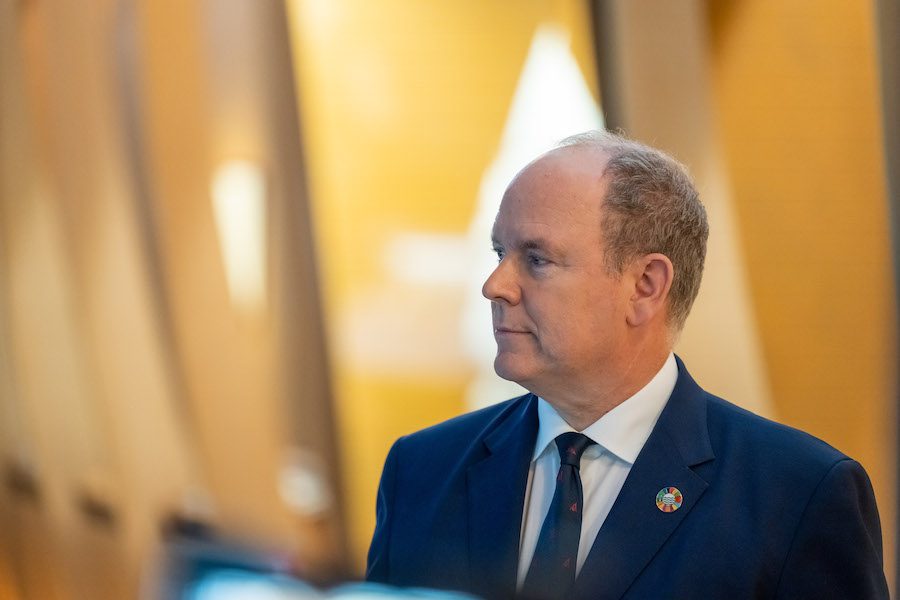
This time, the government has set a two-week time frame, saying in a statement on Thursday that HSH Prince Albert II has decided to extend all current health measures until 2nd April.
Therefore, the curfew between 7pm and 6am will remain in place, as well as the rules relating to restaurants: lunch time service only between 12pm and 3pm, and places reserved solely for residents, employees and students of the Principality.
Mandatory teleworking in the private and public sectors also remains in force, with the aim of “reducing the influx of people from outside the Principality while maintaining economic activity,” said the government.
With more than 5,000 Covid tests per week in Monaco, figures show that the virus is still in active circulation following a slight rebound after the February holidays. As of last week, the incidence rate in Monaco was 221 per 100,000 inhabitants.
“Admittedly, the incidence rate has been halved compared to the beginning of February, but it remains high, placing the Principality at the level recorded at the end of December 2020,” said the government.
The number of hospitalisations has also fallen, however the number of patients treated at the Princess Grace Hospital Centre remains high, with 48 patients including 14 in intensive care on Wednesday.
“The health situation therefore requires us not to lower our guard. Once again, the health authorities insist on maintaining vigilance in the private sphere where more than half of the contaminations occur during convivial meetings,” cautions the government.
Hand washing, social distancing, room ventilation, and individual use of cutlery and glasses is recommended within the home.
The government says the health measures may be extended again, depending on the evolution of the health situation.
 
Photo by Hani Agha


A 2021 Monaco podium finish for Leclerc?

After a series of “unlucky” races in the Principality, Formula One driver Charles Leclerc is hoping the 2021 Monaco Grand Prix will deliver the hometown podium finish that he has always dreamed of.
The rising Formula One star gave a virtual press conference on Tuesday and, when questioned by Monaco Life about the prospect of winning his first top three position at this year’s Monaco Grand Prix, responded: “It will mean the world to me to finally have such a great result in front of my home crowd, in front of my family and friends, and my teachers who are watching the GP and will maybe now understand why I was missing so much school when I was younger. But it means a lot. More than anywhere else.”
It will be the perfect evolution of a dream for the 23-year-old Monegasque, which began many years before in the Principality.
“My first memories were when I was four or five years old and I was watching Formula One from the balcony of my best friend’s house, and I remember dreaming of being one of those drivers. Now I finally have the opportunity (…) to realise my dream as part of the Scuderia Ferrari team.”
And he has every chance of turning the dream of a Monaco podium finish into reality this year with Ferrari’s new SF21, together with new team mate Carlos Sainz whom Leclerc says he has already bonded well with.
“I don’t think I have spent as much time with any other team mate as I have with Carlos,” said Leclerc. “We have spent a lot of time in Maranello since the beginning of the season trying to understand where we can improve and what areas we need to push in… so it has been very interesting. But apart from that, we also get on very well. We have similar ages, similar interests, and we’ve had a lot of good laughs already.”
While early tests in the SF21 have proven positive, Leclerc says only time will tell if the car manages to turn the team’s fortunes around after a disastrous 2020 season which pushed Ferrari to sixth in the championship – their worst finish since 1980.
“The car felt good in Bahrain, but again a car that feels good doesn’t mean it is necessarily fast. So, I will wait before making any further judgements.
“But the first test went well, we did all the kilometres that we wanted to do, which was the most important thing for us, gathering as much data as possible before the first race. Now I am just really looking forward to the first race to finally see where we are compared to the others.”
 
Relate stories:

Ferrari reveals Leclerc’s new wheels

Government: Monaco Grand Prix is a go

 
Photo @Scuderia Ferrari


Digital education: Monaco's path to becoming a world leader

In our new regular feature on Monaco’s digital transition, Georges Gambarini from Extended Monaco explains the government’s latest digital initiatives and how that translates into positive change for citizens. This month, we explore digital education.
Monaco has always placed a very large emphasis on education, and with a baccalauréat pass rate of 100%, it’s clear that the system is working.
But the Principality is also steadfastly moving towards a digital future. So, what does this mean for schools, students and teachers and how will it pay off in the long run?
Monaco Life: What is the government’s aim in bringing digital technology into schools?
Georges Gambarini:  What we are trying to do through the Extended Monaco programme is to improve the education system by introducing some digital technology. Our aim is for Monaco to be the first country in the world to offer this level of digital transformation in education and this is one area where the country can be seen be a world-wide leader.
The main objective is for children to learn to use digital technology, but also to learn through digital technology. It is very important for us to give them a skills basis that will serve them throughout their lives, because we know that 50% to 60% of the jobs that are currently available will not exist in the future.
But it is important to emphasise that in our vision, digital technology will not be a substitute for the current physical system, we are just trying to improve it and provide some new skills that are very important for this generation of the future. They will continue to read and buy books, continue to write with a pen. Digital is there to compliment and improve the system, not to change everything.
Can you give us an example of how digital technology is being applied for the benefit of students?
A very important time in a student’s life is at the end of high school when they are making decisions about further education and future careers. We are utilising an artificial intelligence (AI) programme, through an app, that allows students to communicate directly with the AI and answer specific questions about their goals, fears, passions, doubts, whether they want to remain in Monaco or leave the region, etc. Based on all of this information, the programme is able to orient the student’s choices. It is a digital career and higher education coach and is complimentary to the support of a career counsellor at school. It is very well received by the students, because sometimes it is easier to talk about your desires and questions with a neutral AI Bot.
One of the more noticeable government initiatives has been free laptops at schools. Can you tell us more about the thinking behind this?
Before the Covid pandemic, we had already provided laptops to 500 teachers in Monaco in order for them all to have the same computers, the same software and the same tools available to them. Then in November, the government provided 1,200 laptops to the pupils in the lower secondary school.
We also provided a full digital environment that is very secure and tailored to the needs of education. Every software has been chosen by the teachers; students can find all their books on maths or history, for example, in digital version. They can use the laptops at home and in school.
We deployed a school cloud, Teams, where students can find all of the lessons and interact with their teachers and classmates on a very secure network. They can even ask their teacher questions on the weekend, or take part in a weekend video conference, if they need extra assistance.
It has helped us to individualise the relationship between teacher and student, and it helps create a kind of teamwork within a class.
We also have a lot of very basic software – excel, word, etc, and the students can keep the equipment throughout the school year and during the holidays and give it back when they move on to high school.
What impact did Covid have on the digital programme and its rollout?
It gave us the kick that we needed to innovate and accelerate our actions. In March 2020, we had just finished providing the equipment to teachers, but we were not ready for the students. That was due to come in November. So, we had to create a new education system with the tools we that had at that moment.
If we were to go in to lockdown now, it will be easier. All the students have the same laptops; the entire class already exists in the cloud so they can have very direct interaction. Last year, the problem was, for example, that a French teacher was using Zoom, the maths teacher was using Skype, the English teacher was using WhatsApp, and the history teacher didn’t know how to use anything.
What we did during Covid – and the teachers were honesty incredible – was to give them tutorials to help them use the tools that they had access to. It was not easy, because if a household has an eight-year-old, a 15-year-old, a 17-year-old and just one laptop that the parent needs to work on, what does everyone do? We are lucky in Monaco, most people have a computer at home. But in other cities in France, it was a catastrophic situation.
We also launched a digital summer camp to help 200 students that had difficulties during the confinement period to catch up on some central subjects. Everything was funded by the government, and it showed the involvement of everyone to guarantee that by September, everything possible that could be done, was done for the students.
So, what was difficult to imagine two years ago is now possible, due to the situation. We have the tools and the willingness to do it on every level.
How are teachers adapting to digital and what benefits do they get out of it?
Obviously, it is not easy for the teachers who are not digital minded. So, we are trying to help them to develop their digital capabilities through a very ambitious learning programme to assist in two main areas.
Firstly, to master the basic use of digital. All of our teachers need to be able to use Teams, to help students through chat solutions, to open a digital resource, to understand and use what we call the class management system…
On each teacher’s computer, there is a specific software that enables them to take control of every student’s computer. Therefore, teachers have real time visibility of how the students are learning; they are able to share a window on the digital blackboard, to shut down the WiFi, to help them find a solution, to have a vertical discussion.
For students who are quite shy, it is not always easy for them to say that they don’t understand something in front of an entire class. Now, they can send a message to the teacher to let them know that they are having difficulties, and the teacher is able to interact with them. It helps create a very individual relationship between the teacher and student.
Secondly, each week we have very highly qualified digital education experts hosting workshops in the school to help teachers develop new-use cases. The aim is to develop ideas and put them into practice in new education projects.
This is what we have done for the secondary school teachers and we are now working on the doing the same in high school.
The Monegasque education system is based largely on the French system. How easy is it then to introduce digital technology within that system?
We are still doing maths, French, English, history etc. in Monaco schools, and the baccalauréat is still computerless. But as I said, digital is not about changing everything, it is here to compliment and to improve. We think that by deploying a very ambitious digital strategy we will guarantee a better execution of the knowledge on very traditional subjects such as maths.
In France, they are also starting to move on this subject. Digital is in the programme. Not with the ambition that we have in Monaco, but teachers are starting to work on this subject.
We are, however, the only country in the world to give one-hour coding lessons to all of our students from age six to 18.
Monaco is, however, on the right track to become a world-leader in digital education.
 
 
Photo source: Pixabay


Wealth Report 2021: the results are in

How deep do your pockets need to be to join the wealthiest 1% in Monaco? What impact did Covid have on global wealth? What will the biggest influences on wealth creation be in 2021? We look at the latest Wealth Report to find out.
Each year for the past 15 years, Knight Frank releases its flagship publication The Wealth Report, considered important reading for ultra high net worth individuals (UHNWIs) across the globe and their advisers. In this article, we have identified some of the highlights of this year’s report.
You will be surprised
The top 1% is frequently referred to, but never really defined. That’s because the level of net wealth that marks the threshold for entering this rarefied community varies widely among different countries and territories.
Using the Frank Knight Wealth Sizing Model, it is possible to determine how much wealth an individual needs to get into the Principality’s branch of the 1% club.
According to Knight Frank’s definition, an ultra high net worth individual (UHNWI) is somebody whose wealth exceeds US $30 million.
Interestingly enough, it takes far less to enter the 1%.
The level of net wealth needed to join the top 1% in the Principality of Monaco is US $7.9 million (€6.5 million).
In second place is the home of the private bank, Switzerland, where US$5.1 million gains you access, followed by the US, which has the highest number of UHNWI residents. Here, US$4.4 million is your ticket to 1% status.

Impact of Covid on global wealth
With lower interest rates and more fiscal stimulus, asset prices have surged, driving the world’s UHNW population 2.4% higher over the past 12 months to more than 520,000.
While this was virtually one-third the rate of growth seen in 2019, it is still not what experts would have predicted in the first half of the year, given the impact of the virus.
Growth was seen across North America (+4%) and Europe (+1%), but it was Asia that saw the real upswing with 12%, followed closely by Australasia (+10%), the regions which were seemingly able to control the virus the best.
The expansion in wealth was not universal though, with a fall in the number of UHNWIs in Latin America (-14%), Russia (-21%) and the Middle East (-10%) as currency shifts and the pandemic undermined local economies.
“The rollout of vaccines at the start of 2021 is an extremely positive signal, and one that marks the beginning of a new economic cycle in a post-pandemic world,” said the authors of the Wealth Report.

Biggest influences on wealth creation in 2021
The Wealth Report assessed the biggest potential influences on wealth creation and preservation that individuals should be considering in 2021 and beyond. They identified these key areas.
New investments
The Covid-19 pandemic and its related closures, lockdowns and travel restrictions, have given people more time to reassess every element of their lives, including their businesses and investments. As a result, the number of new companies being set up is rising. “We are entering a new economic cycle and the prospects for wealth creation and growth are huge,” says David Bailin, Chief Investment Officer at Citi Private Bank.
The availability and greater adoption of technology is an overwhelming factor in this uptick.
“The ability to gather and analyse financial data is only going to improve,” adds Bailin. “The world of investing will be revolutionised, and the number of investors will go through the roof. Small investors are already becoming more market aware, which can create much more wealth globally.”

Related stories: Understanding bitcoin and the great crypto boom
The rise of Bitcoin and a Reddit co-ordinated drive to push up the stock price of GameStop are examples of how day traders are giving hedge funds a billion dollar kick in the guts.
New social order
According to the report, we are witnessing a “K-shaped recovery”, with industries and populations recuperating at different paces.
“A team at Harvard University found that between February and October 2020 in the US, workers in the bottom quartile (annual income of US$27,000 or less) saw employment drop by almost 20%, while among those making more than US$60,000 per year it rose by 1%.”
Why is this a concern for UHNWIs? Because it is likely to lead to an increase in wealth taxes as governments scramble to recover the huge costs of the pandemic.
Argentina’s parliament has approved a proposal to impose a one-time 2% tax on individuals with more than US$2.5 million in assets; Canadian President Justin Trudeau has announced plans to spend billions on childcare, housing and healthcare, partly financed by taxing “extreme wealth inequality”; and a one-off wealth tax to pay for the costs of Covid-19 has been proposed in the UK.
Intergenerational relations
Close to 60% of Knight Frank survey respondents said they or their clients had reassessed their attitudes to succession planning in light of Covid-19.
“This is the first time that we see a convergence of the following trends – multigenerational family members working together, and UHNWIs and their families increasingly reflecting more global views,” said Pierre-Yves Lombard of Lombard Odier Group.
“We have also observed younger generations studying in the UK or US before coming back to Asia to work in the family business. They often bring back fresh perspectives and mindsets, which result in very different discussions. They encourage their families to rethink everything.”

Related stories: “If Covid was a systemic wave, climate is a systemic tsunami”

The focus on the future to safeguard and grow wealth is imperative and one of the main tensions comes from environmental sustainability where, as Lombard notes, “new generations are challenging the older generations to do more.”
Regreening the planet
As seen in previous editions of The Wealth Report, the environment and climate change are increasingly driving investment and lifestyle decisions and philanthropic activity, another trend accelerated by the pandemic.
More than 40% of UHNWIs are more interested in environmental, social and governance (ESG)-focused investments than 12 months ago and 22% are excited by opportunities arising from the ESG agenda, with those in the UK, Australasia and North America the keenest.
In previous downturns the green agenda took a back seat, but this time it’s taking centre stage. The EU has been leading with green bonds and Joe Biden’s new administration will see the US focus more on sustainability.
“The rate of development associated with climate change spending, the future of power generation and storage, and how we address global warming will be as radical in our lives as the development of the internet,” predicts David Bailin.
 
Top photo: Cover of The Wealth Report 2021


Monaco Yacht Show gets an overhaul

Organisers of this year’s Monaco Yacht Show are betting on a new badge system to better connect visitors and exhibitors and take the flagship event to another level.
After a forced hiatus due to Covid last year, the Informa Group, owner of the Monaco Yacht Show (MYS), says it has made good use of the time and is looking at the yachting industry and where it is headed with fresh eyes.
In a statement released this week, the group says that it has decided to redesign the event to “rise to the commercial and marketing challenges facing the market.”
In order to make the overall experience clearer to visitors and professionals, a new three-category system is being introduced. There will be a Discover badge for yacht clients, an Advise badge for their advisors and consultants, and a Connect badge for trade visitors.
The badges will show the profile of each visitor so that the right people can connect on sight.
Buyers can therefore suss out designers and builders at a glance, whilst their captains and reps can readily find equipment manufacturers, for example.
“On Wednesday 22nd September, the Dockside Area will be open to Discover and Advise badges only, so that these categories of visitor can meet with shipyards, yacht brokers, designers or tender manufacturers in a more intimate and personalised environment,” indicated the organiser in a press statement. “From Thursday onwards, the Dockside Area will be open to all participants.”
The system will help visitor flow and reduce crowd sizes, an important requirement in the current times.
Meanwhile, in an effort to include more personalised experiences, Informa will introduce the ‘Sapphire Experience’, a VIP programme which includes activities at both the show and in the city for superyacht owners, charterers and potential clients.
Another upgrade is being made to the exhibition areas, which will be renamed to make it easier for visitors to find their way around. They are also adding new sections dedicated to innovative projects and trends in sailing, design and exploration, with the idea that the programme will grow over the coming years to include a range of activities that reflect life on board a superyacht.
The group said that it’s main priority is to safeguard the health of participants, therefore it will implement all necessary health measures, guided by its AllSecure programme and health regulations issued by the Monaco’s government.
The Monaco Yacht Show will run from 22nd to 25th September.
 
Photo by MYS