The Constitutional Reserve Fund of Monaco has donated €10 million to London-based Ocean 14 Capital, an impact fund that focuses on the blue economy.
According to the World Bank, the “blue economy” is defined as the “sustainable use of ocean resources for economic growth, improved livelihoods, and jobs while preserving the health of ocean ecosystem”.
This eco-friendly approach to ocean usage is meant to encourage a multitude of positive results, such as helping to tackle climate change using resource-efficient, low-carbon shipping, fishing, and marine tourism practices as well as advocating marine renewable energy industries.
Monaco has long been actively campaigning for blue economy practices and has now found a partner in Ocean 14 Capital. Ocean 14 Capital, based in London, has just received a generous €10 million to support its end goal of financing sustainable solutions that improve the health of the seas.
Minister of Finance and Economy, Jean Castellini, says, “I believe this investment will enable Ocean 14 Capital to deliver the innovation needed to meet our climate and sustainability goals.
“The sustainable blue economy is now a key focus for us, and this is a rallying cry for start-up and scale-up marine innovators globally to come forward and help avert the crisis in our oceans and return them to a healthy, thriving state.”
The Monaco funds will assist in allowing Ocean 14 to invest in eight companies this year, with the idea to grow their portfolio to 20 to 25 in the next three years. The focus will be on growth-stage business opportunities, with a full two-thirds going to European companies and the rest doled out to companies in other places around the globe.
“Oceans are the critical life-support system for life on earth,” says Chris Gorell Barnes, the Founding Partner of Ocean 14 Capital. “If we are to save the planet, there is clear evidence that if we don’t have a healthy & functioning ocean, we have zero chance. The ocean provides half the oxygen we breathe, absorbs half the carbon, feeds the world, and employs hundreds of millions of people. It will be game over for humanity if it’s not functioning.”
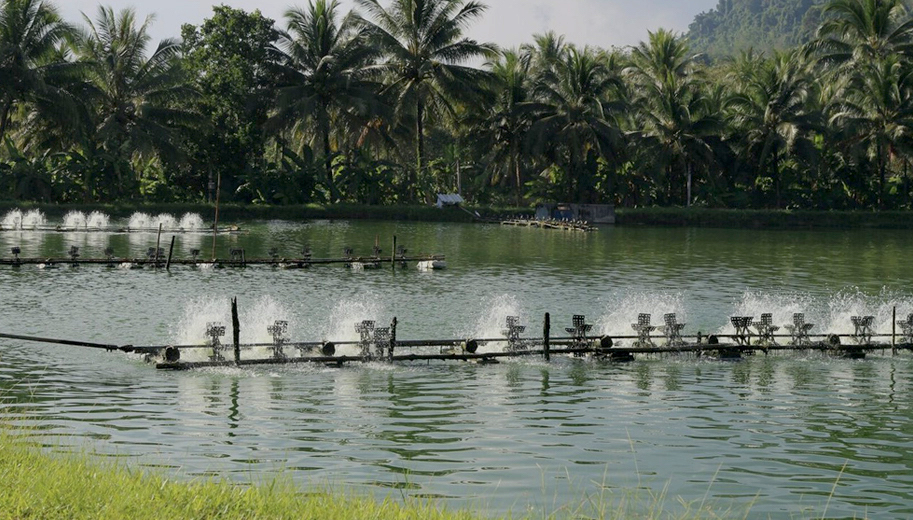
Ocean 14’s investments to date include a shrimp breeding technology specialist company called SyAqua and plastic management platform, AION.
The blue economic sector is expected to be worth $3 trillion by 2030.
Sassan Behnam-Bakhtiar is so many things. He is an artist, a seer, a visionary, a disruptor, a father, a survivor. All of this is displayed on his canvases… the layers, the textures, the energy, the call for his audience to look within themselves and find a truer meaning to reality, to evolve.
For the month of September, Behnam-Bakhtiar’s exhibition ‘Journey Within’ will be on display at Sotheby’s new Monaco gallery. It is a unique exhibition for the multidisciplinary artist, who is very selective about the galleries he works with. But he says he has enjoyed working with Louise Grether, head of Sotheby’s Monaco office, and Mark Armstrong, senior director.
It is an exhibition with which the Franco-Iranian artist continues to question modern value systems and calls for introspection, for a more spiritual, human-centred approach to living.
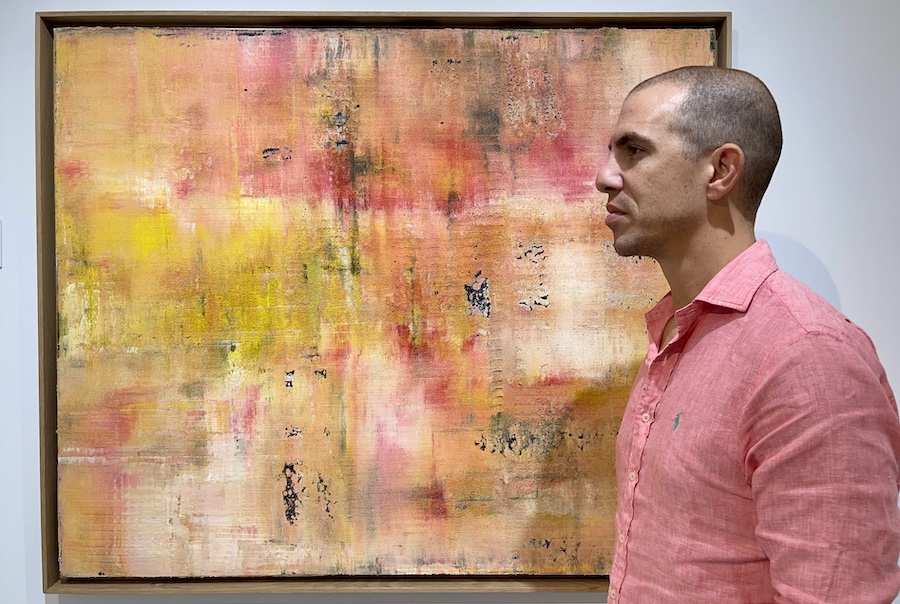
The crisscross finish, and scraped and layered textures have become his signature style of painting. His creative process is impromptu, he tells me during a recent private showing; nothing is planned beforehand, and he mixes his paints on the canvas as he goes. It means that no single piece can ever be recreated; they are as unique as he is.
“My work really focuses on layering and delayering, and time plays a very important role,” he says. “The paints dry to a certain degree, and there is literally a little window when I can successfully scrape off the paint in a way in order to get the texture that you can see.”
Behnam-Bakhtiar compares the layering in his paintings to the layering in life, and he is passionate when he speaks about energy.
“Once you look within, once you start removing the unnecessary layers of your humanity, you get to a point where you really start feeling your source frequency; you understand the universal language, what is going on. Right now, we don’t see it with our physical eyes, but there is such an exchange of energy between all of us. We are made of energy at the end of the day, so if we can really understand how our humanities are made, we will be able to live a life that we are destined to.”
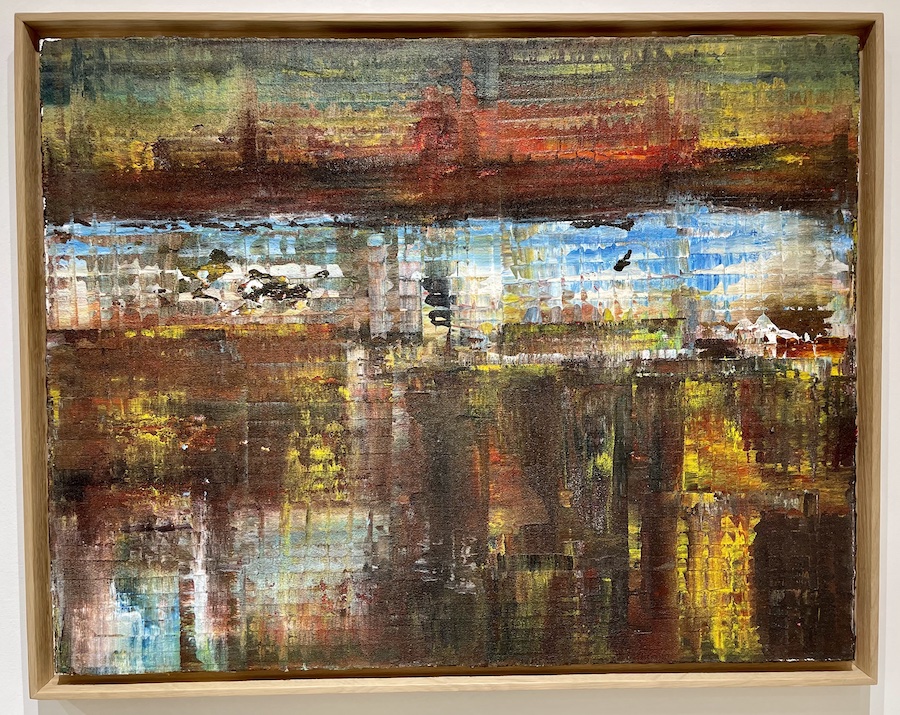
‘London’ by Sassan Behnam-Bakhtiar, photo by Monaco Life
‘London’, for example, radiates a dark energy. Behnam-Bakhtiar admits it was a difficult moment in his life, and his painting of the London landscape reflects that. The others are vibrant and bold, mirroring the colours of the Mediterranean. These were painted at his studio in Saint-Jean-Cap-Ferrat where he has lived with his wife and son for a number of years.
“When it comes to my abstract works, I want that they evoke an emotion that triggers something in your being, something that clicks in the psyche and makes you want to understand more,” he says. “As an artist, the biggest satisfaction I can have is that someone comes in front of my work, has a little click, and leaves with that click and then it alters their way of life. Everyone has a different experience when they come in front of the painting, and I’m always in the corner, watching how people react.”
It hasn’t always been about abstract art for Behnam-Bakhtiar. He started out doing portraiture and has worked with film, installations, and sculptures. “I flirt between abstraction and figuration”, reveals the artist. In 2018, he exhibited sculptures in Villa Santo Sospir before it was closed for renovation, the hallowed grounds of Jean Cocteau’s Cap Ferrat hideaway and the home that he “tattooed” with his unique frescoes in tempera. Along with the sculptures created in his signature scraped-paint style, Behnam-Bakhtiar also edited audio clips of himself talking with Cocteau about how humanity needs to be more connected to the universe.
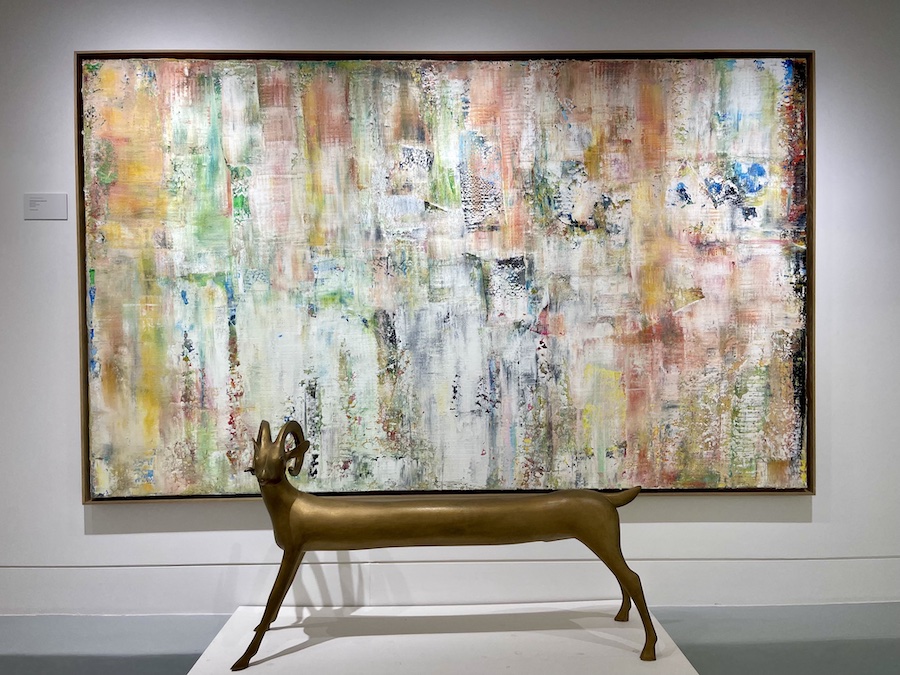
‘Journey Within’ exhibition by Sassan Behnam-Bakhtiar at Sotheby’s Monaco. Photo by Monaco Life
The beauty and light of the French Riviera has long been an attraction for artists, but Behnam-Bakhtiar doesn’t like to be compared to the greats. “All I can say is that I get it why they came here. It’s not a question of following in anybody’s footsteps, but this place truly has an impact. That’s the reason why I moved from London to Cap Ferrat, it’s the light.”
His inspiration, he reveals, comes from life experiences.
Born in Paris in 1984, Sassan Behnam-Bakhtiar is a fourth generation artist and has been painting since the age of four. As a teenager and young adult, he lived in Tehran, Iran. Through his mother, he traces his decent from Iran’s ancient Bakhtiaru tribe. Through his father, he is a descendant of the Qajar monarch Ahmad Shah.
“Ours was a highly prominent family in Iran before the revolution. This current regime doesn’t like people like us because they are paranoid and they see us as a threat. So, I went through a lot of traumatic experiences in my life. Placed in those situations, it pushed me to really look within.”
He points to the largest painting in the room. It is titled ‘Twin Trees of Life’. “I paint trees in abstract form to remind people that no matter where you are, no matter what happens to you on any day, you always have the power to change your life, but you really need to want it, to visualise it. And at some point, you are able to open your third eye.”
Sassan Behnam-Bakhtiar is clearly very spiritual, but he is also an industrialist. In June 2021, at the iconic Grand-Hotel du Cap-Ferrat, Sassan Behnam-Bakhtiar, British digital artist Vector Meldrew, and British singer, composer and entrepreneur Tinie Tempah collaborated in what was the world’s first dedicated NFT residency to create a suite of NFT art works, curated by Kamiar Maleki.
The residency culminated in a unique, collaborative performance of live painting by Sassan Behnam-Bakhtiar and a musical and spoken word performance by Tinie Tempah. “We wanted to merge the contemporary art world, music and digital,” The four NFTs, under the banner Present the Future, dropped on 21st July 2021 and were auctioned by Bonhams. They sold instantly.
“The NFT world is interesting because it does give power to the creatives,” says the artist. “I’m involved in the crypto world as well, so I know what’s going on, but as an artist I had an old school mentality, even though I’m from a younger generation. I will always stick to real, tangible works, but NFTs create opportunities for young creatives, and I respect that. They can get royalties; they have more power.”
Sassan Behnam-Bakhtiar is known in the art world as a disruptor, a “rebel artist” as some international media have called him. And the 38-year-old says he no longer repels the label.
“I was at a panel discussion last summer and someone from the audience said Sassan is a rebel artist. And I thought, oh my God, you know what? I am a rebel artist, and I am a rebel in life.”
Journey Within is featuring at Sotheby’s Monaco Gallery until 26th September.
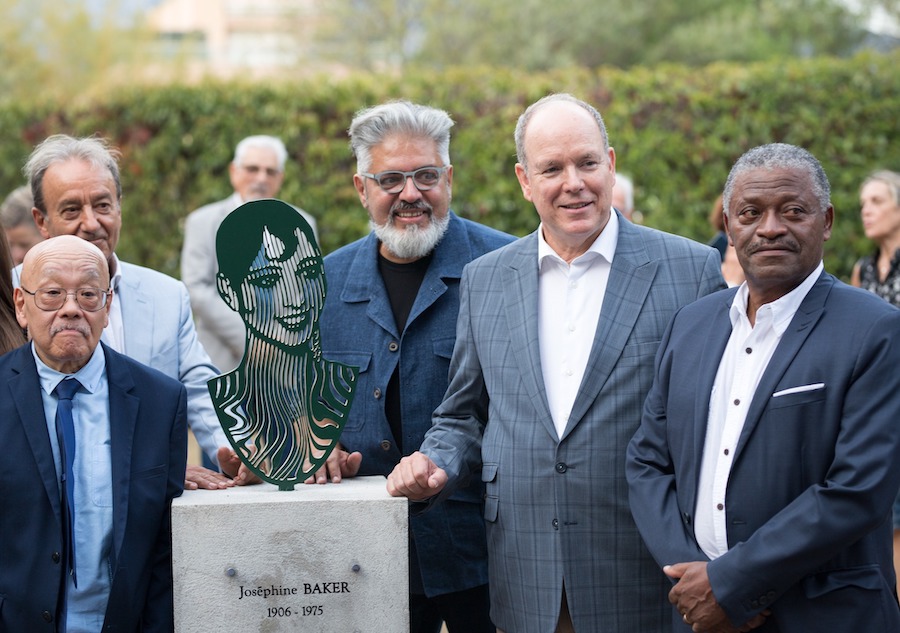
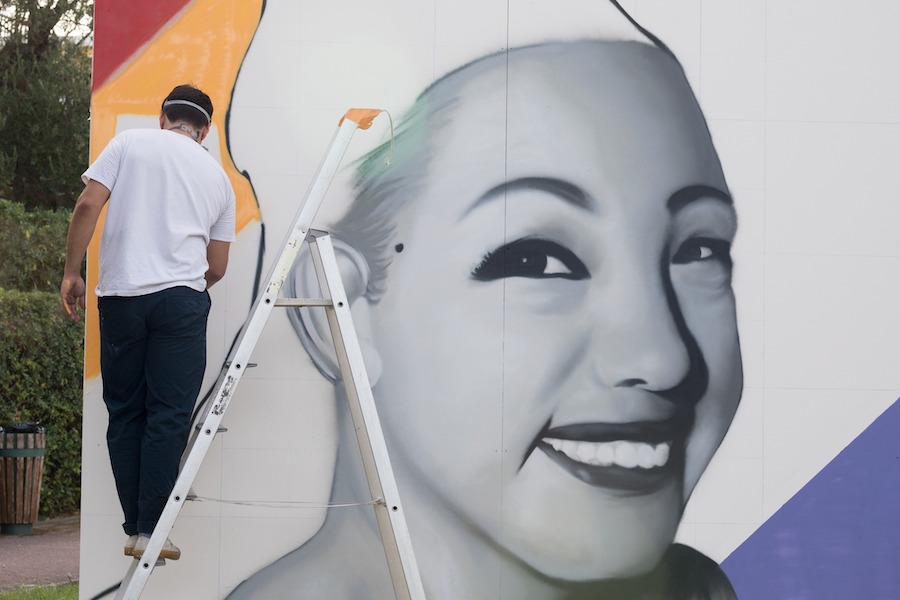
A bust of singer and activist Josephine Baker, created by local artist Marcos Marin, was unveiled by Prince Albert in Roquebrune-Cap-Martin, along with a huge portrait by Nice-based street artist César Malfi.
Singer, dancer, actress and activist Josephine Baker, celebrated as she was in life, is being just as feted nearly a half century after her death. Last December, she was memorialised in Paris’s historic landmark, the Panthéon, where she was inducted as the first woman of colour, the first American and the first performing artist to ever be granted a special place in this oh-so French monument.
Her investiture is a testament to how many boundaries she crossed and how many lives she touched.
In her later years, she befriended Princess Grace, who had a huge admiration for her, and was even buried in Monaco in 1975 after her death at the age of 68 following a stroke.
Photo source: Mairie de Roquebrune-Cap-Martin
Now in 2022, she is being honoured again, this time at the 11th edition of Art-Bre in Roquebrune-Cap-Martin in early September, where a huge painting by Nice-based street artist César Malfi and a bust of the late performer created by Marcos Marin were unveiled by Prince Albert II along with Mayor of Roquebrune-Cap-Martin, Patrick Cesari and Baker’s children and grandchildren.
The bust takes pride of place in the heart of the town in the Parc Des Oliviers, whilst the painting looms large in the village, and was given finishing touches by the Prince himself.
Music of the 1920s and 30s filled the air, in an homage to Baker’s hey days, and the day was rounded out with an evening show entitled Josephine Baker, Paris Mon Amour.
Photo above source: Mairie de Roquebrune-Cap-Martin
The European Commission plans to make sure that 90% of all people who qualify for breast, colorectal and cervical cancer screenings actually receive the tests they need.
Deaths from cancer have been steadily on the rise in Europe, with an estimated 20% increase between 1995 and 2018 and a massive 50% jump in cases during the same period.
The European Commission (EC) is making efforts to combat this deadly disease through its Cancer Beating Plan, by asking member states to get the word out and urge people to get screened regularly.
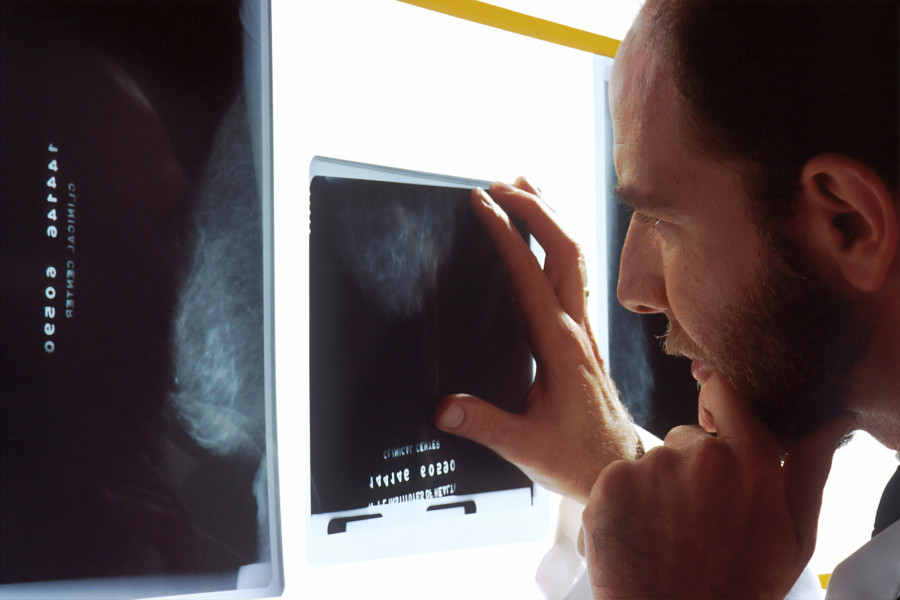
The focus will be on early detection, using the latest scientific developments and research to offer 90% of the population who qualify for breast, colorectal and cervical screenings the testing they need by 2025. The new plan will also expand population-based screenings to include lung, prostate and some gastric cancers.
“In 2020, an estimated 2.7 million people living in the EU were diagnosed with cancer and more than 1.3 million people lost their lives to this disease,” said Stella Kyriakides, Commissioner for Health and Food Safety. “We know that early diagnosis saves lives and improves quality of life. Today, under Europe’s Beating Cancer Plan, we are setting a new course for cancer screening in the EU. With our new recommendations, the EU Cancer Screening Scheme will be covering cancer types that together account for almost 55% of all new cases diagnosed in the EU every year.”
This plan will replace a two-decade old version that is now woefully out-of-date and will reflect the latest in cancer-beating studies.
Some of the specifics of the new programme include extending the target groups for breast screening from the current bracket of 50 to 69 to between 45 and 74 years of age, as well as recommending that Human Papillomavirus (HPV) tests be given for women 30 to 65 every five years in order to detect cervical cancers.
Lung cancer testing will also be made on current and ex-heavy smokers aged 50 to 75, prostate cancer screening for men up to age 70 will be given to those who have markers found in antigen tests, and screenings for Helicobacter pylori and surveillance of precancerous stomach lesions in places with high gastric cancer incidence and death rates will be more available.
The EU will now take steps to adopt the new plan and put it action as soon as possible.
Photo source: National Cancer Institute on Unsplash
French Economist Jean-Pierre Petit has told a room full of Monegasque entrepreneurs that he expects the war in Ukraine to last much longer than anticipated, and that inflation in Europe will continue to rise into next year.
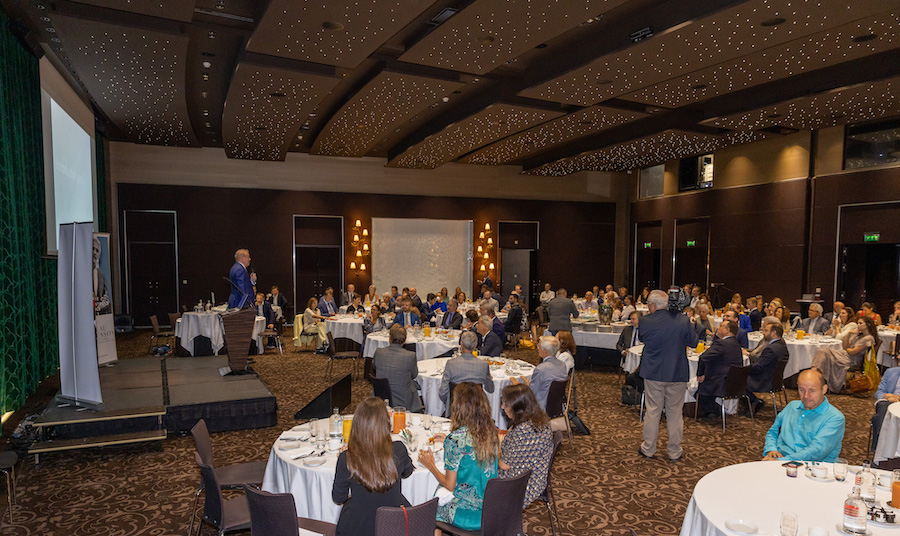
Now that the world is moving forward again after the Covid crisis, information about the state of economic matters are at the forefront of many people’s minds. To offer some insight into that world, the President of the Cahiers Verts de l’Economie Jean-Pierre Petit took to the stage at the Hermitage Hotel on 16th September for an event organised by the Monaco Economic Board (MEB) and Jutheau Husson.
The French economist, who has been speaking in Monaco every year since 2018, explained his key points to an enthusiastic audience of around 120 entrepreneurs and businesspeople, which also included Pierre Dartout, Monaco’s Minister of State.
Petit looked at the conflict in Ukraine and noted the serious consequences reverberating through Europe as a result of it. He said he believed that this war is most certainly going to last longer than anticipated and blamed that on the irrationality of leaders in Moscow.
Photo credit: MEB / Carte Blanche
He touched upon the energy crisis as well and predicted that, in Europe, even with a 15% drop in consumptionand a diversification of imports and production, it would not be enough to cover all needs. Certain sectors, such as transport, heavy industry, textiles and agri-business, will be most hard hit, he said.
On a more global scale, he stated that the situation reveals an overall slowdown in activity as a result of the energy challenges facing the world. China’s ongoing health crisis has slowed their growth, dragging down the entire region. He gave minor praise to the United States, whom he thinks is handling the situation better than most due to a lack of dependence on outside players for energy.
European households, he thinks, need to continue to be protected through support measures, and despite the risk of inflation, he says that maintaining current levels of activity will make it possible to limit decline and social consequences, though not eliminate them. Tellingly, he thinks inflation will peak soon, except in Europe, where indicators show it will rise until next year.
The President of the Cahiers Verts de l’Economie also said that interest rates are topping out, and called for caution with regard to share prices for stocks, as the upward trends in the markets has yet to begin.
The next MEB economic conference will take place on 4th October during the Monaco Business fair, with the intervention of Christophe Barraud, chief economist and strategist at Market Securities.
Photo above: From left to right Président of MEB Michel Dotta, Minister of State Pierre Dartout, Président des Cahiers Verts de l’Economie Jean-Pierre Petit, and Hervé Husson, Président of Jutheau Husson. Credit: MEB / Carte Blanche
Roca Team finish pre-season with a win ahead of curtain-raiser
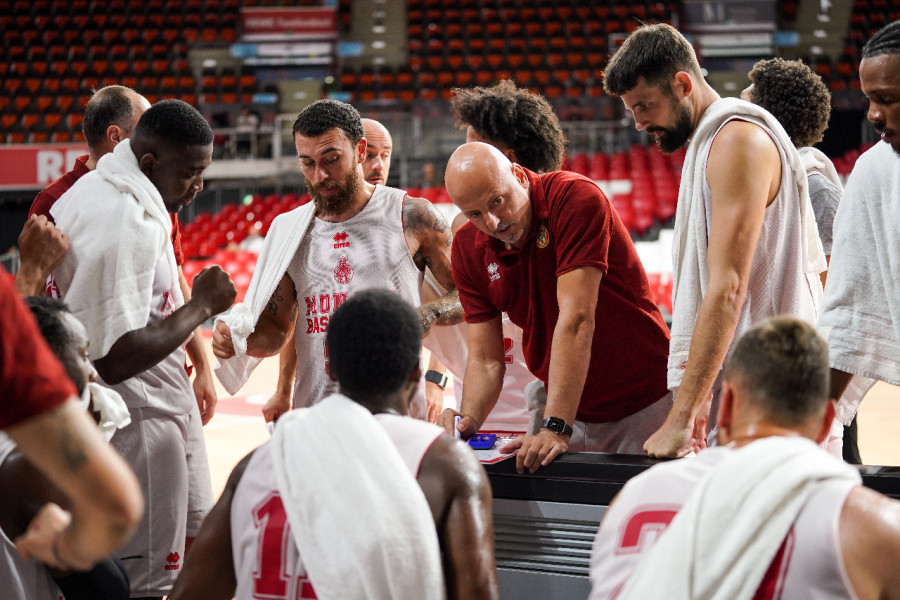
AS Monaco Basketball concluded their pre-season tour with a victory against Bahceshir Koleji (58-76) ahead of their season-opener against Nanterre on Saturday.
It has been a while since the home faithful have been able to see the Roca Team in action, in person. Due to the continued expansion works on the Salle Gaston Médécin, the club have been forced to take to the road this summer, traveling to Italy, Germany and Turkey.
The wait will also be prolonged by the scheduling at the beginning of the season. Monaco face Nanterre in the season-opener this Saturday before heading to Nancy the following Tuesday. Fans will have to wait until 2nd October to see their team return to the new-look Salle Gaston Médécin to face Roanne. The first Euroleague game to take place in the Principality will be on 13th October.
The Europe-wide pre-season tour has provided for the club’s many new recruits to create on and off-court relationships. Just like the previous season, the club has experienced a high turnover of players this summer, although there is the hope and expectation that this will be the last transfer window of mass upheaval.
Monaco have been able to integrate their new players, whilst ensuring a pre-season of positive results. They finished their preparations with a comfortable win against Bahceshir Koleji on Sunday, meaning they finish their tour with five wins and just two losses.
Despite the new-look feel to the Roca Team roster, it was the recognised faces of Mike James and Donatas Motiejunas who finished as Monaco’s top scorers in the final fixture with 17-points apiece.
One player that hasn’t been able to integrate into the side during the summer is Élie Okobo, who was bought from ASVEL. He has been on international duty with France, guiding the side to the Euros final before falling short against Spain. Okobo has, however, now joined up with his teammates and will add a level of domestic and international experience that fans hope will prove the difference.
This season, the club will be looking to finally get their hands on the Betclic Elite trophy, whilst also going once again making the Euroleague play-offs. Their preparation alludes to a successful upcoming season, but it is up to this new-look Roca Team to produce the goods on-court to convert hope into silverware.
Photo by AS Monaco Basket
All the headlines and highlights from Monaco, direct to you every morning