

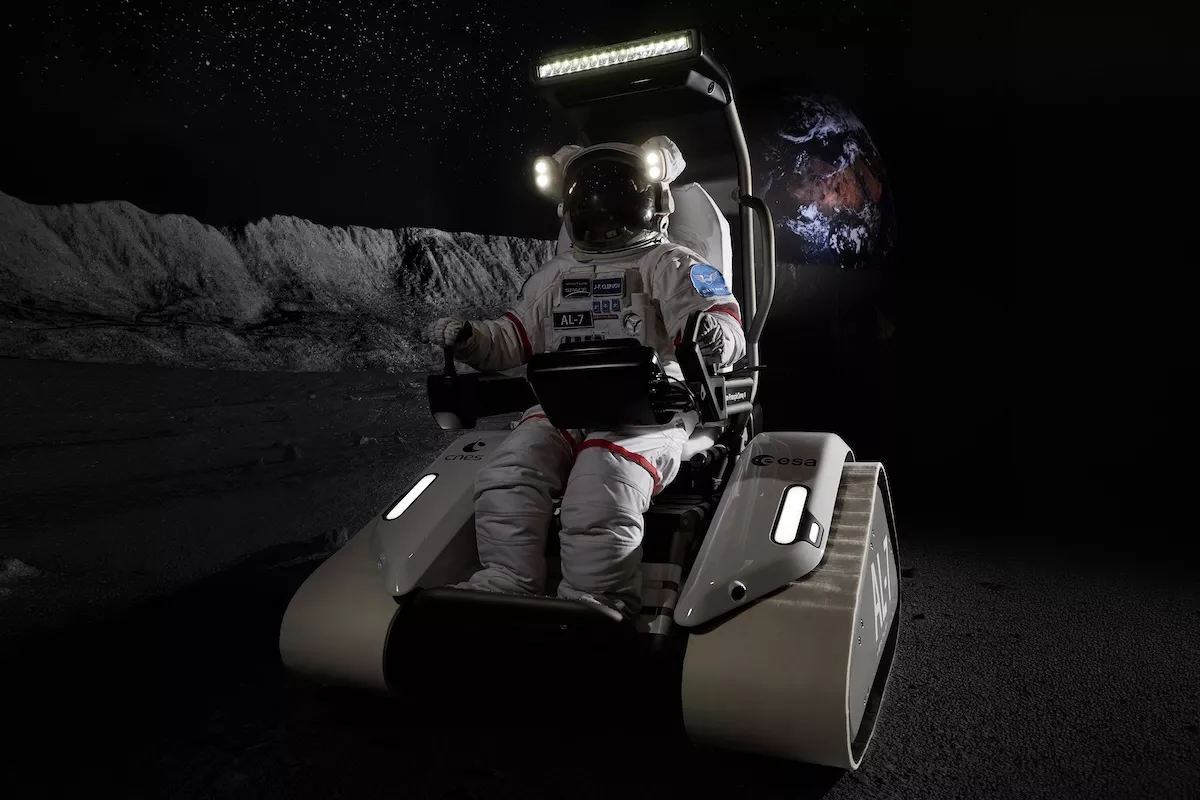
Astronauts working around future Moon bases could soon have their own compact utility vehicle, capable of carrying them across the lunar surface before continuing the job autonomously. Monaco-based Venturi Space has unveiled Alta Luna, a single-seat tracked rover designed to support the practical realities of living and working on the Moon.
Presented at the International Space Summit in Paris on 9th and 10th September, the vehicle is intended to operate close to lunar habitats, transporting astronauts and equipment, preparing terrain and carrying out essential construction work.
Led by Monégasque entrepreneur and Venturi Space president Gildo Pastor, the project offers a glimpse of what daily movement on the Moon could eventually look like: an astronaut climbing aboard a compact tracked vehicle, driving across difficult terrain and receiving real-time information about both the mission and the surrounding space environment.
Built for astronauts to drive on the Moon
Weighing a targeted 300kg, Alta Luna is substantially smaller than Mona Luna, the 750kg exploration rover unveiled by Venturi Space 15 months ago. Its compact dimensions are intended to make it highly manoeuvrable around lunar bases, where astronauts will need to move between habitats, equipment and work sites.
For the first time in one of its lunar programmes, Venturi Space has replaced wheels with tracks. The design is intended to give Alta Luna greater traction and allow it to climb steeper slopes across the Moon’s uneven surface.
The rover can be driven directly by an astronaut or operate autonomously. While its single-seat layout places the astronaut firmly at the controls, artificial intelligence can assist with navigation and other driving functions.
When no astronaut is aboard, Alta Luna can use LiDAR, stereo cameras and AI to navigate independently. It could excavate and grade terrain, prepare routes, help establish basic infrastructure and transport payloads between sites.
Multiple vehicles could also operate as a coordinated fleet, combining their capabilities to complete larger tasks around a lunar settlement.
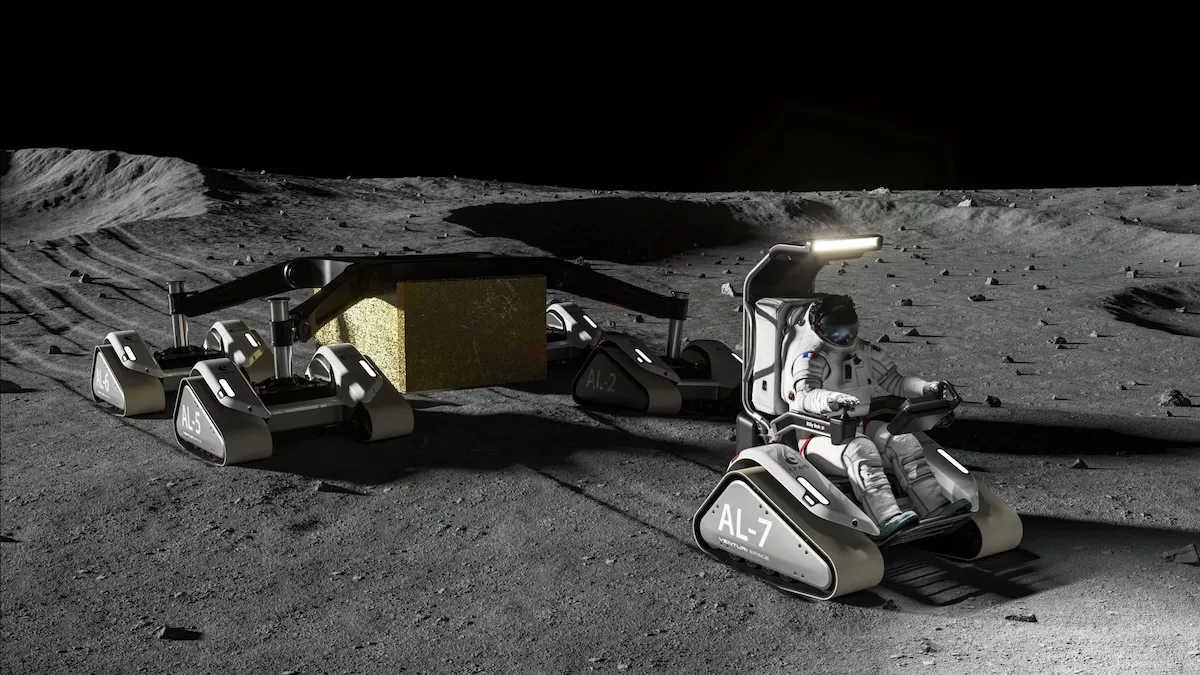
A rover that can bring its driver home
Alta Luna has also been designed to watch over the person driving it. Its electronics can connect with an astronaut’s spacesuit to monitor their health during a mission.
If the astronaut becomes unwell or incapacitated, the vehicle is designed to take control and return them autonomously to base. Its interface can also deliver mission information and warn the driver of hazards in the wider space environment, including an approaching solar storm.
This combination of manual driving, autonomous navigation and health monitoring positions the rover as both a working vehicle and a safety system for astronauts operating outside their habitat.
The rover uses the battery and battery-management technology developed by Venturi Space. The same technology has been integrated into Venturi Astrolab’s Flex lunar vehicle, which was selected by NASA for development under its Lunar Terrain Vehicle programme for the Artemis missions.
Preparing for everyday life beyond Earth
Rather than being conceived for long-distance exploration alone, Alta Luna is designed around the routine tasks that will become necessary if humans establish a sustained presence on the Moon.
“I enjoy designing vehicles for extreme environments, but above all I like to see them prove their value in real-world conditions,” said Gildo Pastor. “I will therefore devote all the necessary energy to ensuring that Alta Luna supports the first inhabitants of the Moon in their daily lives.”
Antonio Delfino, director of Venturi Space, said future lunar activity would require many of the same systems that support industrial development on Earth.
“On the Moon, we will need to build, develop sites, transport, maintain and connect,” he said. “We will face challenges similar to those of industrialisation on Earth: transport routes, habitats, infrastructure and logistics.”
According to Delfino, meeting those needs will require a range of specialised vehicles able to work individually or as part of a fleet.
The unveiling comes five years after Venturi Space was created and ahead of the planned launch of FLIP, an American lunar rover equipped with Venturi batteries. The vehicle is due to travel to the lunar South Pole aboard Astrobotic’s Griffin-1 lander by the end of the year.
Monaco Life is written by qualified journalists, writing original content. Sign up for our free newsletter, listen to our podcasts on Spotify, and follow us across Facebook, Instagram, LinkedIn, and Tik Tok.
Main photo source: Venturi Space